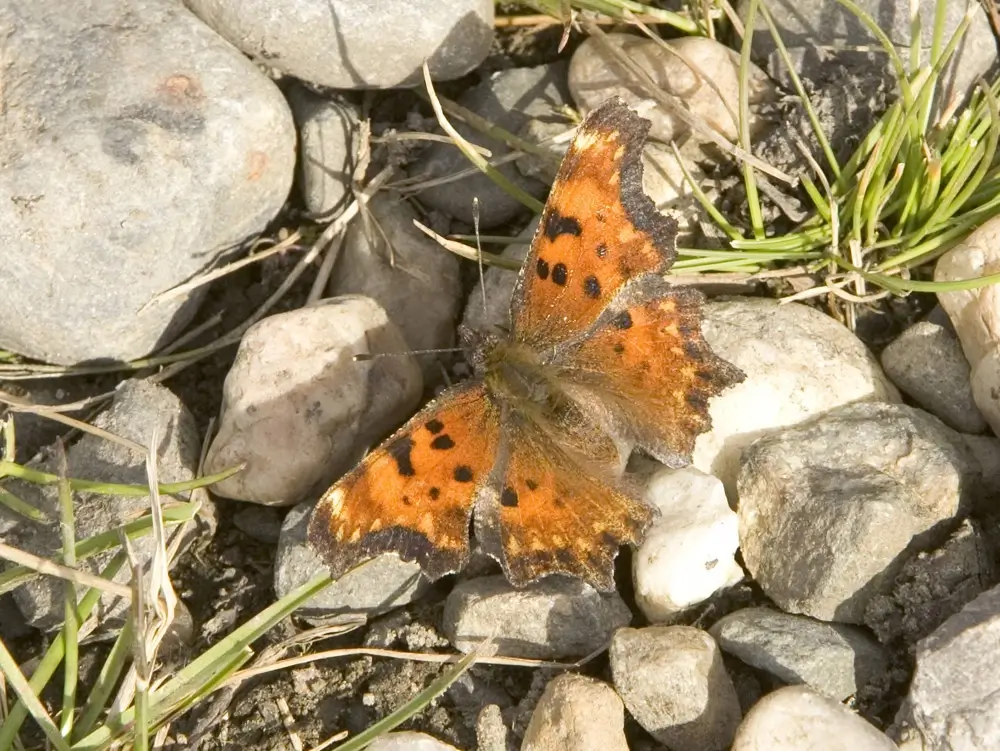
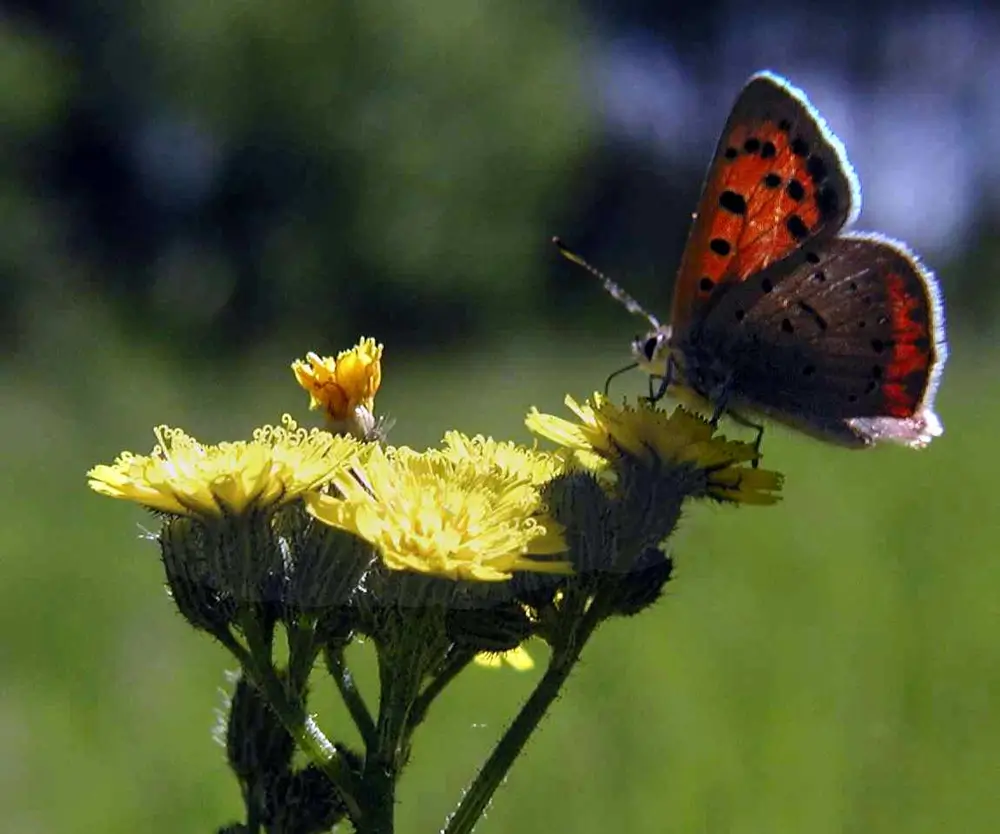
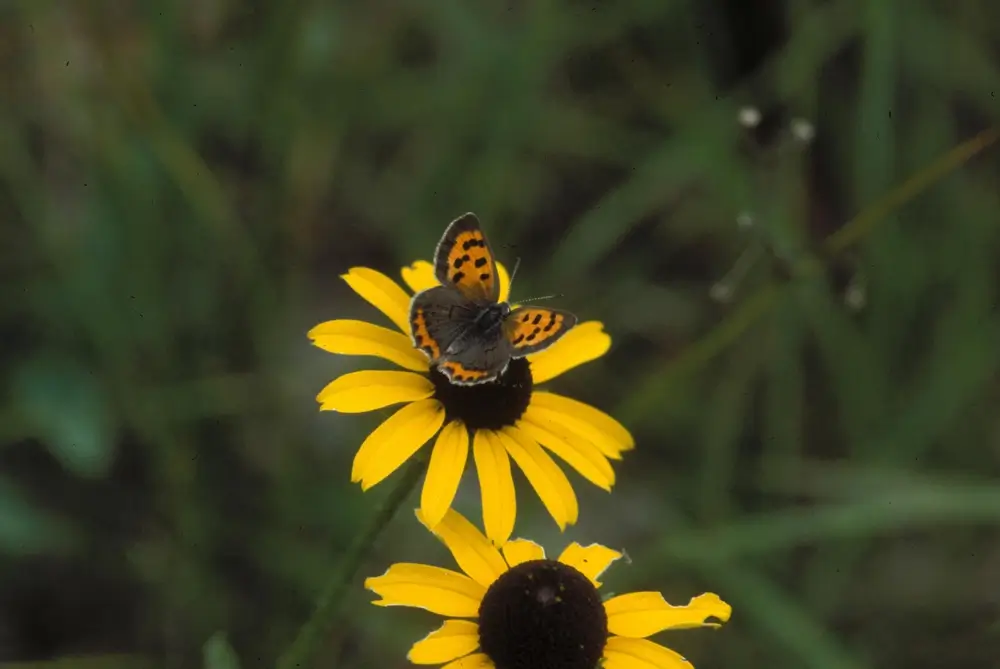
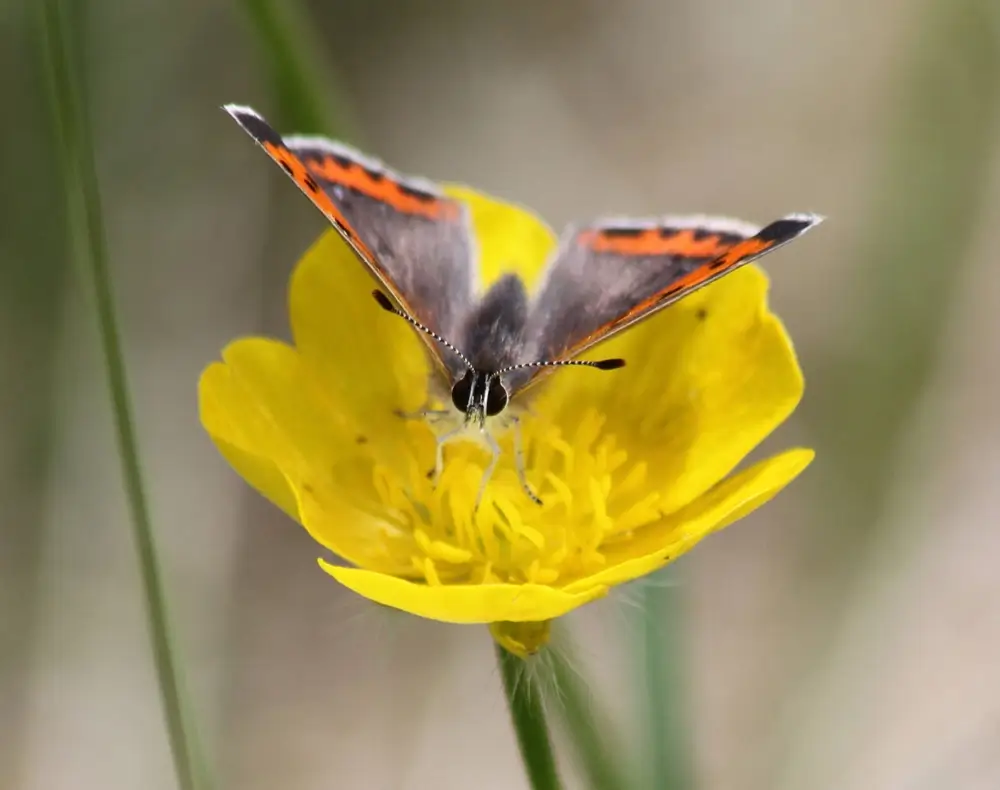
The American copper has a wingspan of about an inch (2.5 cm). It has rounded wings. The uppersides of its forewings are bright copper with black spots and a gray border.
Its hindwings are grayish-brown with a copper border. The undersides of its wings are gray with black spots. The underside of its hindwings has a wavy, orangish-red band near the edge.
Habitat
Lowland populations of American coppers are found in pastures, landfills, roadsides, yards, and fields. Arctic and alpine populations are found above the tree line on barren ground and talus slopes. A talus slope is a pile of rocks at the base of a cliff or slope.
Diet
The American copper caterpillar eats herbs of the Polygonaceae family, including sheep sorrel and curled dock. The adult feeds on the nectar of common buttercup, goldenrod, white clover, butterfly weed, and yarrow.
Life Cycle
The male American copper perches in grassy areas and waits for a female. The female lays one egg at a time on the leaves of a host plant. The American copper produces one to two broods a year. The caterpillar is red to yellow-green and has red and white stripes.
Behavior
American coppers are very territorial. They often chase away other insects—and sometimes even birds. These busy butterflies fly low, just 1–2 feet above the ground, and are always on the move. Male coppers are extra bold, chasing after females and guarding sunny, open spots where they like to hang out.
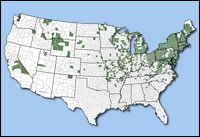
Lowland groups of the American copper are found from Nova Scotia, Canada south to Arkansas and Georgia, and west to North Dakota and Kansas.
Arctic and alpine populations are found from Greenland west to Alaska and south to the Hudson Bay. American copper populations are also found in the mountains of some western states.