The Andean cock-of-the-rock is a medium-sized perching bird around 12-13 inches (30.5-33 cm) in length.
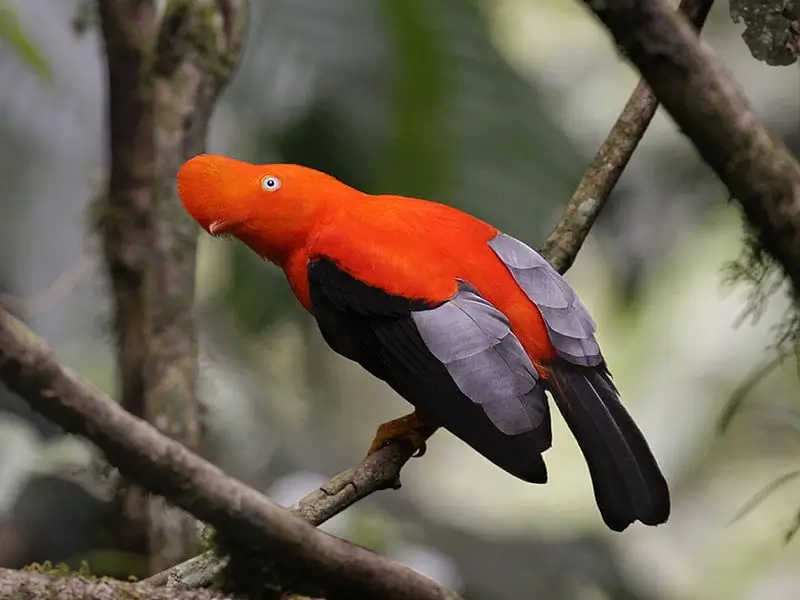
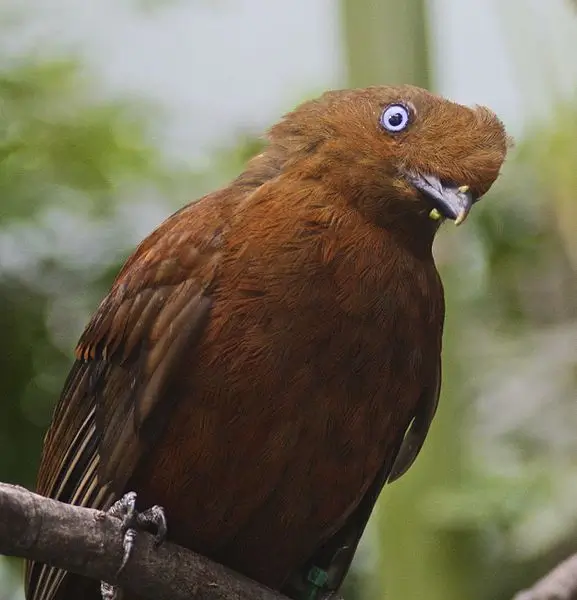
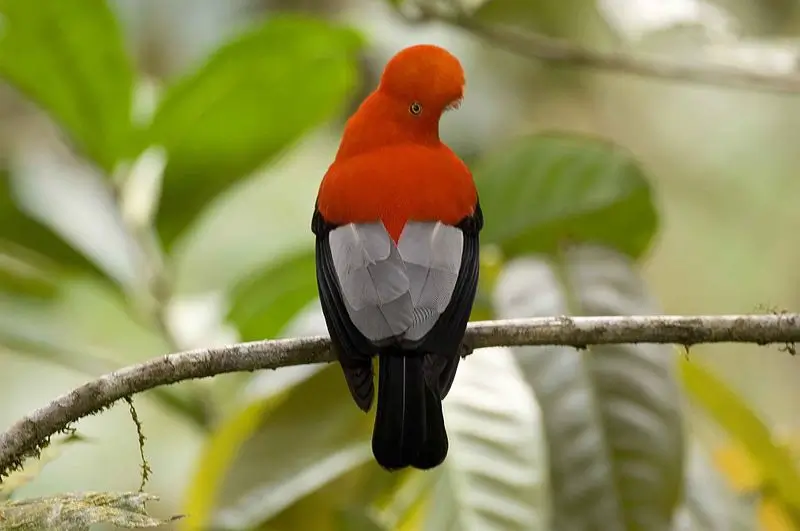
The male Andean cock-of-the-rock has a bright red-orange head, neck, breast, and shoulders. It has a black body, gray wings, and a large disk-shaped crest of feathers that extends over its bill. The female is brownish-orange and has a smaller crest.
Habitat
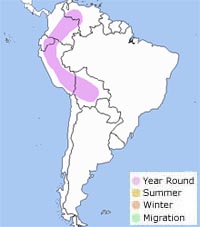
The Andean cock-of-the-rock is found in humid, rocky forested areas and is often found in ravines near water or by forest streams. It is usually found at elevations of 1,500-8,900 feet (457.2-2712.7 m).
Diet
The Andean cock-of-the-rock eats fruits and berries and occasionally insects.
Life Cycle
Andean cock-of-the-rock males gather in groups in a lek in the forest. A lek is an area where animals, usually birds, gather to perform courtship displays. The males try to attract females with a call that sounds like a pig squealing. They also bob up and down, bow, and hop around to display their bright plumage.
Males will mate with more than one female. The female builds a nest of mud under a rocky outcrop or in a cave. She lays 2 eggs and incubates them for around 28 days. She cares for the chicks by herself.
Behavior
When at the lek, males sometimes pair off with another male and perform “confrontation displays”. They will face each other and bow, jump, flap their wings, and snap their bills, while squawking and grunting.
Did You Know?
The Andean cock-of-the-rock is the national bird of Peru, where it is known as the tunqui.