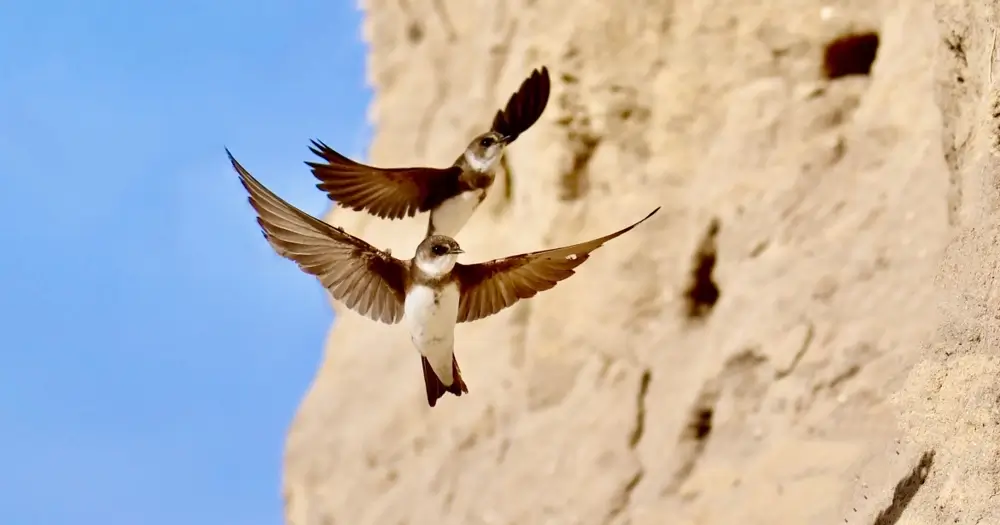
The bank swallow is the smallest swallow species in North America. It is 4.7-5.5 inches (12-14 cm) in length and has a wingspan of 9.8-13.0 inches (25-33 cm).
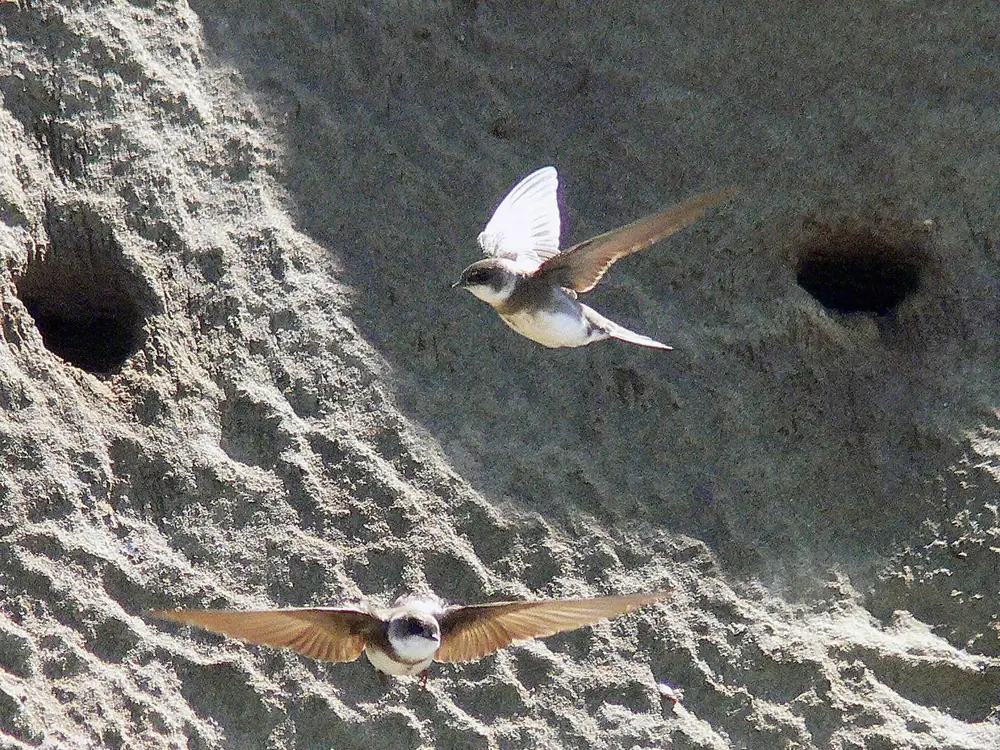
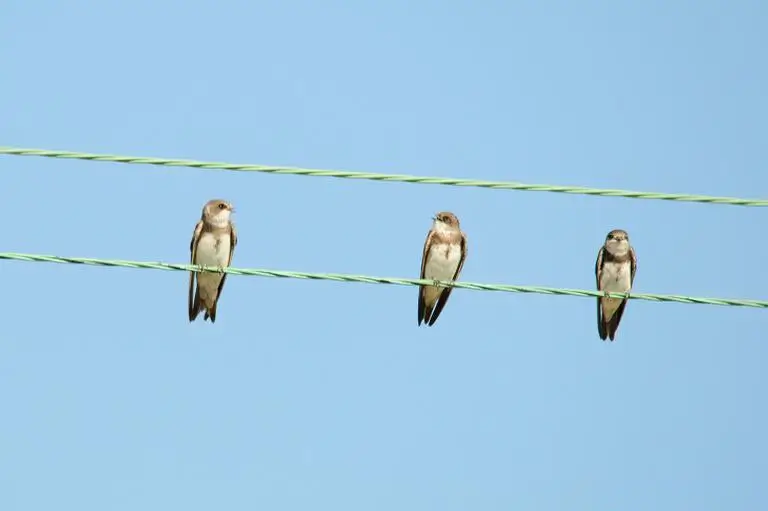
It has short pointed wings and a slightly forked tail. It is brownish-gray with a white belly, neck, and chin, and a brown band across its chest.
Habitat
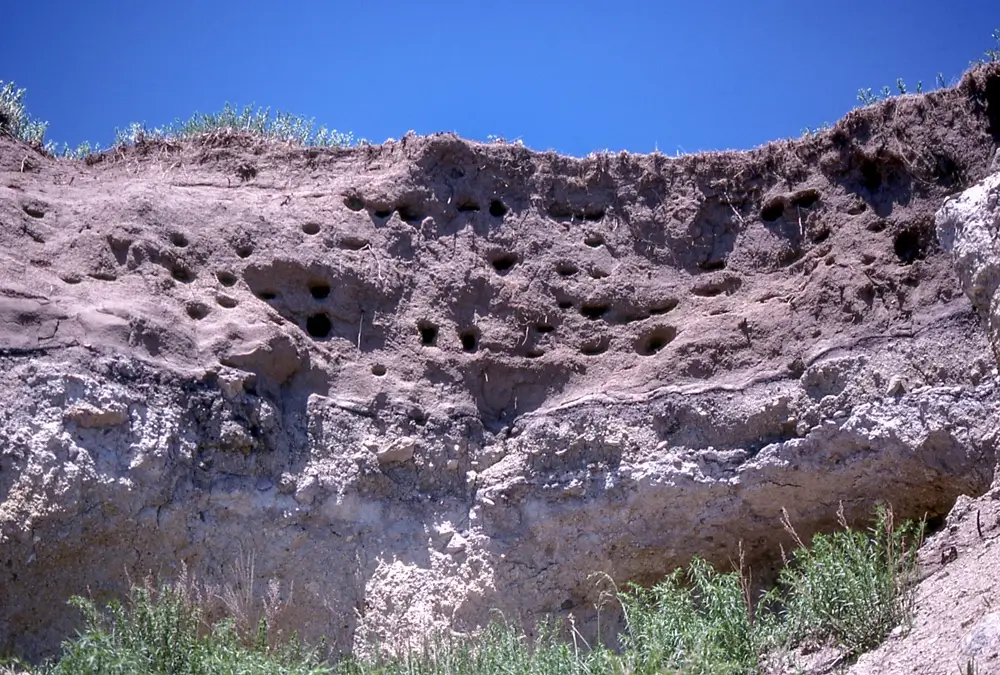
The bank swallow lives in low-lying areas along rivers, streams, ocean coasts, and reservoirs. Bank swallows need vertical banks and cliffs to form their colonies of nests.
Although the bank swallow used to be found mostly around natural banks and waterways, many are now found in human-made sites such as sand and gravel pits.
Diet
The bank swallow eats flying or jumping insects such as bees, wasps, ants, butterflies, and moths. They catch food while flying, at heights of 50 feet (15.2 m) above the water or ground. Sometimes, the bank swallow will take an insect from the ground or the surface of the water.
Life Cycle
The bank swallow builds an impressive nest. The male uses its bill, feet, and wings to dig a burrow that leads to the nest chamber. The burrow can be as long as 2 feet (0.61 m) into the side of the bank. By placing the nest so far inside the bank, temperatures remain more constant than the outside air temperature.
The female builds the actual nest, using straw, grass, and leaves to form a nest mat. She lays 2-6 white eggs and incubates them for 13-16 days. The chicks stay in the nest for another 18-24 days before flying.
The bank swallow has a lifespan of 2-3 years in the wild.
Behavior
The bank swallow is a very social bird. It nests in large colonies with as many as 2,000 nests.
Did You Know?
Support for NatureWorks is provided by:
The Bank Swallow in NH
The bank swallow breeds in the Connecticut, upper Merrimack, and Saco River valleys in New Hampshire. Some birds also breed in gravel pits in southeastern New Hampshire.
It was found across the state in the 1980s, but its population has seen a steep decrease since then.
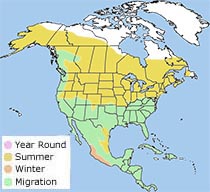
The bank swallow breeds throughout much of Alaska and Canada and south into the United States. It breeds along the Rio Grande River in Texas and into northern Mexico.
In the winter, the bank swallow migrates throughout South America. Some colonies spend the winter along the western coastal slopes of Mexico.
The bank swallow is also found in Europe, Asia, and Africa and is known as the sand martin or the collared sand martin.