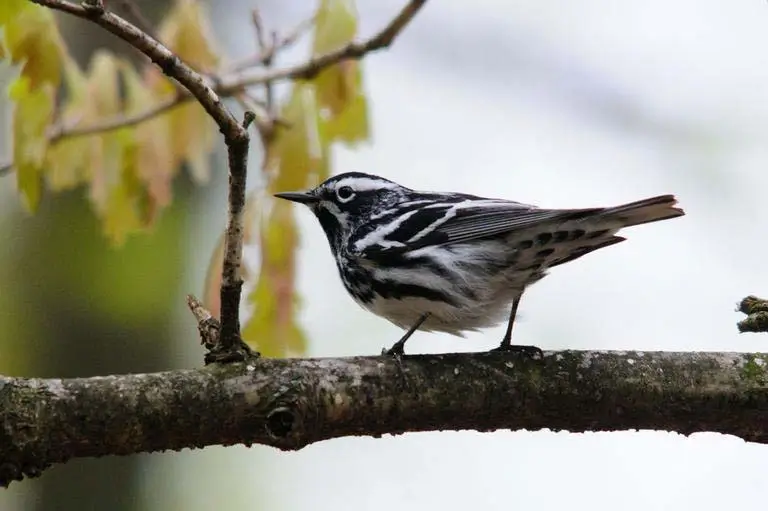
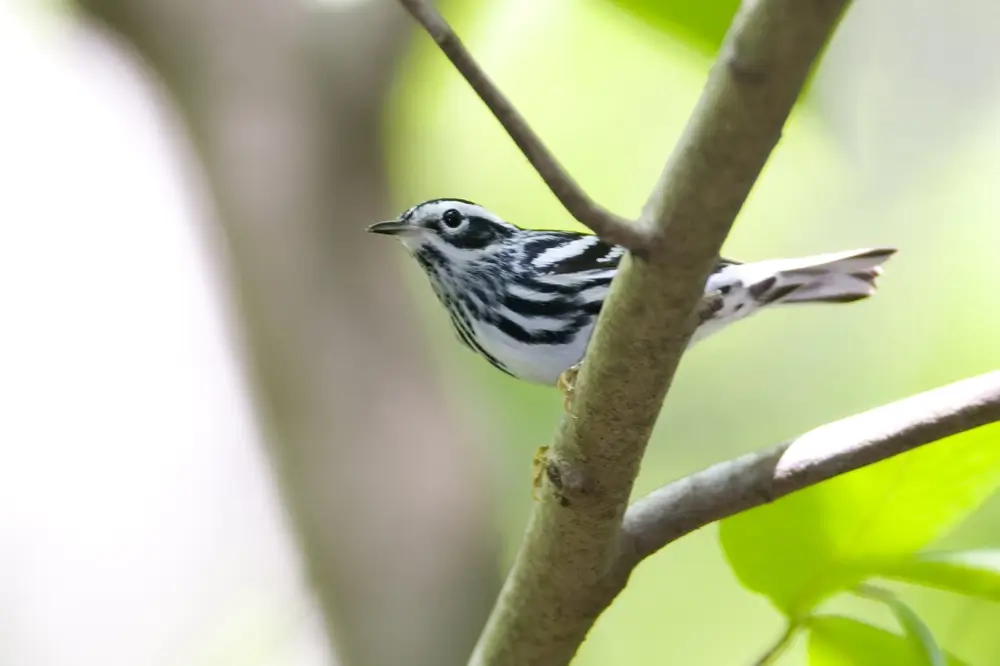
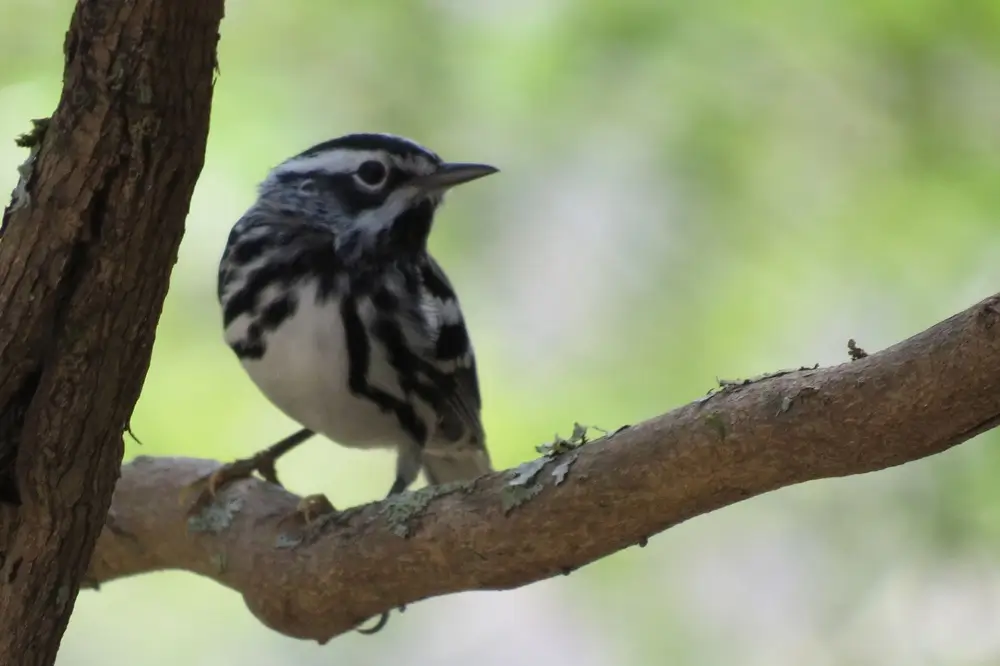
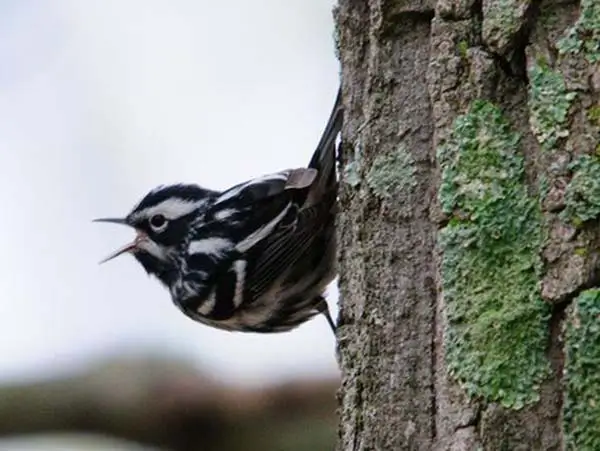
The black-and-white warbler is a small perching bird that is 4.3-5.1 inches (11-13 cm) in length with a wingspan of 7.1-8.7 inches (18-22 cm).
It has black and white stripes that run from the crown of its head to its rump. The male has a black throat, and the female has a white throat. inches in length. It has a slightly hooked bill; webbed feet;and 6-10 inch long pointed center tail feathers that stick out beyond its other tail feathers.
During the non-breeding season, it loses its center tail feathers. In the breeding season, it has a gray back and wings, a white head and belly, and a dark brown cap on its head. In the non-breeding season, its cap has white and gray spots on it, and its undersides have light brown and white bars. Males and females look alike.
Habitat
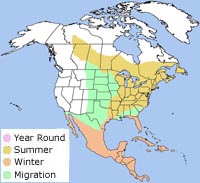
The black-and-white warbler is found in deciduous and mixed forests.
Diet
The black-and-white warbler is sometimes called the black-and-white creeper. It creeps around tree trunks and branches in search of insects and spiders hidden under the bark.
Unlike the brown creeper, the black-and-white warbler can creep in any direction.
Life Cycle
Male black-and-white warblers arrive at the breeding ground first, usually in April or May, and establish a territory. Males court females by pursuing them, preening, and singing. Once the chase is over, the male will perch next to a female and flutter his wings.
The female builds an open cup nest of leaves, pine needles, grass, and bark on the ground, usually at the base of a log or a tree. She lays 4-5 eggs and incubates them for 10-12 days.
The male helps protect the nest and brings food to the female while she is nesting. Both parents feed the chicks and defend the nest. The chicks fledge in 8 to 12 days. Most females have only one brood year.
The black-and-white warbler has a lifespan of 5 to 6 years in the wild.
Behavior
The black-and-white warbler is more aggressive than most warblers and will attack red-breasted nuthatches, black-capped chickadees, and other birds.
Did You Know?
Support for NatureWorks is provided by:
The Black-and-white Warbler in NH
The black-and-white warbler breeds across New Hampshire.