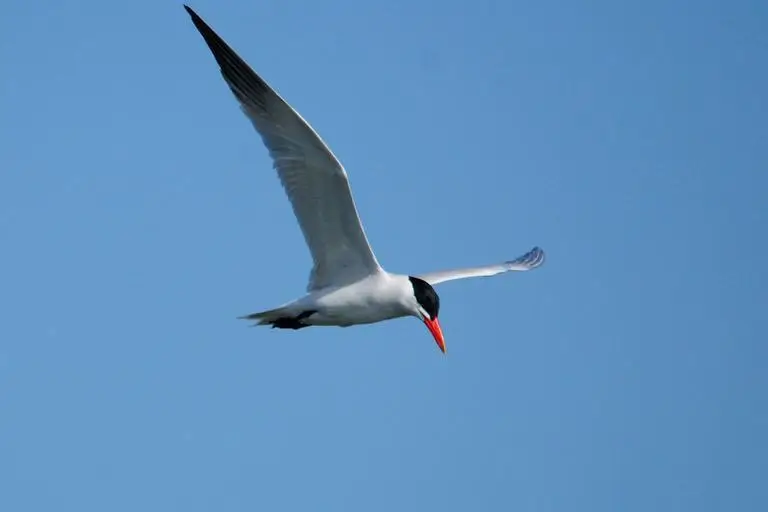
The Caspian tern is the largest species of tern in North America. It is 18.5-21.3 inches (47-54 cm) in length with a wingspan of 49.6-50.4 inches (126-128 cm).
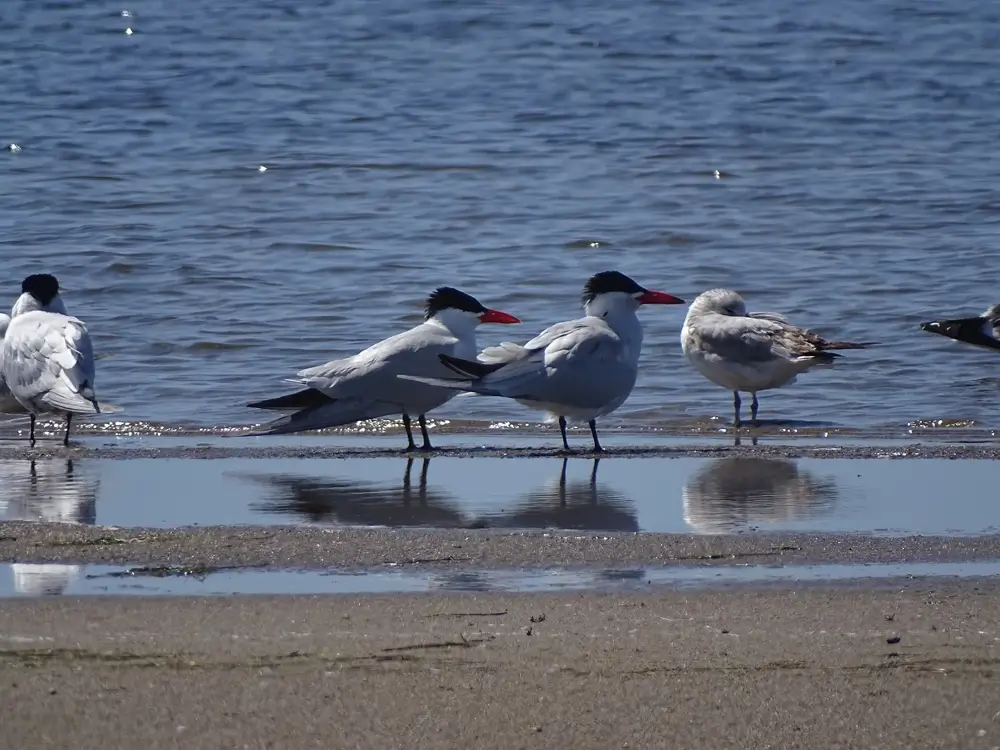
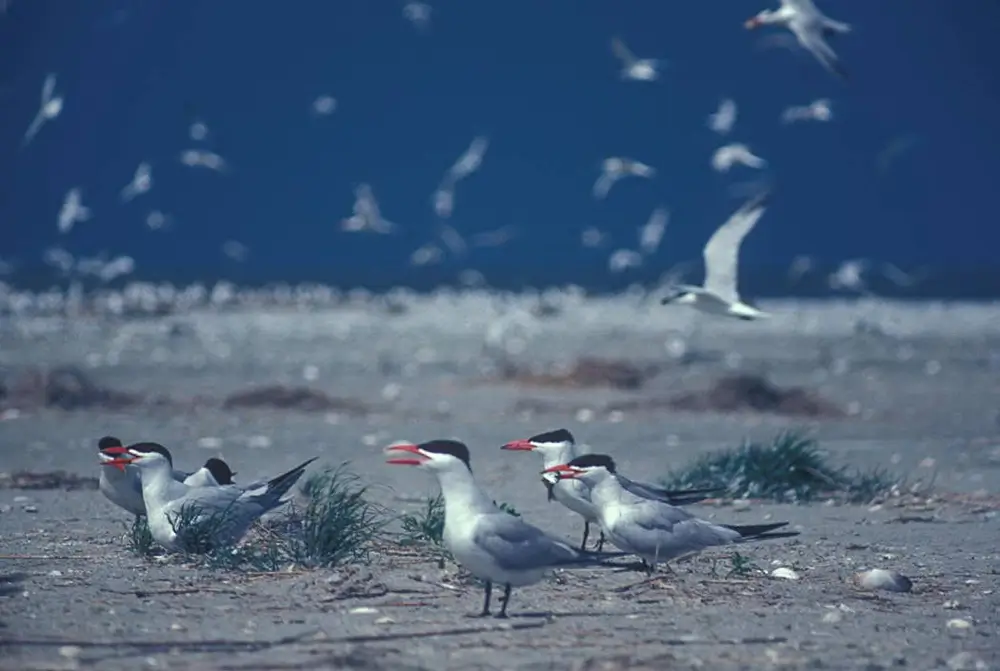
It has white undersides, a white breast, slate gray upper wings, and a gray back. It has a black cap on its head and black legs and feet. Its stout, bright red bill has a gray tip, and it has a slightly forked tail.
Males and females look alike.
Habitat
The Caspian tern breeds in salt marshes, barrier islands, lake islands, and river islands. It winters along coastlines, rivers, and lakes.
Diet
The Caspian tern flies over the water with its bill pointing down, looking for fish. When it locates its prey, it plunges into the water and snatches it up.
It also feeds from the surface of the water and eats insects, crayfish, and the eggs and chicks of other terns and gulls.
Life Cycle
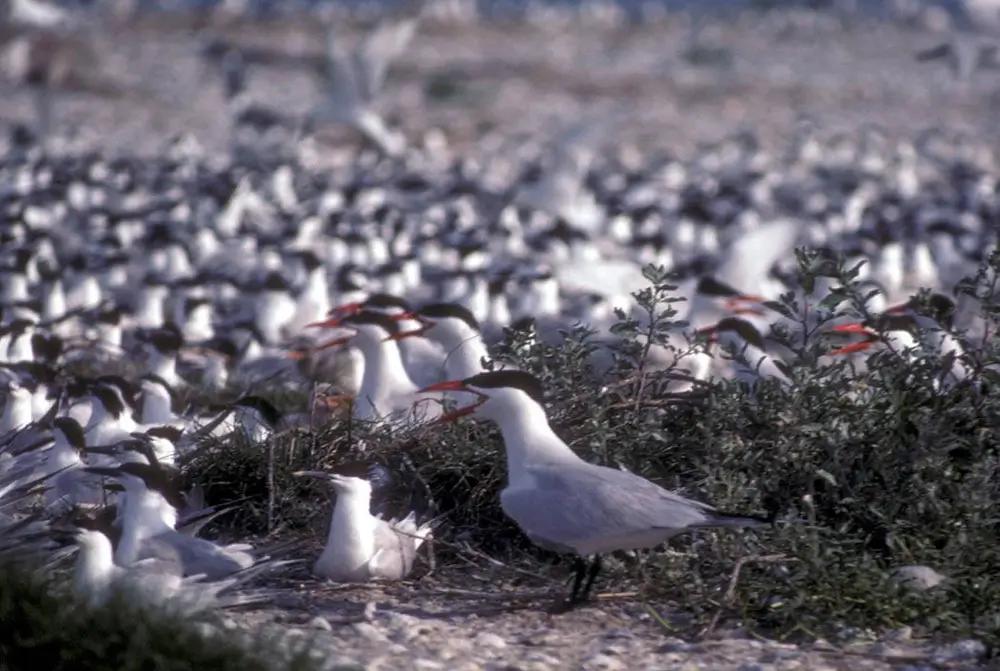
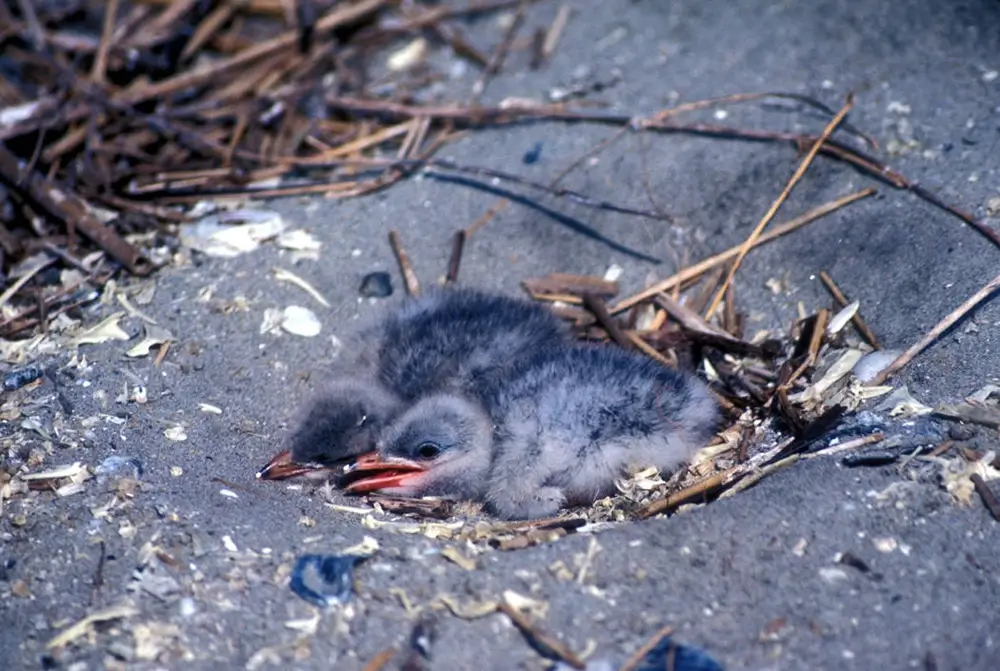
Caspian terns nest in colonies or singly on islands or rocky beaches. The nest is a scrape on the ground lined with dried vegetation, pebbles, and shells.
The female lays 1-3 spotted, cream-colored eggs. The male and the female incubate the eggs for 20-22 days, and both parents care for and feed the chicks.
The chicks fledge when they are 4-5 weeks old, but their parents may continue to feed them for up to 7 months after they fledge.
The Caspian tern has a lifespan of 10 to 12 years in the wild.
Behavior
The Caspian tern is very aggressive when protecting its breeding grounds. It chases and even attacks other birds that enter its area. It will even peck the heads of people that wander into its territory.
Did You Know?
Support for NatureWorks is provided by:
The Caspian Tern in NH
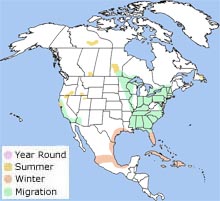
Caspian terns can be found in New Hampshire during their migration in the spring and the fall, usually in coastal regions and over large bodies of water.
The Caspian tern breeds in scattered areas along the Atlantic, Pacific, and Gulf Coasts; along the Great Lakes; in the west-central United States; and in central Canada.
It winters along the Pacific Coast from southern California south to Guatemala, and along the Atlantic and Gulf Coasts from North Carolina south to the Caribbean and along the Gulf Coast south to Mexico.
It is also found in Europe, Asia, Africa, Australia, and New Zealand.