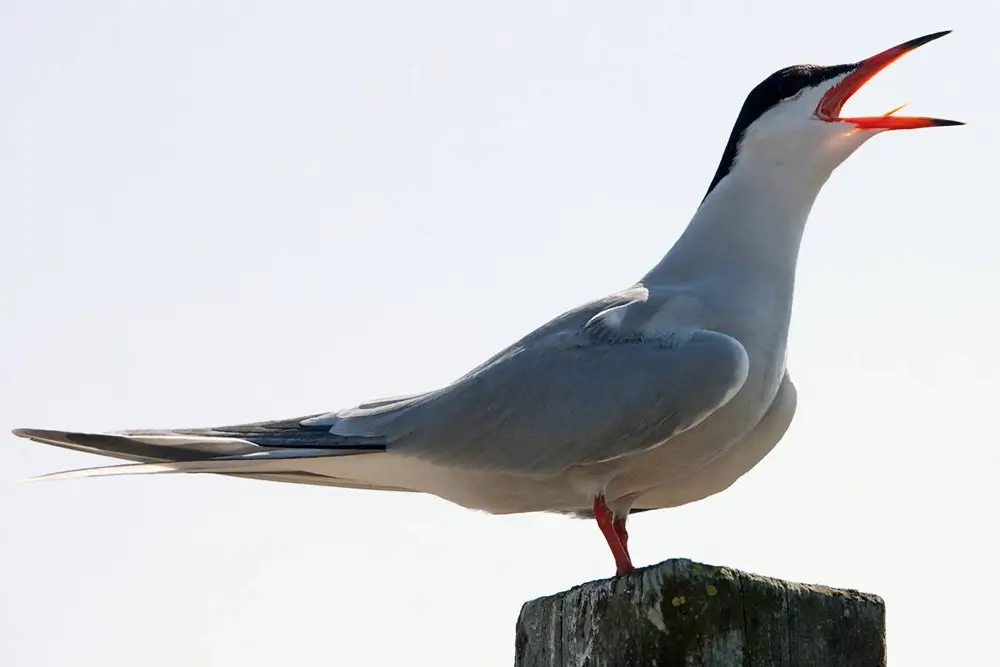
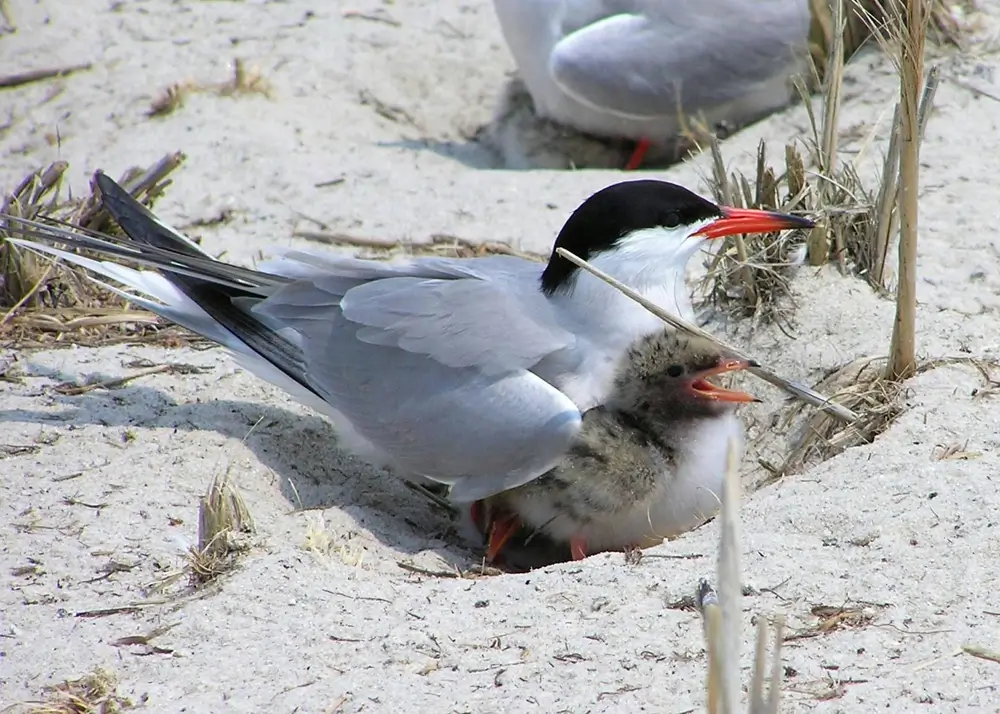
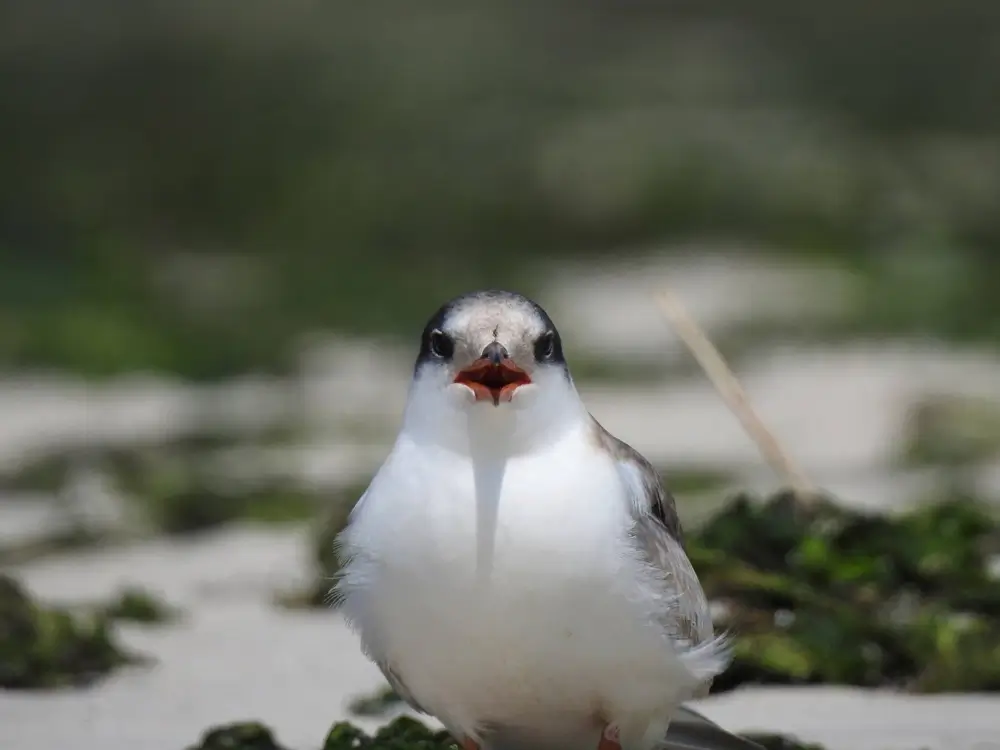
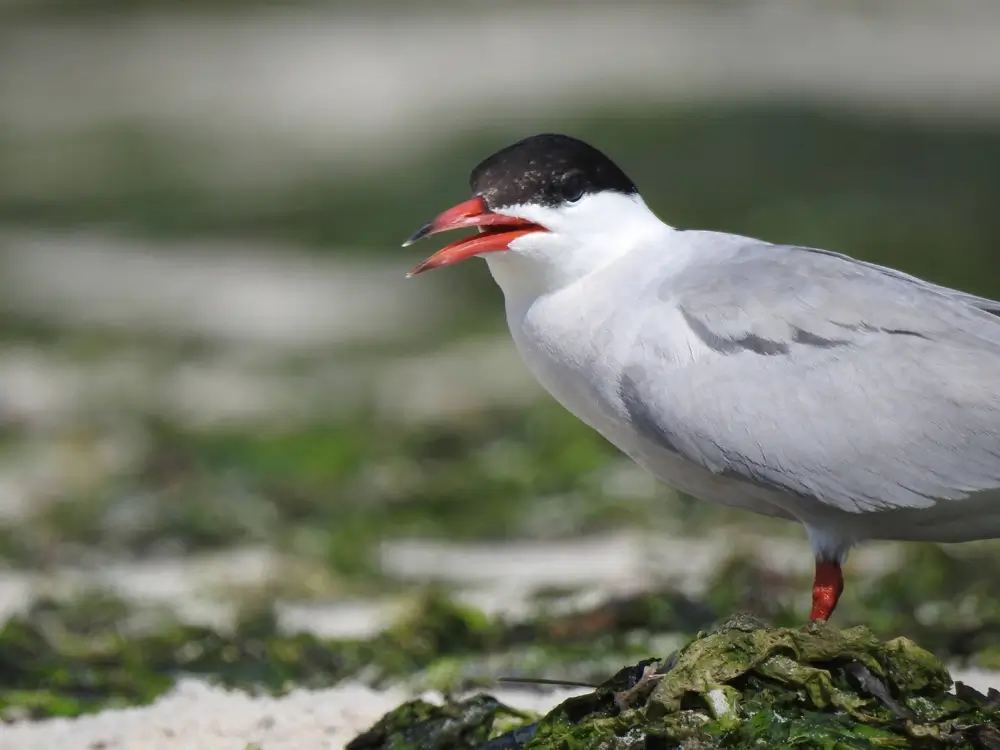
The common tern is 12 – 15 inches in length with a wingspan of 30-31 inches. It has a white breast and undersides and a slate gray back and upper wings. It has a black cap on its head and orange-red legs and feet. It has a pointed, bright orange bill with a black tip and a forked tail. Males and females look alike.
Habitat
The common tern is found on islands, marshes, lakes, ponds, rivers, and beaches.
Diet
The common tern eats small fish. It flies over the water and then plunges below the surface to snatch up its prey. It occasionally eats crustaceans and insects.
Life Cycle
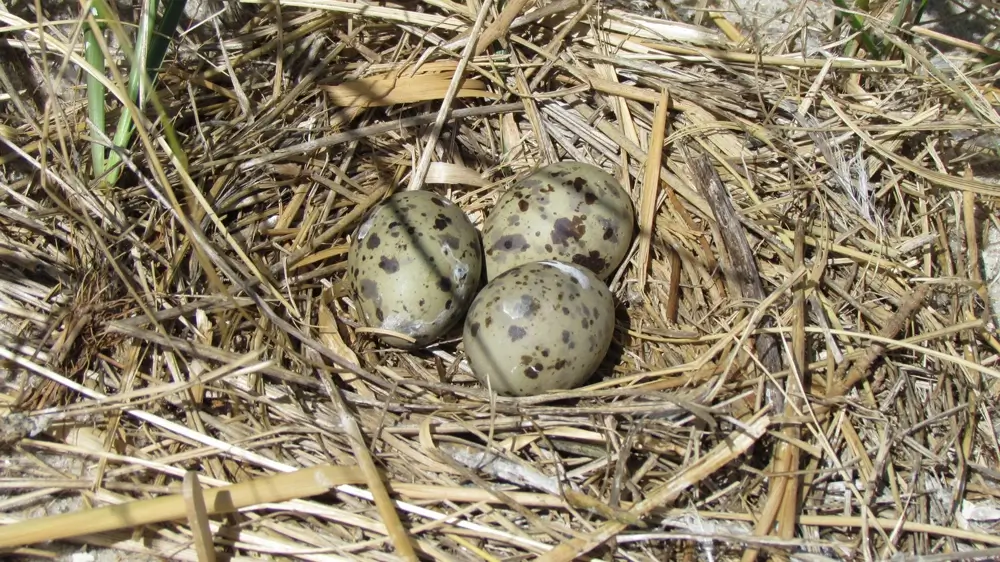
The common tern nests in colonies. The male selects a breeding territory and protects it. He courts a female by bringing her a fish. The male mates with only one female. The nest is a pile of dead vegetation placed on sandy or rocky beaches or on rocky ground.
The female lays 1-4 eggs, and the male and the female incubate the eggs for 20-26 days. Both parents care for and feed the chicks and aggressively protect them from predators by diving at intruders and striking them with their bills The chicks fledge when they are 27-30 days old. The common tern mates when it is three years old.
Behavior
The common tern population has been declining due to habitat loss and nest disturbance. Their nests are often difficult to see on beaches and their eggs can be easily destroyed by people stepping on them. The common tern is a threatened species in New Hampshire.
Did You Know?
Support for NatureWorks Redesign is provided by:
The Common Tern in NH
In New Hampshire, the common tern breeds on the Isles of Shoals. By the early 1950s, the common tern population on New Hampshire’s Isles of Shoals had disappeared. Hunting and competition and predation from a growing American herring gull population had destroyed the common tern population that had bred on the islands for hundreds of years.
In 1997, the Audubon Society of New Hampshire and the NH Fish and Game Department began creating safe nesting sites for the common tern on White and Seavey Islands. The safe nesting sites use decoys and other non-lethal tools to drive away seagulls. In the first year of the project six pairs nested. Today there are over 2,500 nesting pairs of common terns on the Isles of Shoals. The safe nesting place has also attracted some roseate tern and arctic tern pairs.
The common tern breeds from Alberta, Canada east to Labrador, Canada, and south to Montana, the Great Lakes, and the Atlantic coast. It winters from Florida south to the Caribbean and South America. The common tern is also found in Africa, Europe, Asia, and Australia.