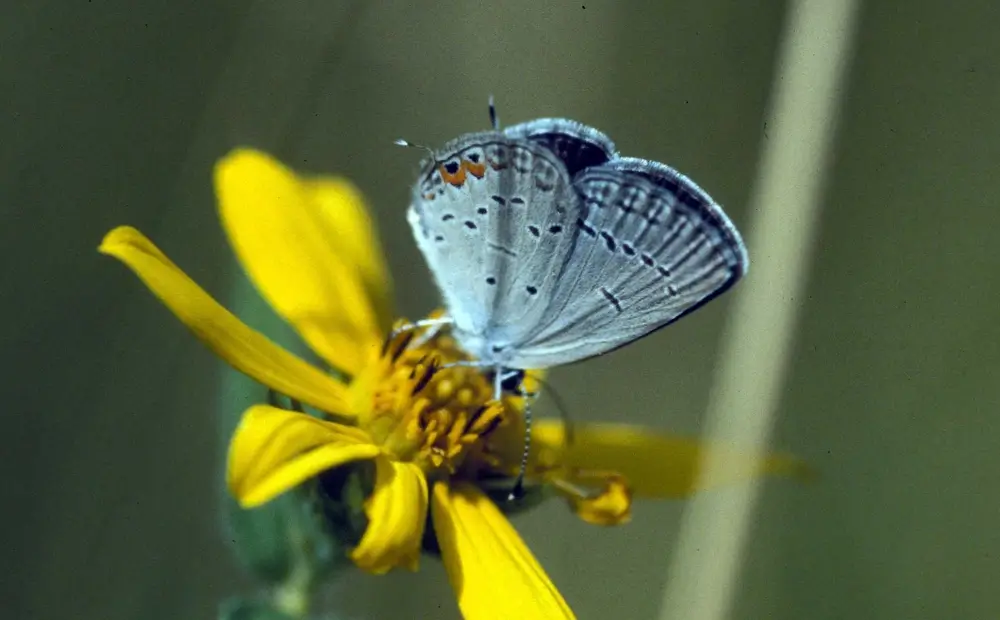
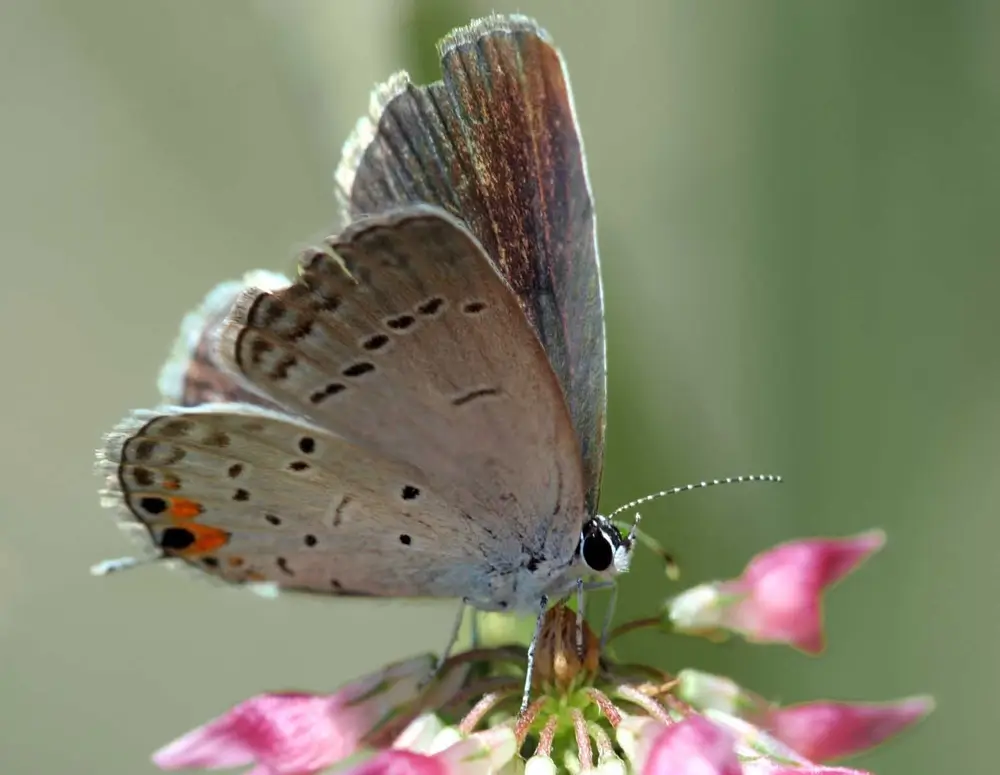
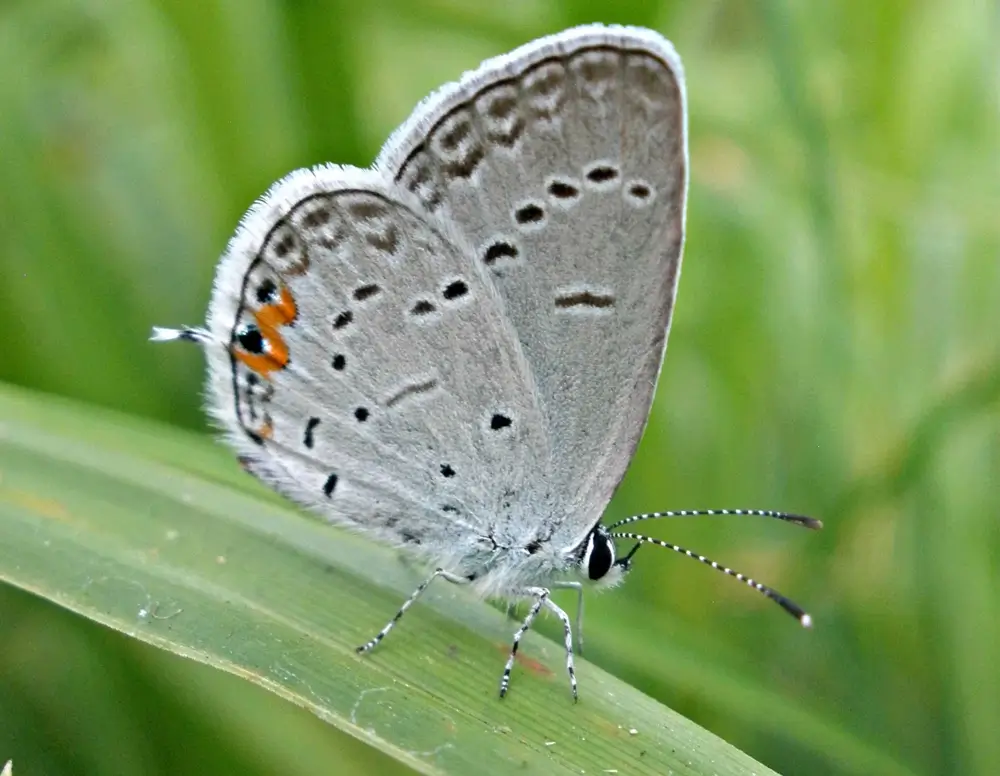
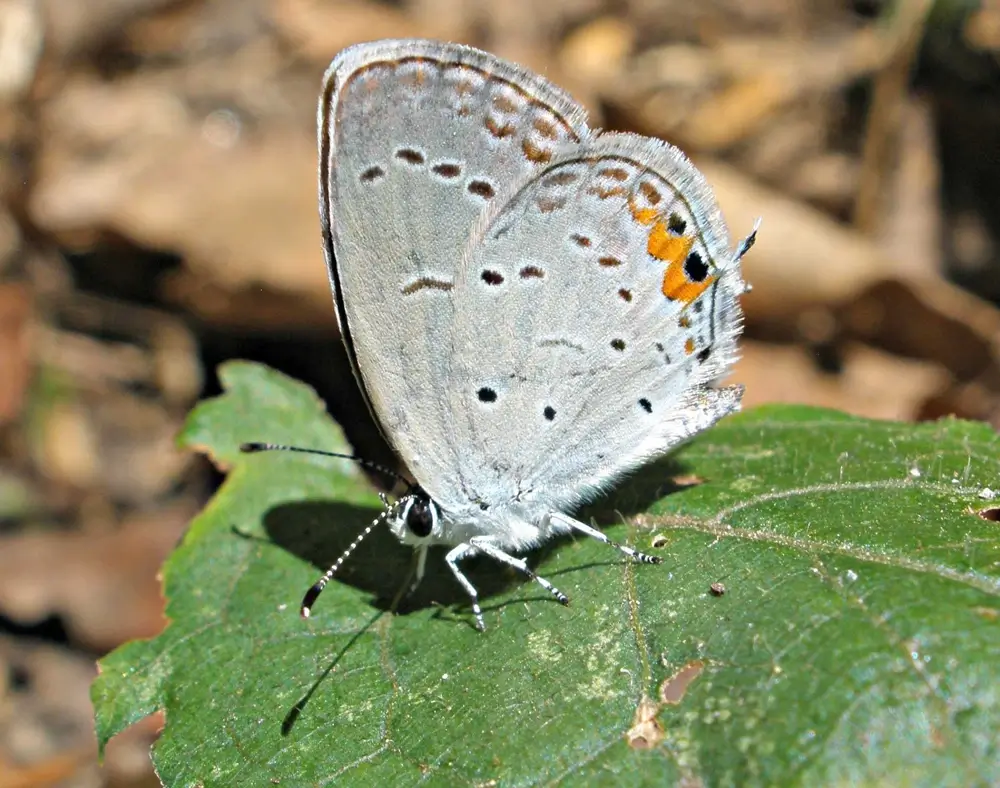
The eastern tailed blue has a wingspan of up to one inch (2.5 cm). The uppersides of the male’s upper wings are an iridescent blue and brownish-gray along the borders.
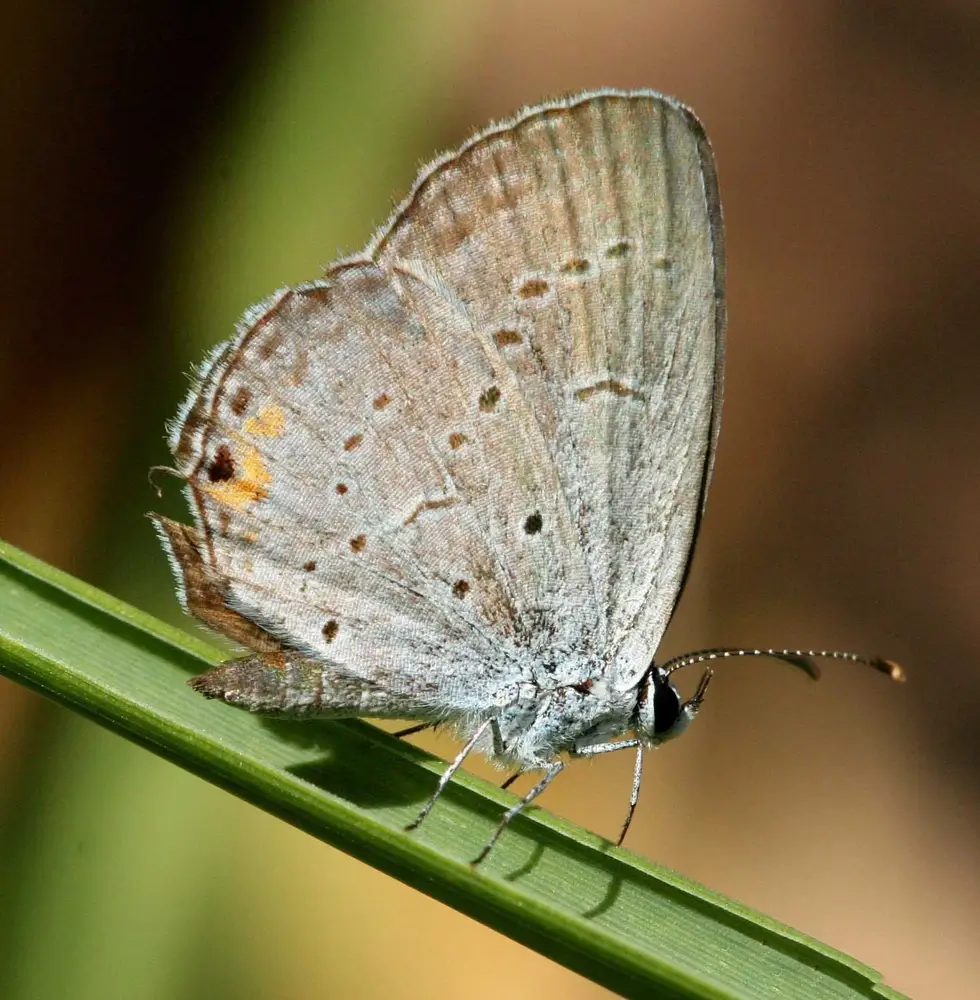
Both the male and the female have orange spots on the rear of their hind wings. Both the male and the female have a white fringe on the edges of their wings.
The eastern tailed blue is very similar to the Karner blue butterfly, except for the tiny tail-like points at the bottom of its wings.
Habitat
The eastern tailed-blue is found in open sunny areas like fields, meadows, roadsides, and forest glades.
Diet
The eastern tailed-blue caterpillar eats a variety of plants in the pea family, including cow vetch, clover, alfalfa, and wild pea.
The butterfly feeds on flowers close to the ground, like clover, shepherd’s needle, wild strawberry, winter cress, cinquefoils, and asters.
Life Cycle
The male eastern tailed-blue perches on potential host plants and waits for a female. The female lays her single eggs on the flower buds or stems of a host plant like white or red clover, beans, wild pea, and trefoil.
There are usually three broods a year. The last year will overwinter in bean and pea pods.
Behavior
Eastern tailed-blue butterflies are not strong fliers. They fly just above the tops of the grass.
Did You Know?
Support for NatureWorks is provided by:
The Eastern Tailed-Blue in NH
The eastern tailed-blue is found throughout New Hampshire.
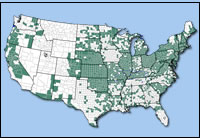
The eastern tailed-blue is found throughout the eastern United States west to North Dakota, Colorado, and Texas. It is found in some lower elevations in the west and is also found in southern Canada and in Mexico and Central America.