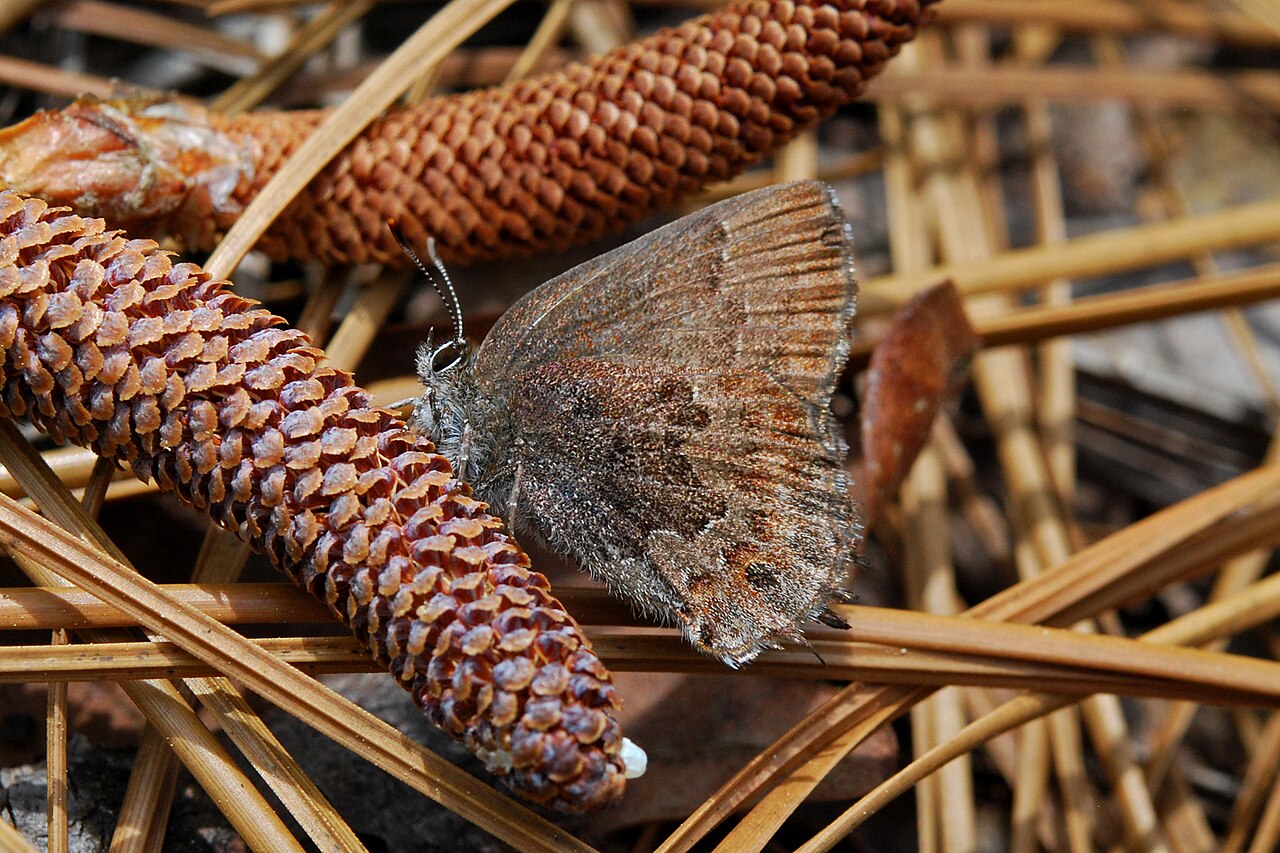
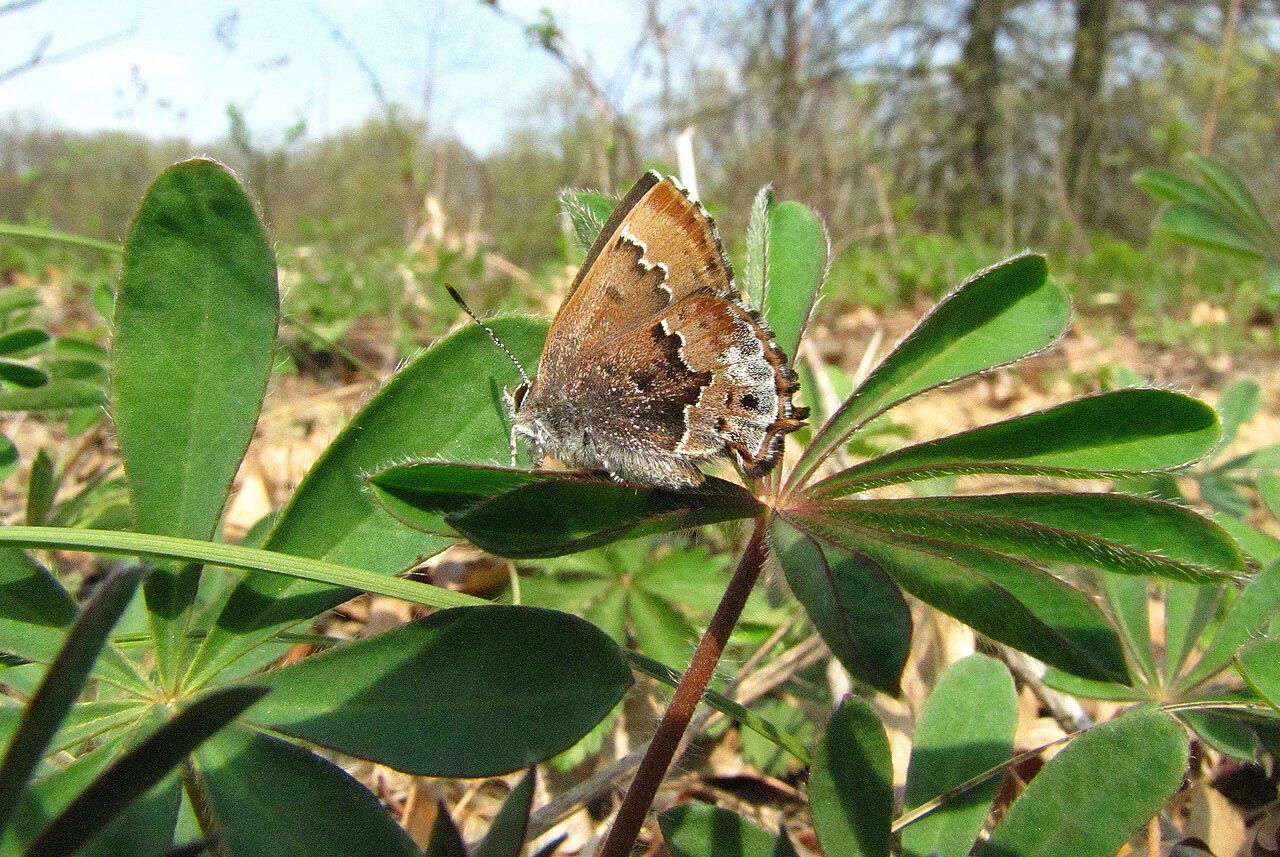
The frosted elfin has a wingspan of 0.87 to 1.42 inches (2.2 to 3.6 cm).
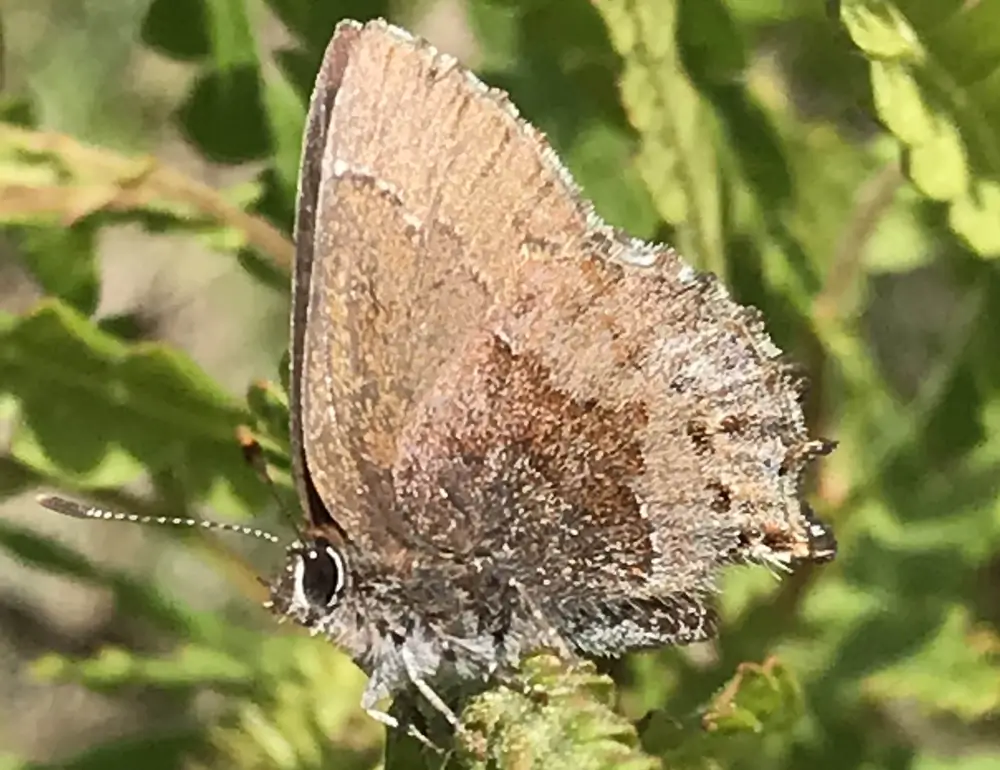
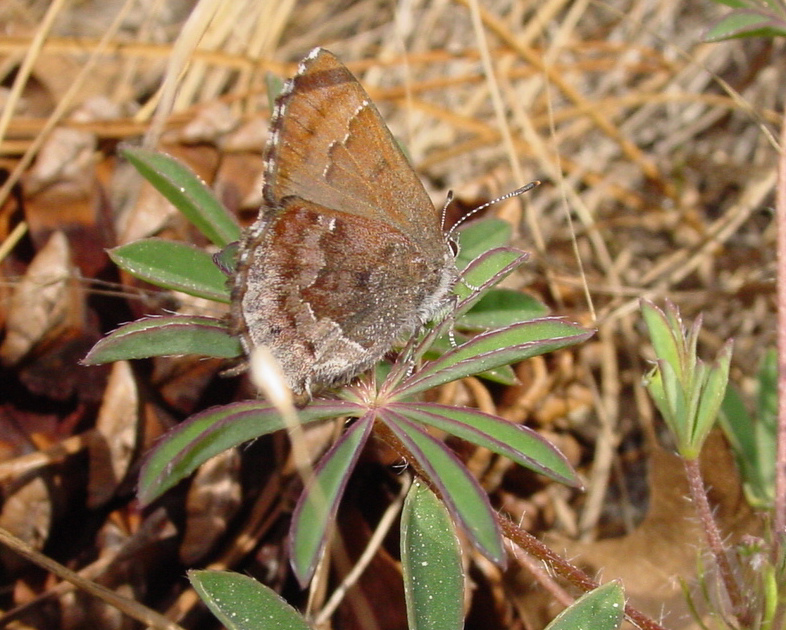
The male frosted elfin butterfly has gray-brown upper wings. The female is a reddish brown color on her upper wings. It has a stubby tail with a black spot at the base.
The larvae are light blue-green and have white lines down their backs.
Habitat
The frosted elfin butterfly is found in oak savannah and pine barren habitats and open woods and forest edges with wild blue lupine.
Diet
The caterpillar of the frosted elfin butterfly eats wild blue lupine, but some populations of the caterpillar also eat wild indigo, blue false indigo, and rattlebox.
Adult frosted elfin butterflies eat the nectar of a variety of flowers.
Life Cycle
The frosted elfin female lays her eggs in the spring on the flower buds of a host plant, usually wild lupine or false indigo. The chrysalis weaves a cocoon in leaf litter under the host plant. The caterpillars eat the flowers and seedpods of the host plant.
Behavior
The frosted elfin is a poor flier. This, along with its dependence on lupine, may explain why its populations are isolated and scattered.
Did You Know?
The frosted elfin gets its name from the gray scales that edge its hind wings and give its wings a frosted look.
Support for NatureWorks is provided by:
The Frosted Elfin in NH
The frosted elfin is endangered in New Hampshire. It is only found in the Concord Pine Barrens. According to old records, it once may have been found in Webster and Durham.
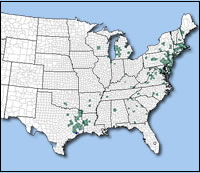
The frosted elfin butterfly is found in scattered local communities from Maine west across New York and southern Michigan to central Wisconsin; south along the Atlantic coast and the Appalachians to northern Alabama and Georgia.
There are isolated colonies in eastern Texas, northwest Louisiana, and southwest Arkansas.