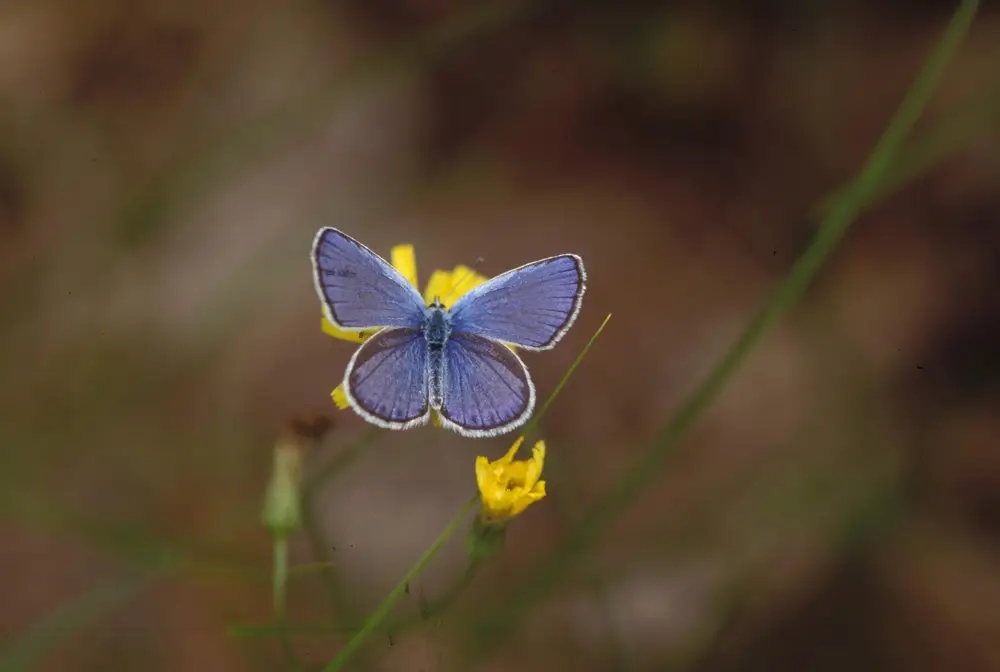
The Karner blue butterfly is a tiny, dime-sized butterfly with a wingspan of only about one inch (2.54 cm) across.
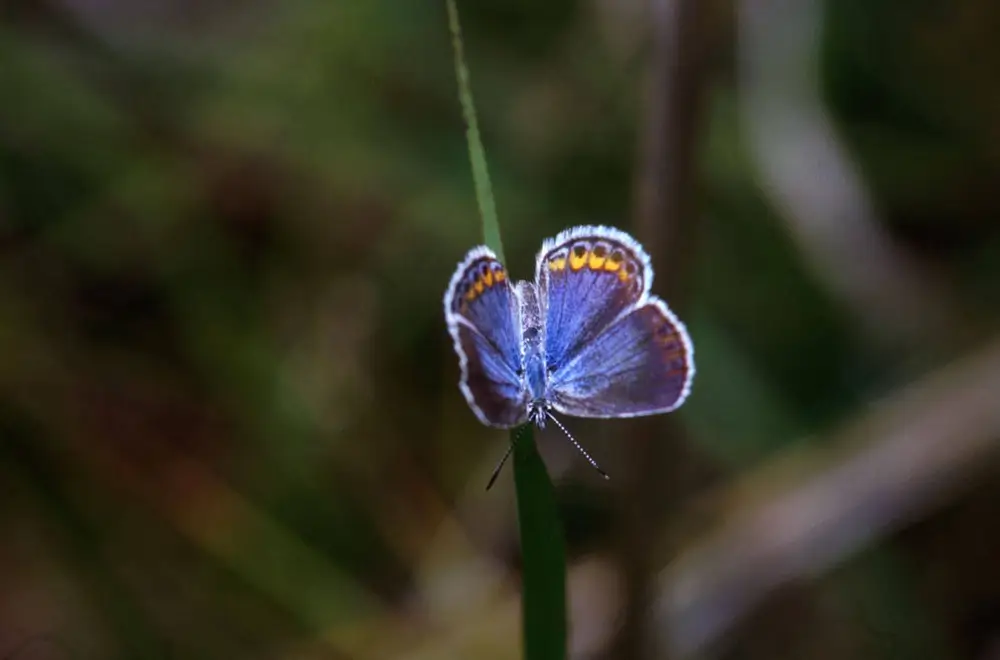
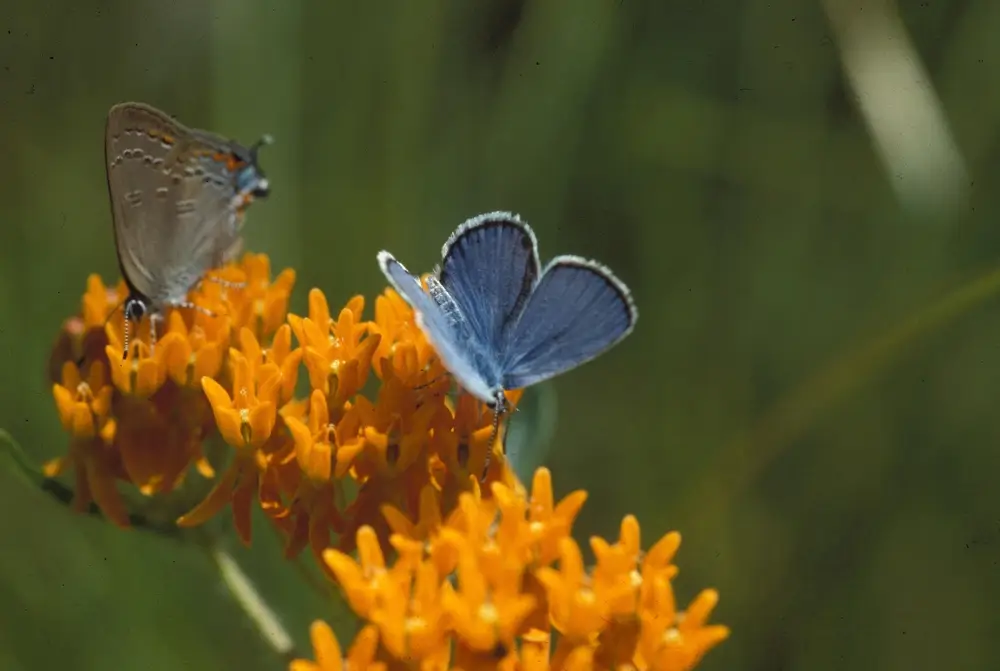
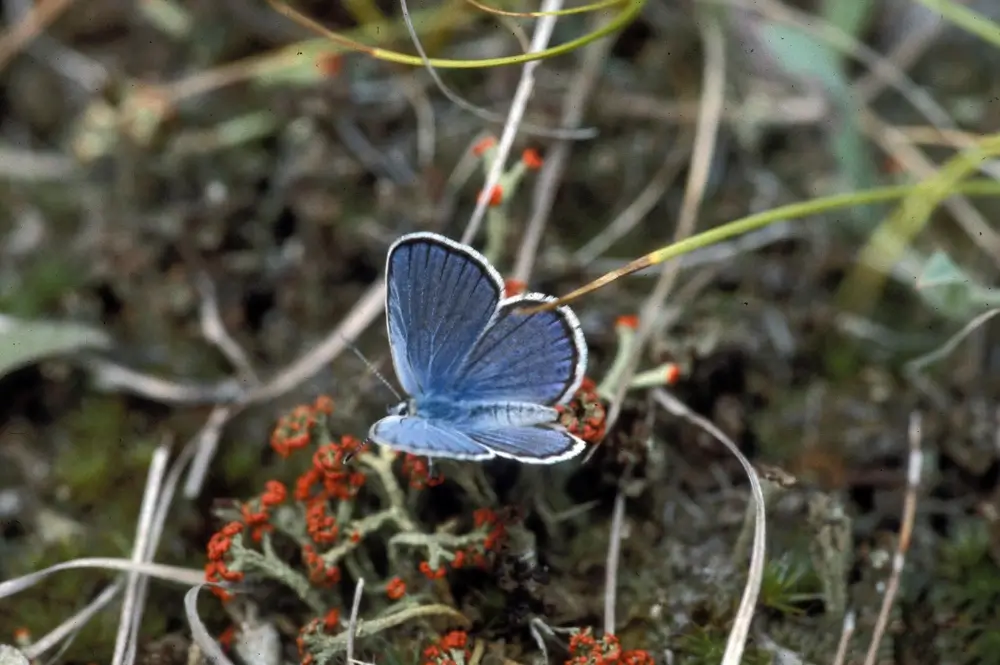
The male has dark blue or silver-blue wings with a black border. The female’s wings are a duller blue that fades to a brownish or grayish color towards the edges of its wings. The female’s wings are bordered with a row of dark spots with orange crescents.
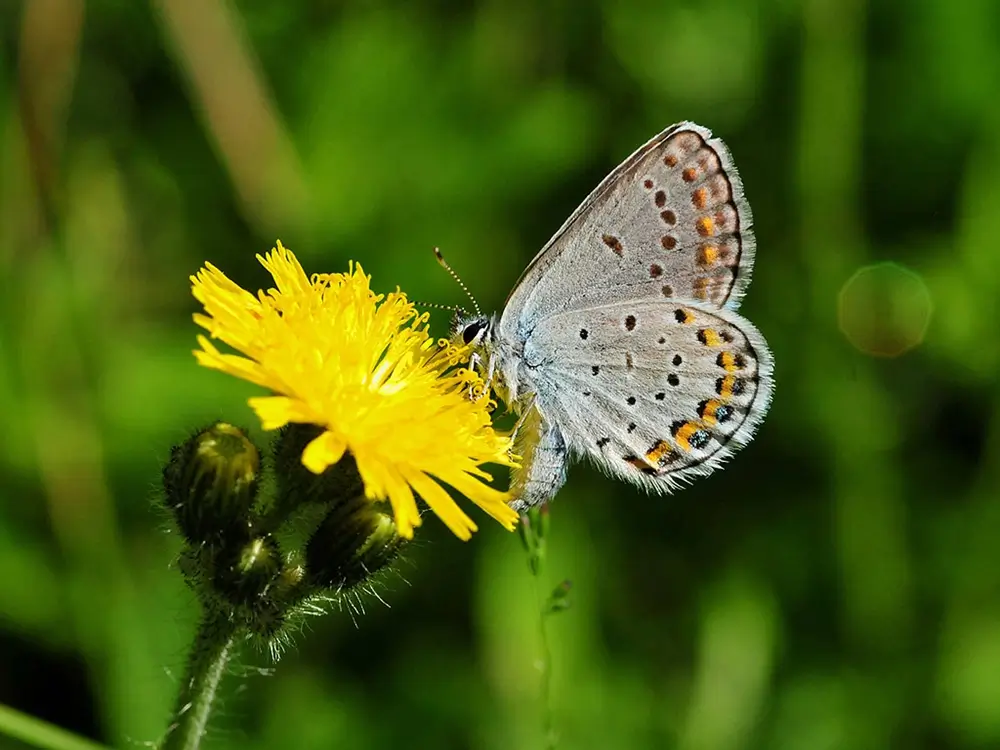
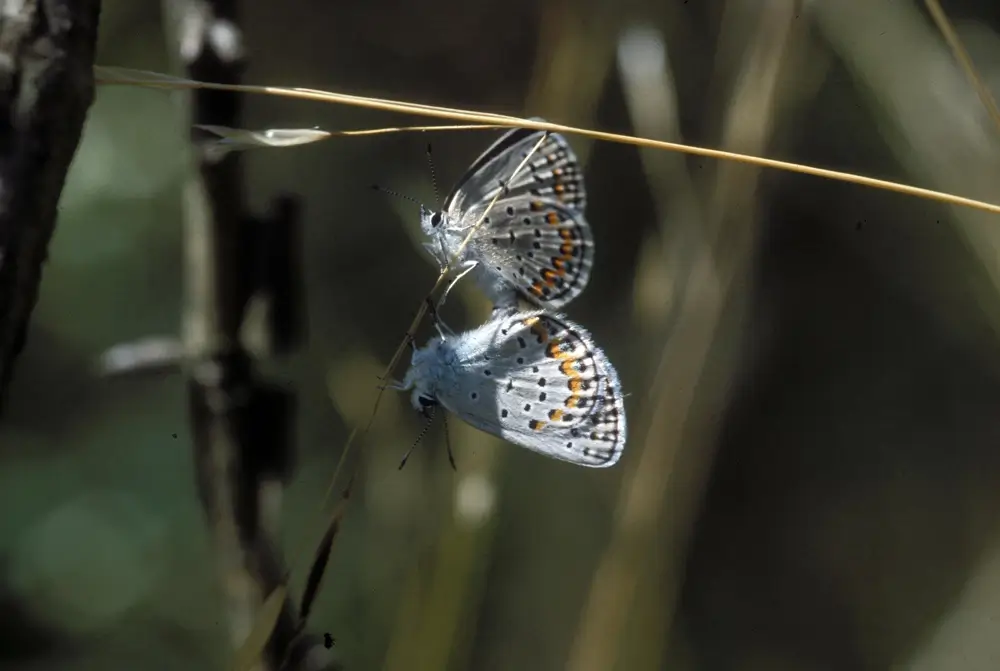
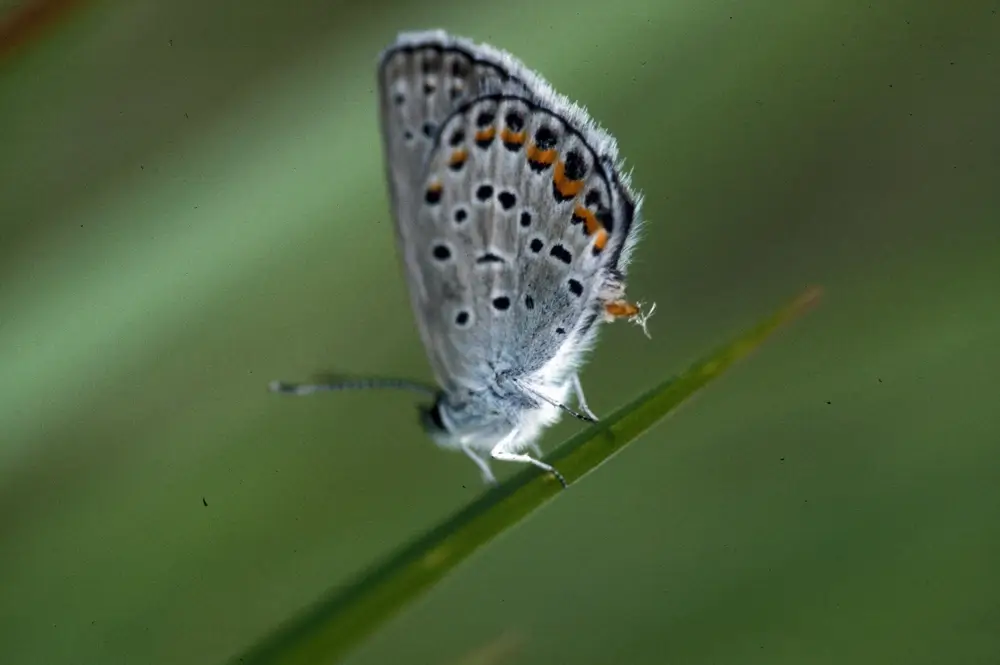
The underside of both the male and female Karner blue butterfly is light gray to grayish-brown with rows of brown spots. The edges of the undersides of their wings have a row of blue-green, orange, and black spots.
Habitat
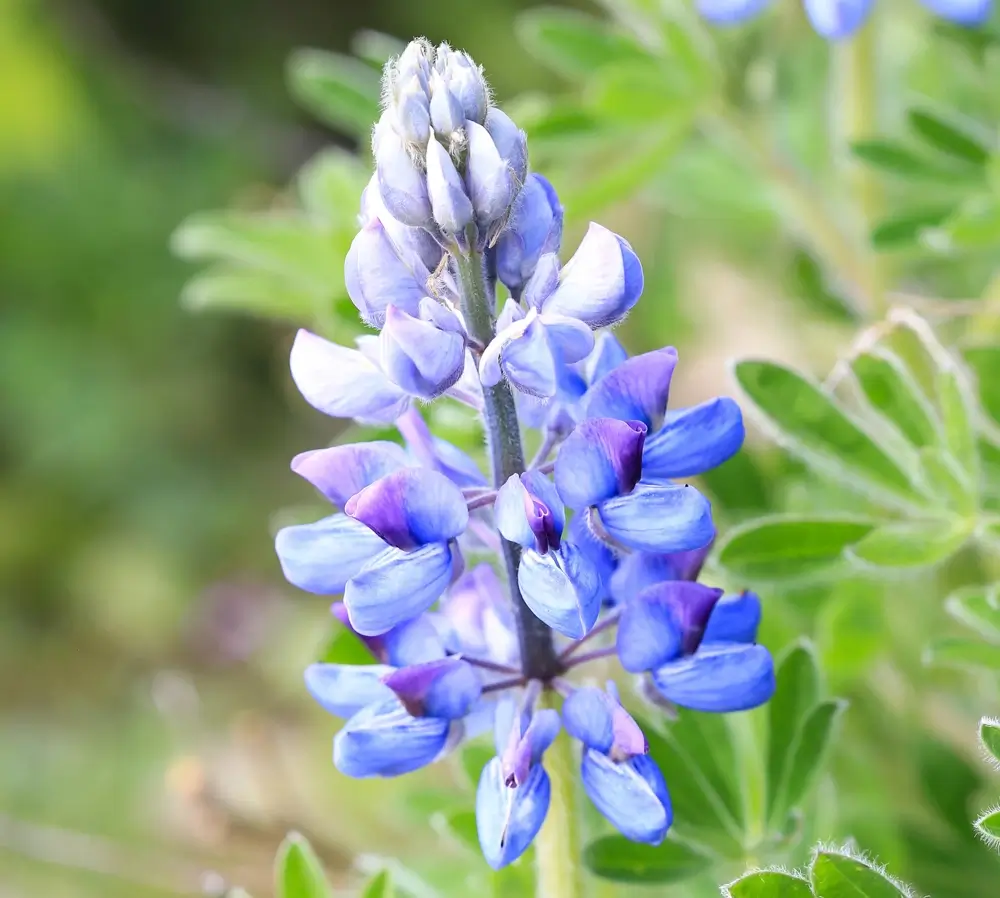
The Karner blue butterfly is found in dry sandy areas with open woods and clearings like pine barrens, lakeshore dunes, and sandy pine prairies that contain lots of wild blue lupine.
Diet
The larvae of the Karner blue only eat wild blue lupine. Adult Karner blue butterflies eat the nectar of a variety of flowers including rock cress, raspberry, goldenrod, and butterflyweed.
Life Cycle
Two broods of Karner blue butterflies hatch each year, one in the spring and one in the summer. After mating, the female Karner blue lays her eggs on a lupine plant. The eggs are about 1 millimeter in diameter.
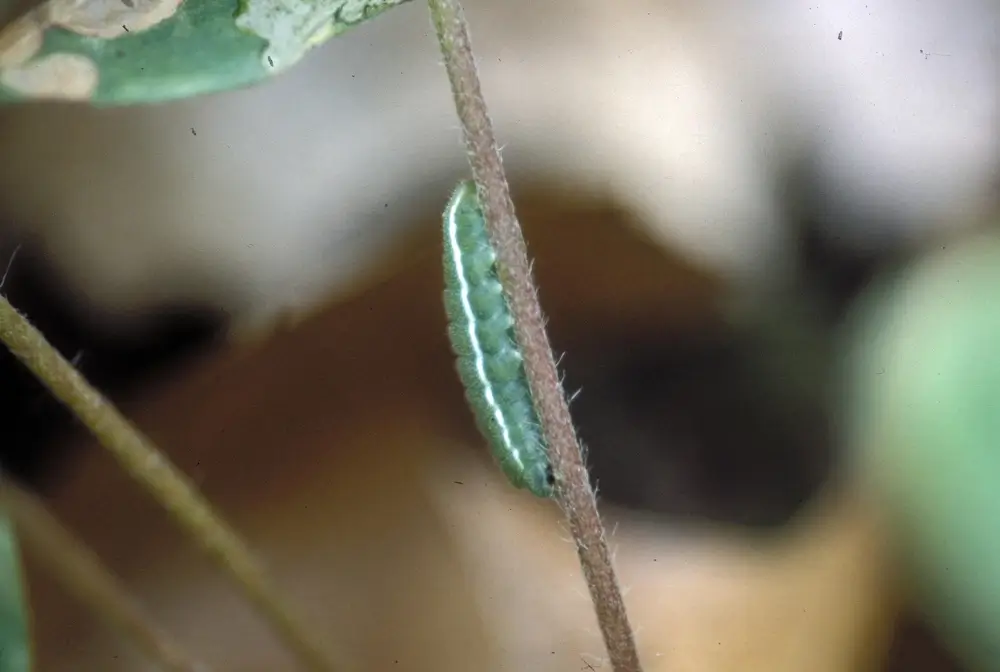
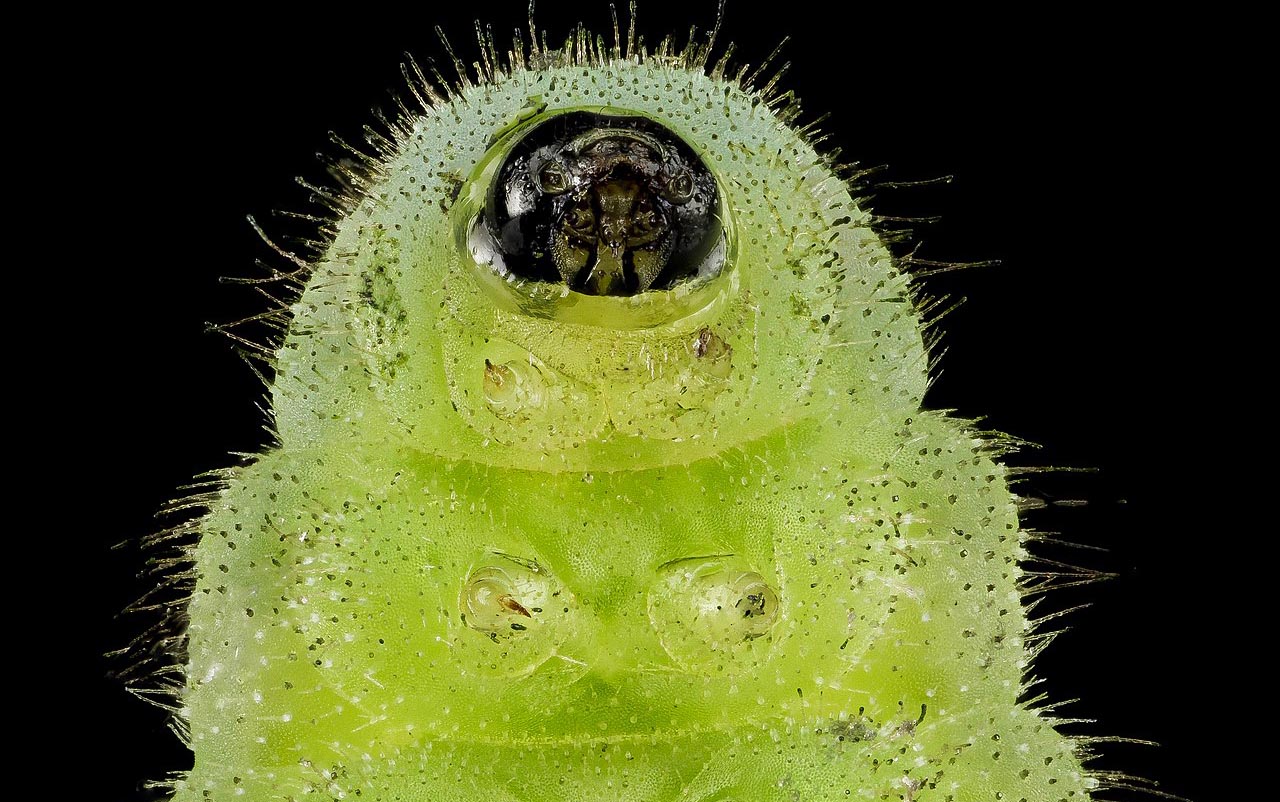
When the caterpillars hatch, they are tiny, less than a third of an inch or a few millimeters long. They crawl up the lupine plant and begin to eat the leaves. They eat the leaves of the blue lupine for three to four weeks and then form a chrysalis and pupate for 8-11 days.
During pupation, wings, antennae, and legs form, and the caterpillar’s mouth changes to a proboscis – the straw-like extension that butterflies use to suck nectar from flowers.
When the Karner butterfly emerges, it expands its wings and dries them for about 45 minutes. It then gathers nectar from wildflowers. Karner blue butterflies live for only a week or two.
During that time, they mate, and the females lay their eggs on a lupine plant. The eggs from the spring mating will hatch in the summer. This second group of Karner blue butterflies mates and lays their eggs on or near a blue lupine plant. These eggs remain dormant until the next spring, when they hatch, and the cycle begins anew.
Behavior
Karner blue butterflies depend on blue lupine, and blue lupine depends on pine barrens, but pine barrens are hard to find.
Pine barrens are flat with dry, sandy soil. The soil in pine barrens is very acidic. When settlers first came to New Hampshire, they didn’t have much use for the pine barrens. Because the land was so acidic, it wasn’t good for planting crops.
One of the plants in the pine barrens that the settlers did find a use for was the pitch pine (Pinus rigida). The pitch pine tree wasn’t good for wood like the white pine tree (Pinus strobus), but it was good for other things.
Settlers would tap the trees for their pitch. The pitch was used as a caulk, or it was boiled down to make turpentine, which in colonial times was used as a medicine. Colonists also used knots from the pitch pine for torches and the wood from the trees as fence posts. For the most part, the pitch pines in the pine barrens were left standing by the colonists.
The white pine tree, on the other hand, was cut down and its wood used for buildings, masts, and boat building. When the colonists cut down the white pine trees, they helped keep the pine barrens from being overrun by the stronger and faster-growing white pine. Fire and grazing animals also helped keep the pine barrens free of other trees. So, for a long time, the pine barrens were mostly left alone, but as time went on, the way people made a living changed, and the uses they had for the land changed.
People saw the flat pine barrens as good places to clear for houses, buildings, and roads. As more and more land was cleared for development, the blue lupine had fewer places to grow, and the Karner blue caterpillars had fewer blue lupine to eat.
Did You Know?
The Karner blue was named by novelist and lepidopterist (butterfly expert), Vladimir Nabokov.
Support for NatureWorks Redesign is provided by:
The Karner Blue Butterfly in NH
Karner blue butterflies are found in the Concord Pine Barrens in East Concord.
For a number of years, biologists have been releasing captive-bred Karner blues in the hopes that they will begin breeding in the wild.
The Karner blue butterfly is the state butterfly of New Hampshire.
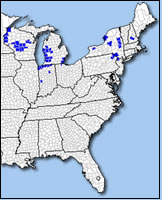
The Karner blue butterfly could once be found from Maine to Minnesota. Today, its population is limited to Illinois, Indiana, Michigan, Minnesota, New Hampshire, New York, Ohio, Wisconsin, and Ontario in Canada.