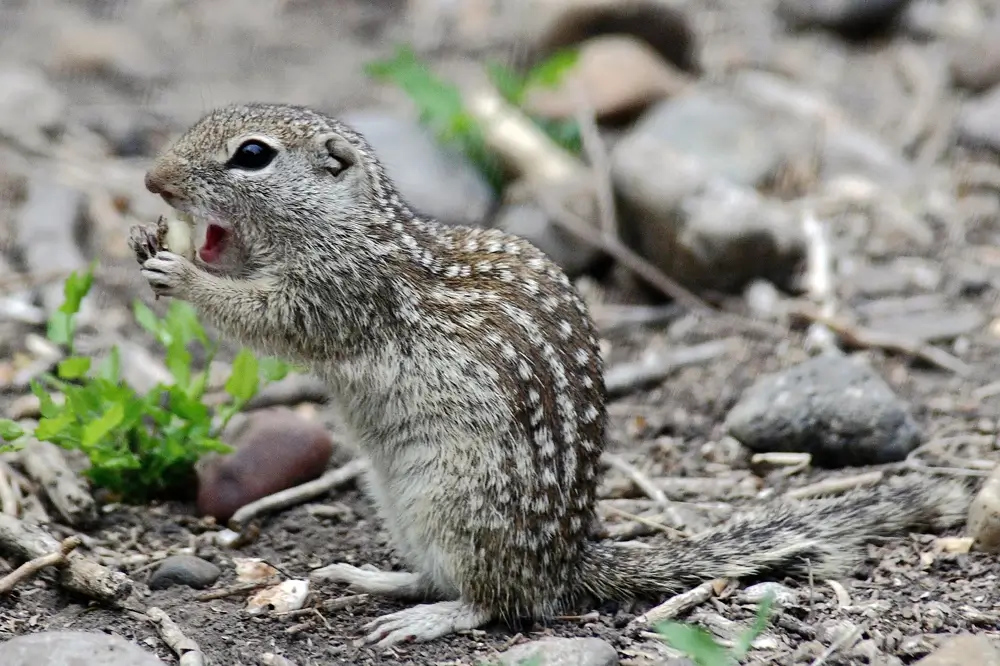
The Mexican ground squirrel is brown with nine rows of squarish white spots on its back. It has a white to cream belly; a long, flattened, somewhat bushy tail; a white circle of fur around its eyes, and small, rounded ears.
It is 11-15 inches (28-38 cm) in length and weighs 7.7-14 ounces (217-398 g). Males are larger than females.
Habitat
The Mexican ground squirrel lives in flat, brushy, or grassy areas and usually prefers areas with gravelly or sandy soil. It is often found in sandy and mesquite areas of savannas.
Diet
The Mexican ground squirrel is omnivorous and feeds during the day. Its diet includes seeds, nuts, grains, roots, bulbs, plant stems, leaves, mice, insects, and eggs. It often stores seeds, grains, and nuts in its cheek pouches and takes them back to its den to eat later.
In the spring, most of its diet is plant matter. In the summer, it eats insects. It also eats carrion or dead animals and is often seen eating roadkill on the highway.
Life Cycle
Breeding season is in March and early April. The gestation period is 23-28 days. The female Mexican ground squirrel prepares a nesting chamber in her burrow and lines it with mesquite and grass.
She gives birth to 1-10 young, although the average litter size is five. The young ground squirrels are toothless, naked, and blind at birth. They will stay with their mother for about three months.
If it can avoid predators like hawks, foxes, coyotes, badgers, and snakes, the Mexican ground squirrel has a lifespan of 2-4 years in the wild.
Behavior
Except for during the breeding season and when raising young, the Mexican ground squirrel is a solitary creature. While it is solitary, it may live in a colony burrow system. Each squirrel has more than one burrow, and each burrow has two entrances. The entrances are difficult to locate, and they are unmarked by dirt piles.
The Mexican ground squirrel may hibernate in the northern part of its range.
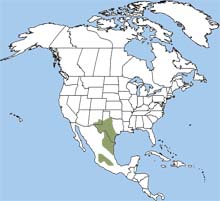
The Mexican ground squirrel can be found from Northern Mexico north along the Gulf coast of Texas and into western and central Texas and southeastern New Mexico.