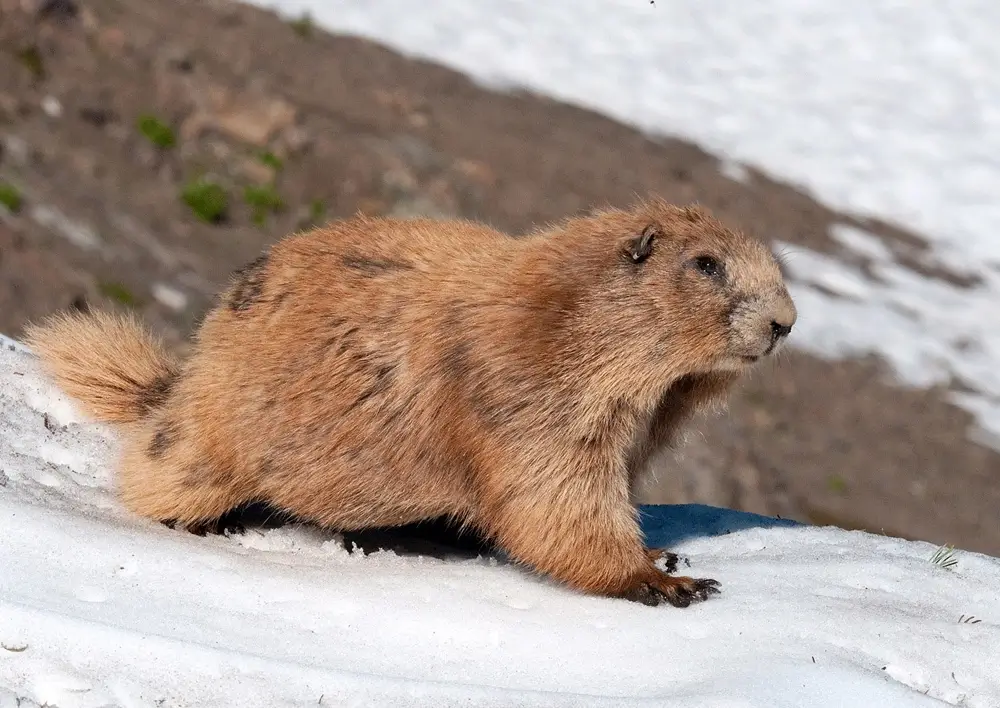
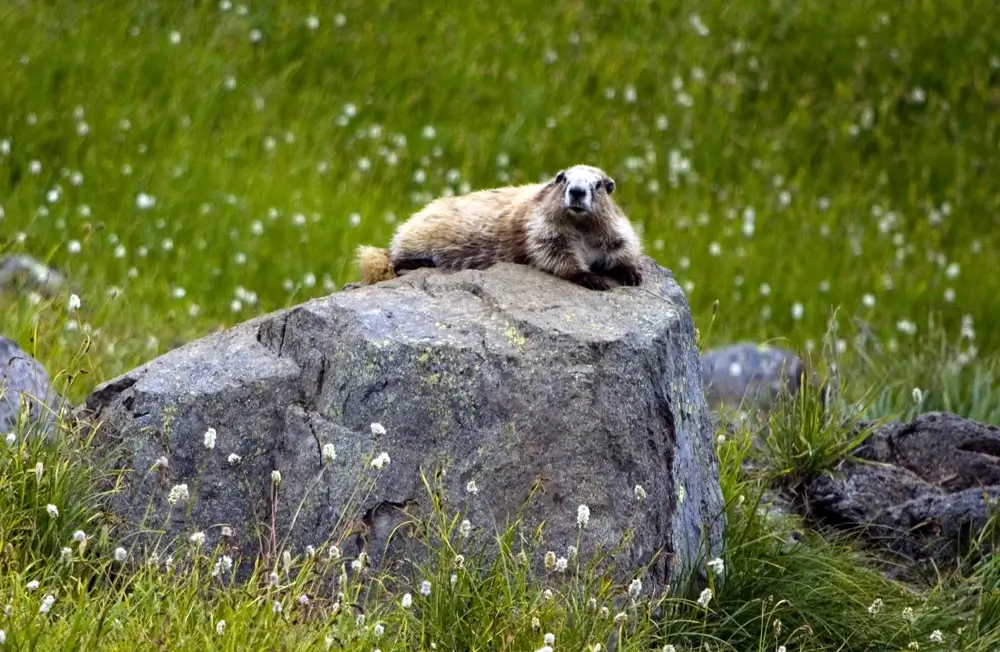
The Olympic marmot has brown fur mixed with white. Patches of its fur may turn light brown in the summer. It has a white muzzle, small ears and eyes, a bushy tail, and short legs. The Olympic marmot has sharp claws that it uses for digging.
Olympic marmots are around the size of a house cat. They are 26-30 inches in length (66-76 cm) and weigh 6-24 pounds (2.7-11 kg). Males are larger than females.
Habitat
The Olympic marmot is found on rocky mountain slopes and hillsides and in alpine meadows.
Diet
The Olympic marmot eats a variety of grasses, flowers, including sedges, lupines, mosses, lilies, and heather blossoms. Occasionally, it eats insects.
It hibernates from September through May. After it comes out of hibernation, roots make up a large part of its diet until new plants bloom.
Life Cycle
The Olympic marmot mates a couple of weeks after it comes out of hibernation. About a month after mating, the female gives birth to four to five babies. Baby marmots are called pups.
Pups stay with their family group for at least two years. Female Olympic marmots usually have a litter every other year. Olympic marmots have an average lifespan of 2-6 years in the wild.
Behavior
The Olympic marmot is active during the day. It feeds in the morning and afternoon. When it is not feeding, it spends its time sunning itself on rocks. It retreats to its burrow at night.
The Olympic marmot is very social. It lives in family groups made up of one male, two or three females, a litter of year-old marmots, and a new litter. Males mate with one female one year and another female the next year.
Family members greet each other by touching their noses. They also groom each other.