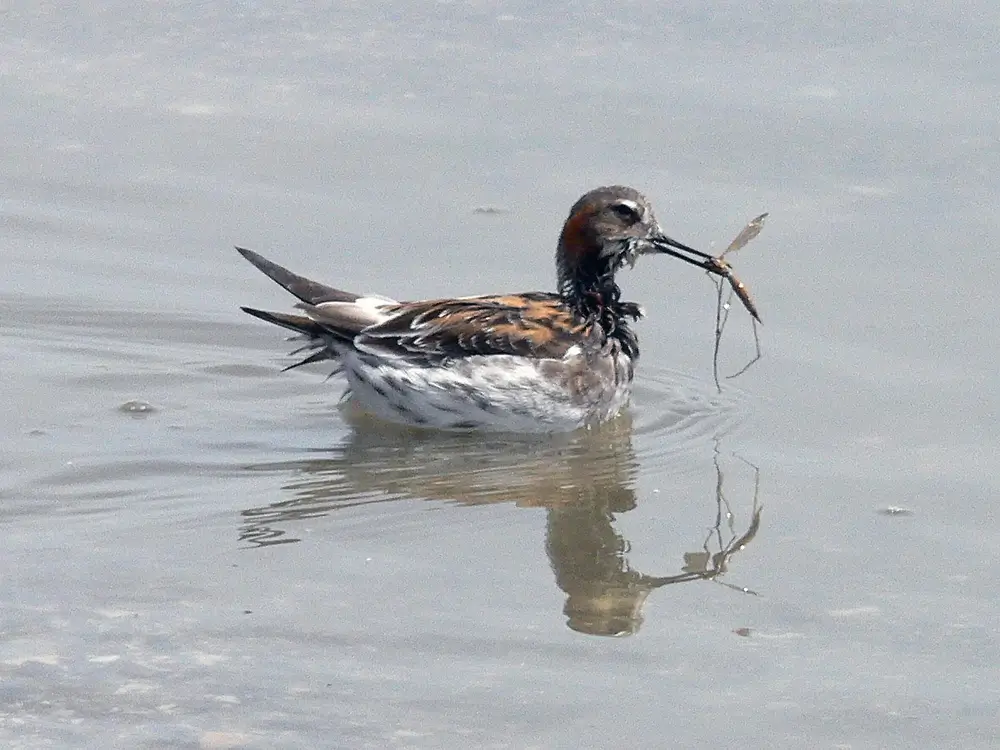
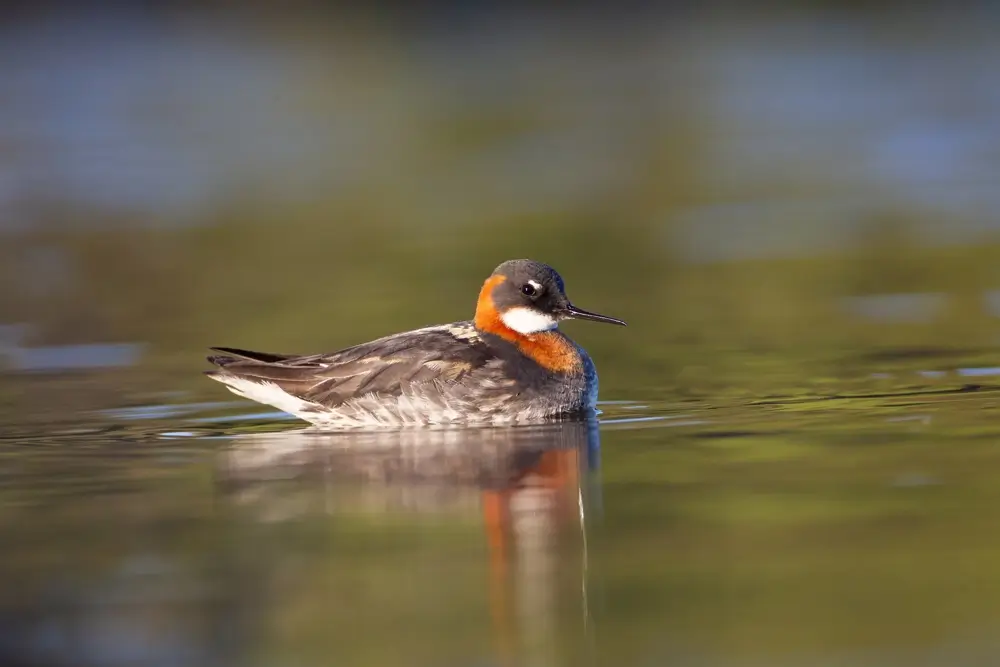
The red-necked phalarope is a small shorebird that spends most of its time on the open ocean. The red-necked phalarope is the smallest species of phalarope. It is 7-8 inches (18-20 cm) in length with a 12.6-16.1 inch (32-41 cm) wingspan.
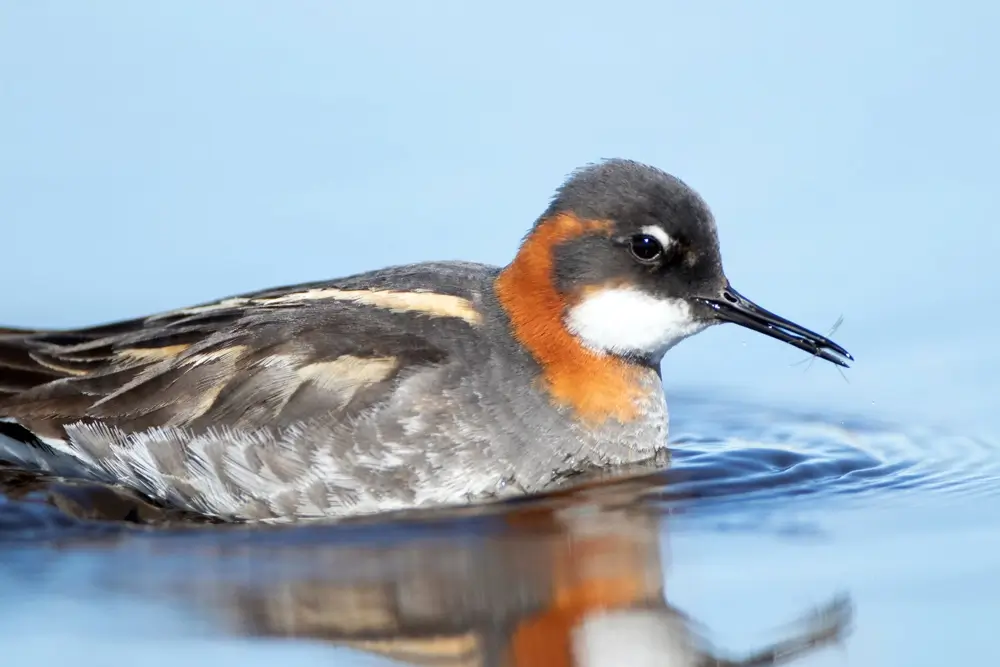
It has a long, pointed black bill and long, black legs with lobed toes. During the breeding season, the female has a gray breast. Her back is dark gray and streaked with brown. She has a dark gray head, a white spot above her eyes, a dark red neck, and a white chin.
The male has similar coloring, but he is a little duller in color and has a white line over his eyes.
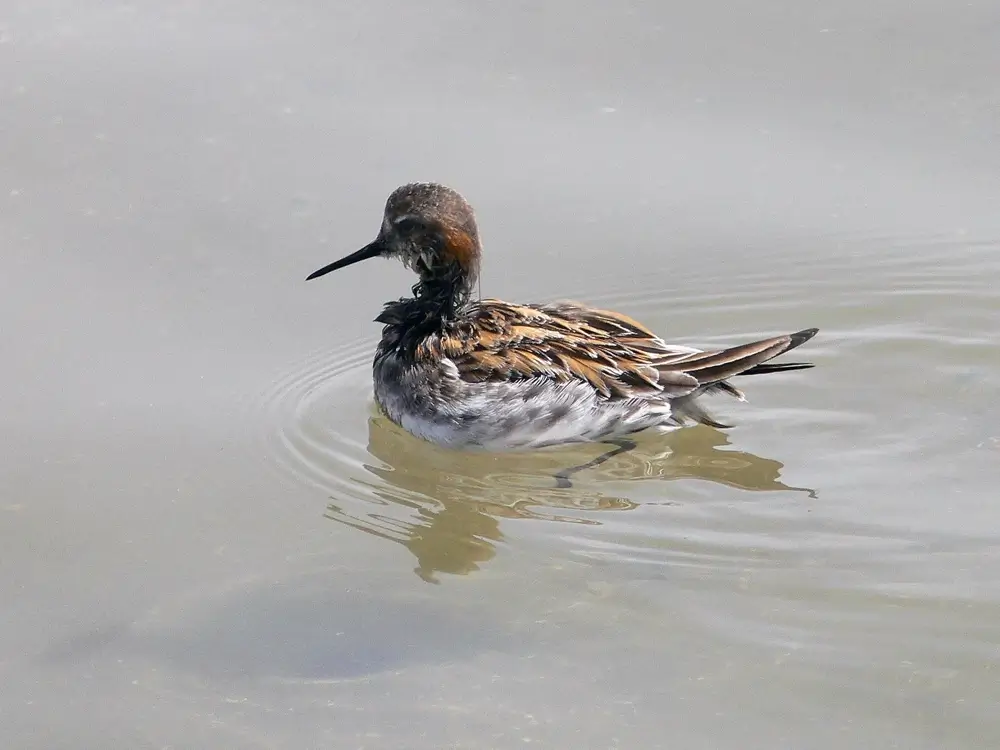
In the non-breeding season, the red-necked phalarope is gray on its back and white on its belly. It has a white head and dark patches on the side of its face.
Habitat
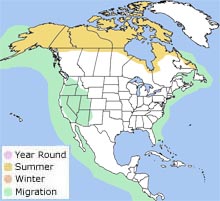
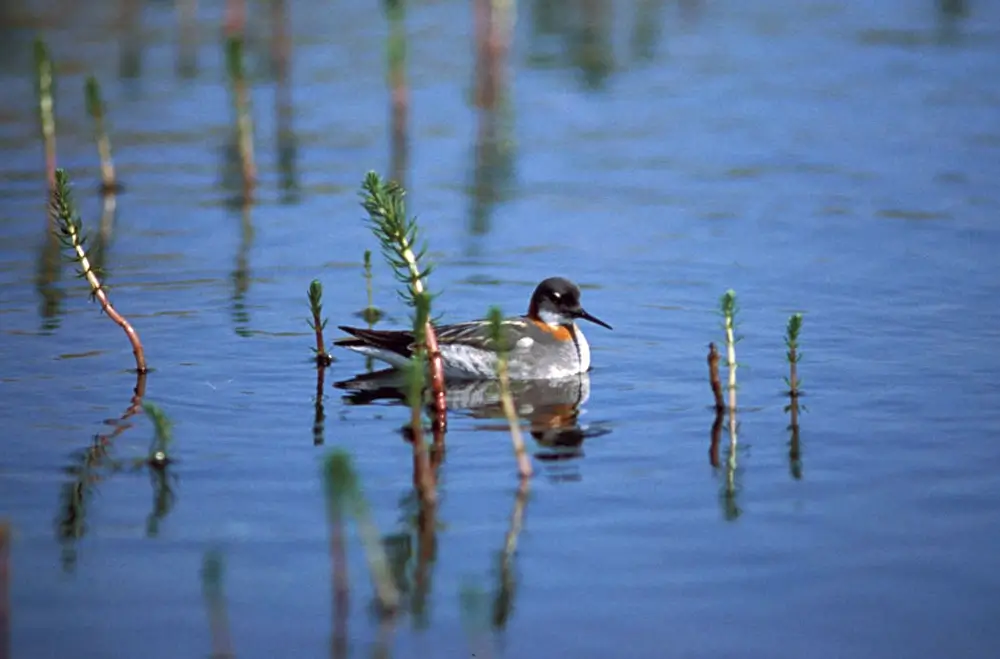
The red-necked phalarope breeds on tundra ponds. During migration, it is found on marshes, shores, and lakes. In the winter, it is found on the open ocean off the coast of South America.
Diet
During the breeding season, the red-necked phalarope eats insects, crustaceans, and mollusks. The red-necked phalarope isn’t built for diving, so on the ocean it skims zooplankton, small crustaceans, and small mollusks off the surface of the water.
It is often found in areas where ocean currents meet and create an upswelling of water that brings food to the surface.
Like the red phalarope, it also swims in circles to create whirlpools to bring food up to the water’s surface.
Life Cycle
Like the red phalarope, the male and female red-necked phalarope switch traditional roles during the breeding season.
The female red-necked phalarope arrives at the breeding grounds first and establishes a breeding territory. She tries to attract a mate with a display flight. Both the male and the female create a scrape in the ground. The female picks the best one.
The scrape is lined with lichen, moss, and grass. The female lays four eggs and then leaves. Sometimes she even tries to attract another mate and may have a second brood.
The male incubates the eggs for 17-21 days and then cares for the chicks. The chicks are precocial and leave the nest and feed themselves shortly after hatching. The male stays with the chicks until they are two weeks old. The chicks fledge when they are 16-18 days old.
Behavior
The red-necked phalarope is a solitary bird in the winter, but in the summer it gathers in large flocks.
Did You Know?
Support for NatureWorks is provided by:
The Red-Necked Phalarope in NH
The red-necked phalarope does not breed in New Hampshire, but it can be seen in the state during its migration.