The royal tern is a large, slender tern. It is 18-20 inches (45-50 cm) in length with a wingspan of 49-52 inches (125-135 cm).
It has a long, sharp, orange-red bill; black legs and feet; and a short, forked tail. It has a black cap with a shaggy, black crest, a slate-gray back and wings, and a white breast and belly.
In the non-breeding season, it has a white forehead. Males and females look alike.
Habitat
The royal tern is found on sandy beaches, harbors, estuaries, and waters near the coast.
Diet
The royal tern plunges into the water and catches small fish and shrimp.
Life Cycle
The royal tern nests in large, dense colonies. The female usually lays just one egg in an unlined scrape on the ground.
Both the male and the female incubate the egg for 30-31 days. Shortly after hatching, the chick joins a crèche (group) of other chicks on the beach.
The chick’s parents recognize their chick by its voice. They feed it regurgitated food. The parents continue to feed and care for the chick until it fledges at 28-30 days old.
The royal tern has a lifespan of 20-30 years.
Behavior
Male and female royal tern pairs defecate (poop) on the rim of their nest. Royal tern eggs are often swept out to sea by the surf, and defecating on the rim of the nest hardens the edge of the nest and may protect the egg.
Did You Know?
Support for NatureWorks Redesign is provided by:
The Royal Tern in NH
The royal tern does not breed in New Hampshire, but it may be seen as a vagrant in the state.
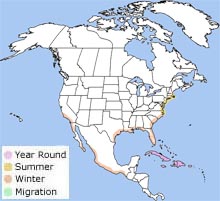
The royal tern breeds along the Atlantic Coast from Maryland to Florida, and along the Gulf Coast to northern Mexico. It sometimes wanders further north. It also breeds in southern California and western Mexico.
It winters on the Pacific Coast from southern California to Peru, and along the Atlantic and Gulf coasts from North Carolina southward to northern South America and throughout the Caribbean.
It is also found along the coast of western Africa.