


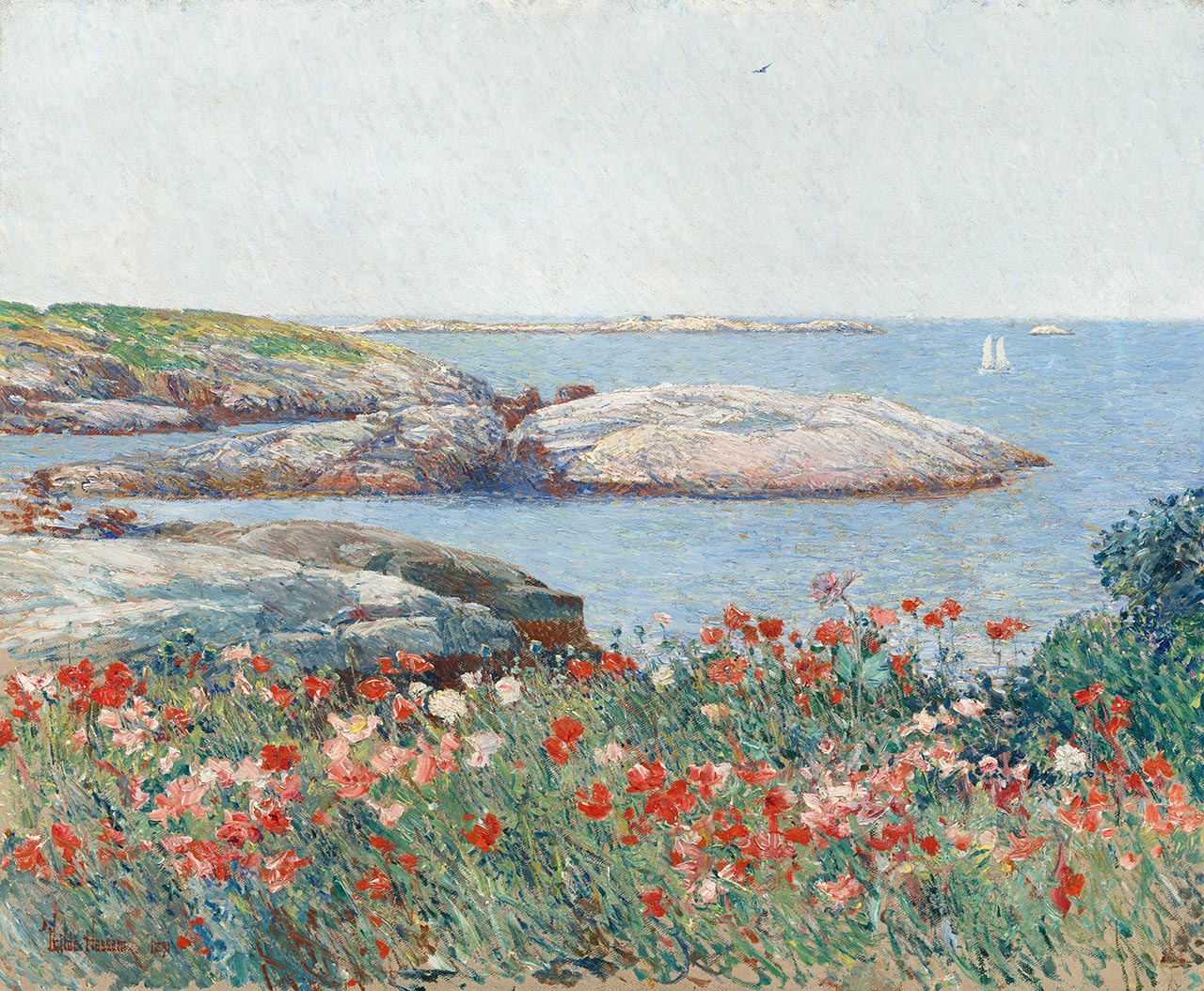
Poppies, Isles of Shoals 1891, Childe Hassam
The Isles of Shoals are a small group of rocky islands located in the Atlantic Ocean off the coasts of New Hampshire and Maine. The islands are known for their beautiful scenery, historic buildings, and rich fishing history. Long ago, fishermen used the islands as a base for catching cod and other fish.
A fishing and trading outpost was established on Londoner’s (currently Lunging) Island between 1615 and 1620.
The first recorded landing on the Isles of Shoals was by Christopher Levett in 1623. He wrote about the Isles:
“Upon these islands I neither could see one good timber tree, or so much good ground as to make a garden.”

Fisherman, Isles of Shoals Fisherman, Isle of Shoals, 1903, Childe Hassam
The name Isles of Shoals probably originated from the large schools or “shoals” of fish that the early settlers found in the waters around the islands.
By the mid 1600s, some 600 people were living on the Isles of Shoals. Most of them lived on Hog (Appledore) and Smuttynose Island. They made their living fishing. The people who lived on the islands were very independent.
In fact, when Massachusetts tried to tax the people living on Hog Island, which was in Maine, many families took apart their houses, loaded them on boats, and rowed over to Star Island in New Hampshire, where they formed the town of Gosport.
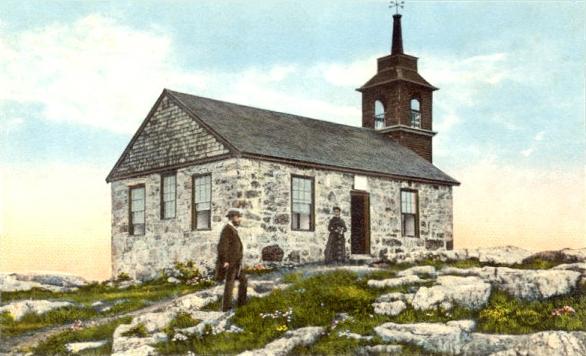
Gosport Chapel, Star Island, Isles of Shoals, New Hampshire, 1905
In 1778, New Hampshire ordered the people living in Gosport to the mainland. There was fear that during the Revolutionary War, the independent islanders might aid the British.
After the war, some residents returned to the islands, but the population never returned to its pre-war numbers. In 1870, the people remaining in Gosport were bought out by hotel interests and moved off the island.
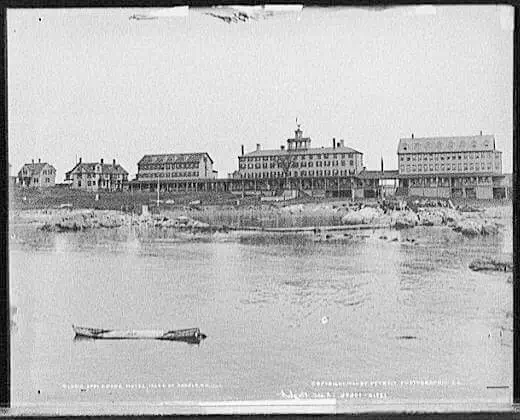
In the 19th and early 20th century, grand hotels were built on Appledore, Smuttynose, and Star Island.
In the 19th and early 20th century, grand hotels were built on Appledore, Smuttynose, and Star Island. Railroads allowed vacationers to escape the summer heat in Boston and other large cities and relax on the seacoast. Today, the Oceanic Hotel on Star Island is still standing and is used as a conference center.
