

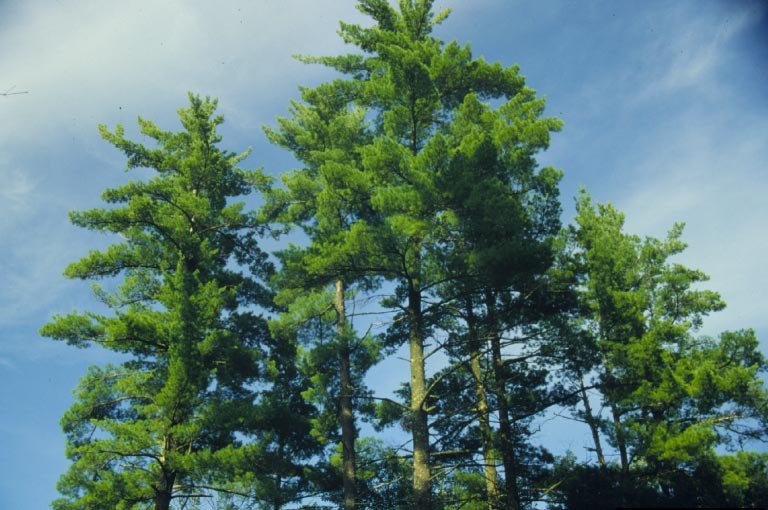
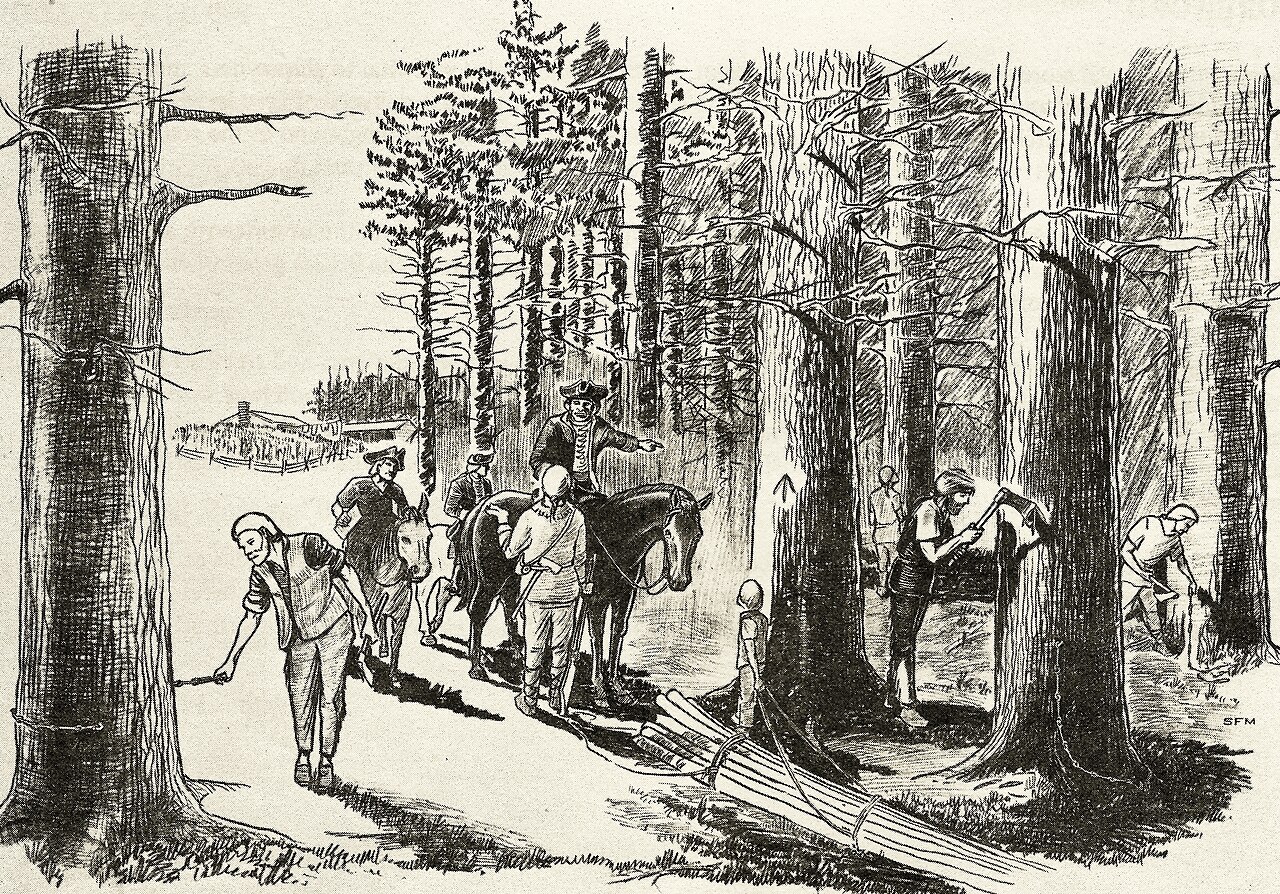
Marking trees witht he King's Broad Arrow.
England depended on the American colonies for lumber because it no longer had many large forests of its own. Over time, most of England’s forests had been cut down to make farmland. England used to acquire a type of tree called Scotch fir (Pinus sylvestris) from countries such as Russia and Sweden, but these supplies could be blocked during wars. Also, Scotch fir was not as strong as the white pine trees found in the colonies. Because of this, England looked to the colonies for a steady supply of strong wood to build ships for the Royal Navy.
White pine trees were especially valuable, so the king wanted to control them. Each winter, royal surveyors (officials sent by the king) traveled through the forests and marked the best trees with a symbol called the “King’s Broad Arrow.” This mark looked like three slanted lines forming an arrow.
Colonists were not allowed to cut down these marked trees for their own use. Instead, the trees were saved for the British government, especially for shipbuilding. Workers cut down the marked trees, removed the branches, and dragged the logs—often using oxen—to nearby rivers. When the ice melted in spring, the logs were floated downstream to the coast and then shipped out to be made into ship masts.
Many colonists were frustrated by these rules. They relied on trees to build homes, barns, and their own ships, and they didn’t like being told they couldn’t use the best ones. Some people even broke the law and cut down marked trees anyway. This conflict over natural resources was one example of the growing tensions between the colonies and Great Britain that eventually led to the American Revolution.
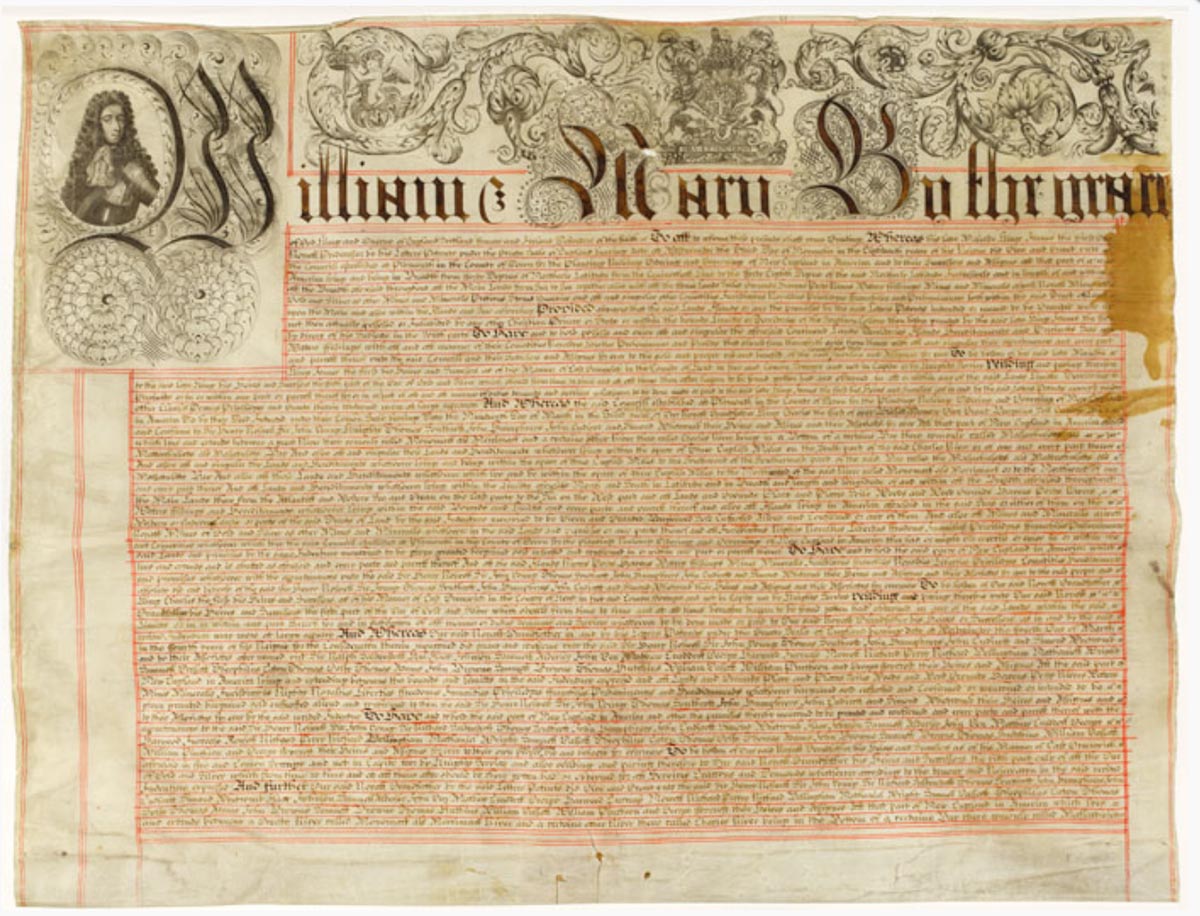
Massachusetts Bay Colony Charter, 1691
The preservation of trees for the mast trade was so important to England that it was even written into the Massachusetts Bay Charter of 1691.
New Hampshire was once connected to Massachusetts. Massachusetts governed the area between 1641 and 1643. In 1679, New Hampshire became a separate royal colony, but the British crown still named one governor to rule both colonies until 1741. That year, Benning Wentworth became the first independent governor of New Hampshire.
“For better providing and furnishing of Masts for our Royal Navy wee do hereby reserve to us Our Heires and Successors ALL trees of the diameter of 24 inches and upward of 12 inches from the ground, growing upon any soils or tracts of land within our said Province or Territory not heretofore granted to any private persons. We doe restrains forbid all persons whatsoever from felling, cutting or destroying any such trees without the the Royall Lycence from us Our Heires and Successors first had and obteyned vpon penalty of Forfeiting One Hundred Pounds sterling vnto Ous Our Heires and Successors for every such Tree soe felled cult or destroyed without such Lycence “
The Charter of Massachusetts Bay – 1691.
