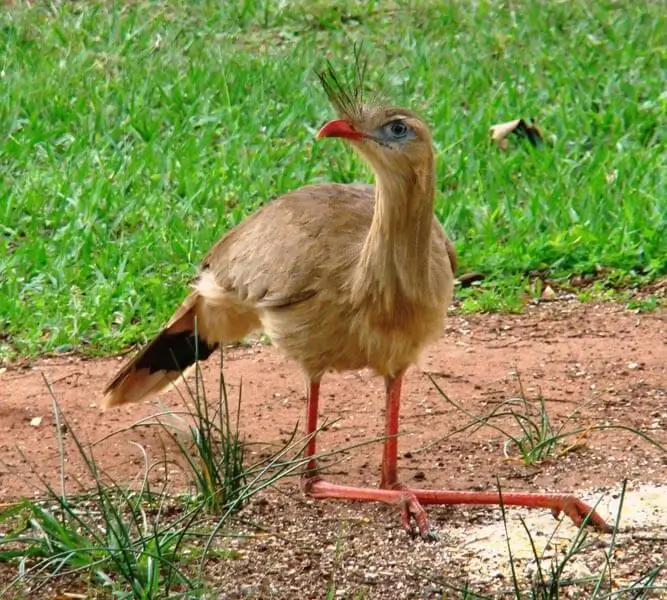
The order Cariamiformes includes a small group of ground-dwelling birds found in South America. Today, it has just one living family, Cariamidae, and two species: the red-legged seriema and the black-legged seriema. These birds are also related to extinct terror birds, which were large, flightless predators that lived millions of years ago.
Seriemas avoid dense forests and prefer open spaces where they can move quickly on the ground and spot prey easily.
These birds have long legs for running, upright bodies, and brownish feathers that help them blend into dry grass. Even though they can fly, they spend most of their time walking or running. They also have a special claw that helps catch and hold prey.
Seriemas are usually seen alone or in pairs. They are known for their loud calls that can be heard over long distances. They build nests in trees or bushes, but they hunt on the ground by chasing prey and sometimes hitting it against the ground to kill it.
They eat a varied diet, including insects, small mammals, frogs, and reptiles, and sometimes bird eggs or small birds. This makes them flexible hunters in their environment.
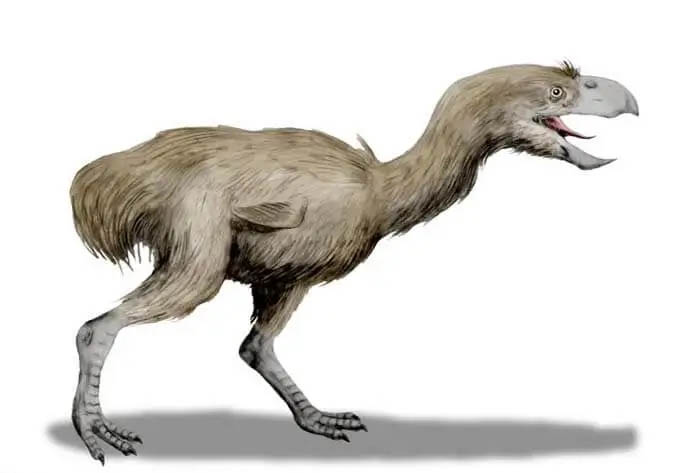
Terror birds were a group of extinct, large, flightless birds that were related to today’s seriemas in the order Cariamiformes. They lived mainly in South America millions of years ago, and some later spread into North America. They went extinct about 1.8 million years ago.
Unlike modern seriemas, terror birds were much bigger. Some were over 6 feet (1.8 m) tall. They could not fly, but they had strong legs for running, large heads, and powerful hooked beaks.
Terror birds were likely top predators in their environments. They hunted small to medium animals, including early mammals, and used their strong beaks to grab and kill prey.
Over time, as new predators such as large mammals appeared, terror birds disappeared. Today, their closest living relatives are the much smaller seriemas.
FAMILIES
Cariamidae (seriemas)
Phorusrhacidae (terror birds)