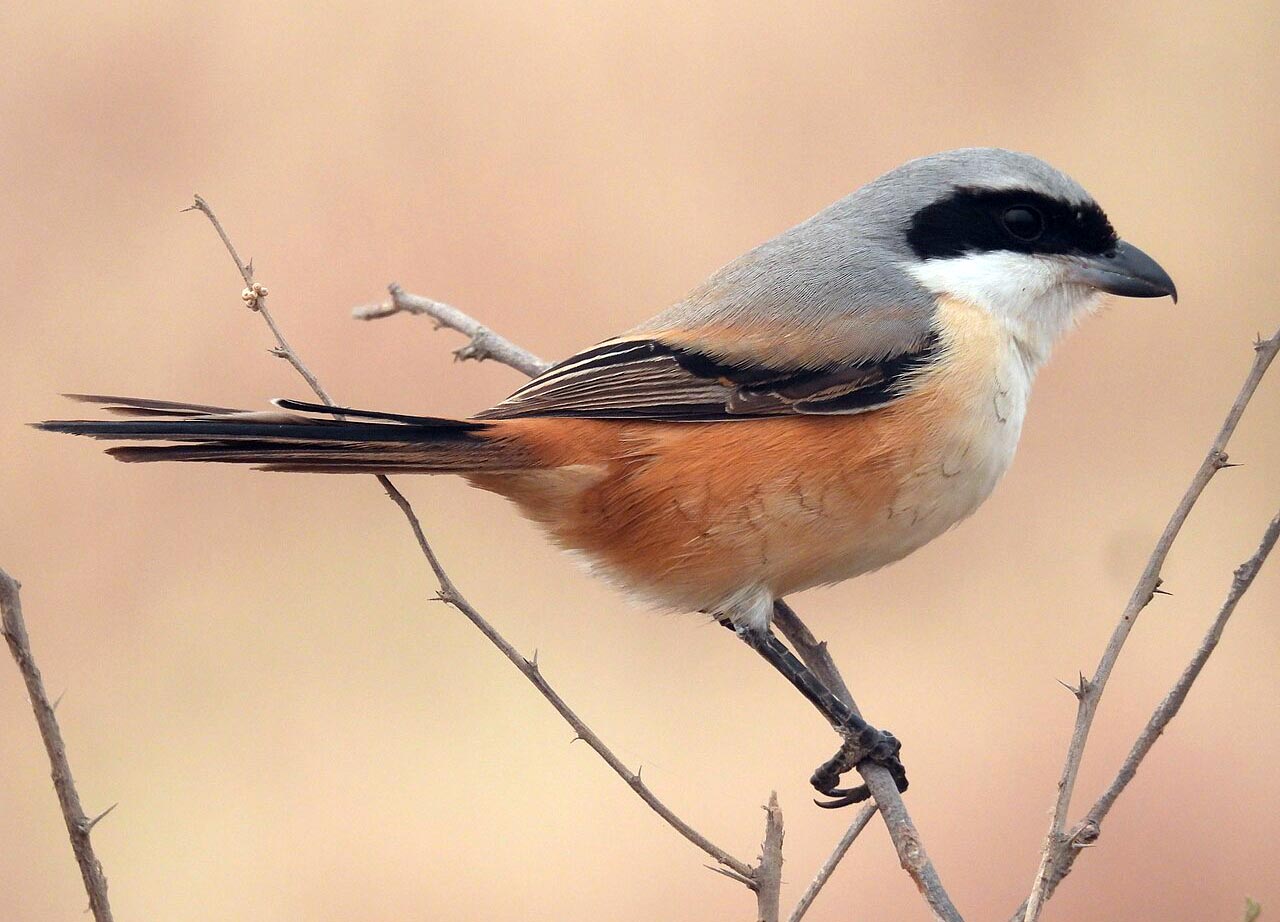
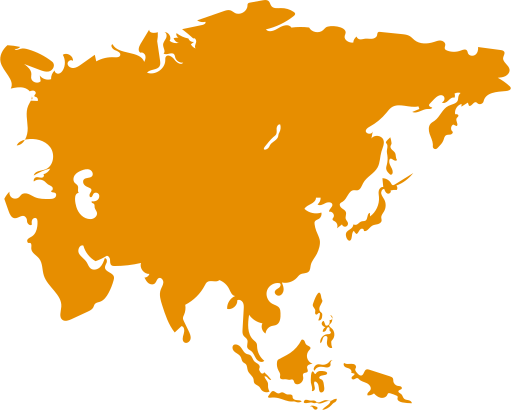
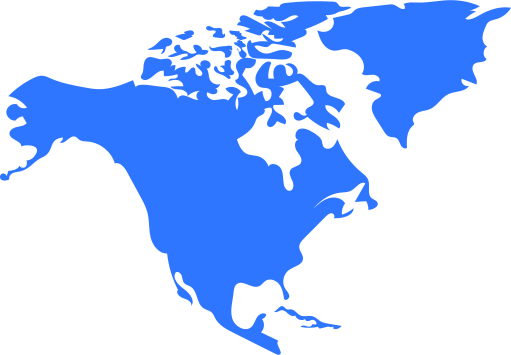
There are around 33 bird species in this family. Shrikes are found in Europe, Asia, Africa, and North America. They are not found in South America or Australia, although one species, the Long-tailed Shrike (Lanius schach), occurs on the island of New Guinea.
Shrikes range from about 6 to 14 inches (15.2–35.6 cm) in length. They have strong, slightly hooked bills and sharp claws. Most species have long, narrow tails. Their feathers are usually gray, brown, black, or a combination of these colors, with many species having paler feathers on their undersides.
Shrikes are predators that eat both vertebrates and invertebrates. Their diet can include large insects as well as small birds, mammals, reptiles, and amphibians. Their hooked bills are specially adapted for killing prey.
The family name Laniidae comes from Lanius, the Latin word for “butcher.” Shrikes are sometimes called “butcher birds” because of the unusual way they handle their prey. They often impale animals on thorns, sharp branches, or barbed wire. This allows them to tear apart larger prey and can also provide a food supply for later.
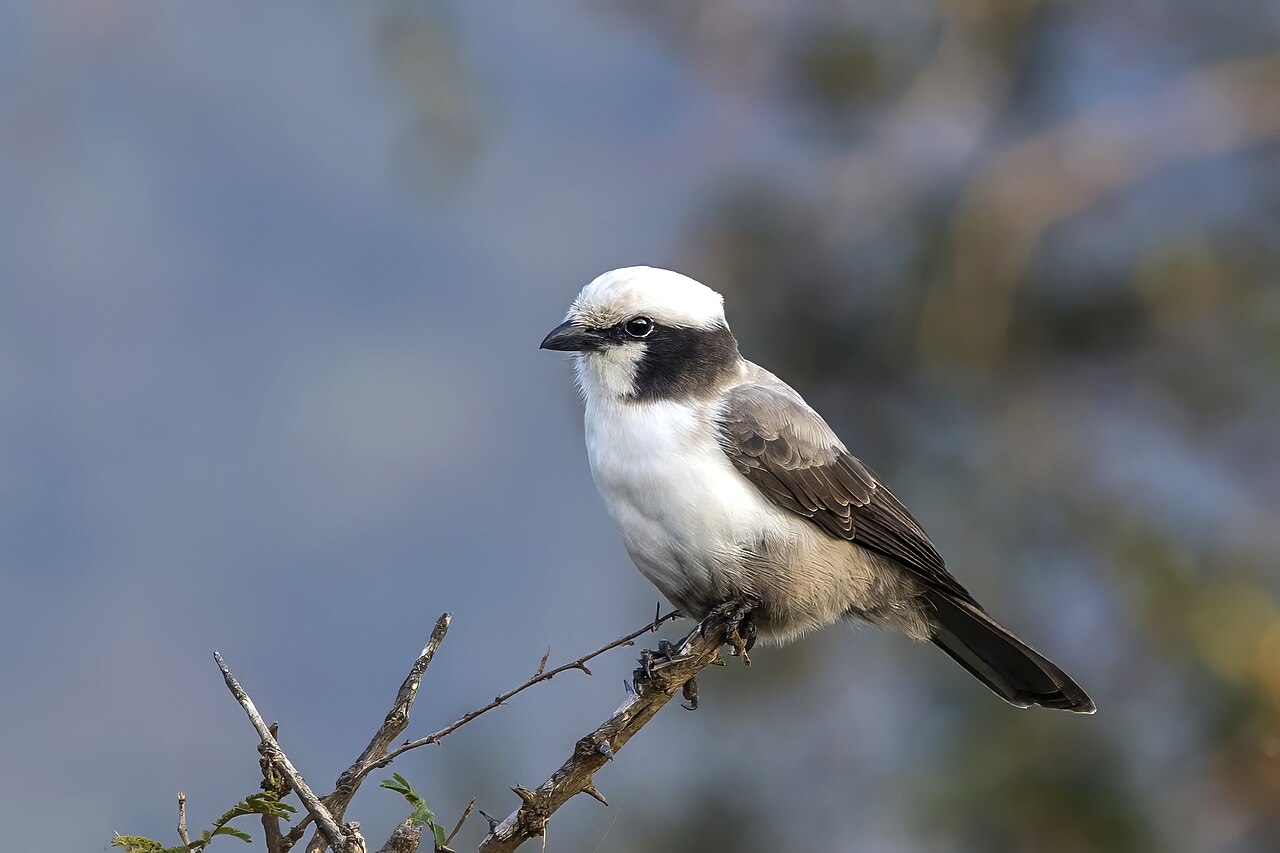
The Northern White-crowned Shrike is found in Ethiopia, Kenya, Somalia, South Sudan, Sudan, Tanzania, and Uganda. IUCN Redlist Status: Least Concern
Northern Gray Shrike (Lanius borealis)
The Northern Gray Shrike has a circumpolar range. It breeds in northern North America and Eurasia. In winter, it migrates south into Canada, the northern United States, including New Hampshire, and parts of Europe and Asia. IUCN Redlist Status: Least Concern
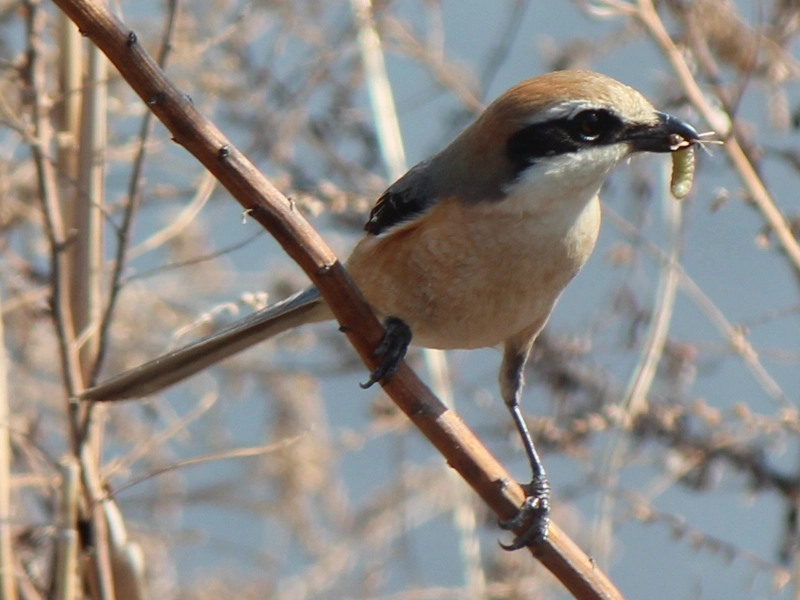
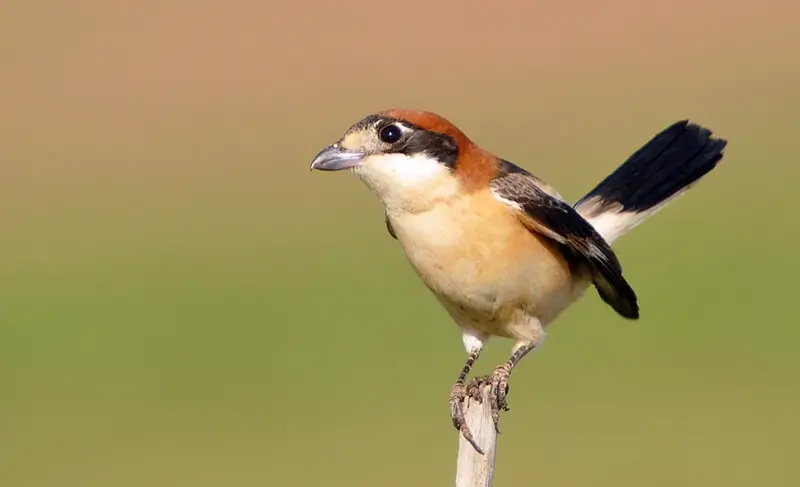
Bull-headed Shrike (Lanius bucephalus)
The Bull-headed Shrike is found in China, Japan, North and South Korea, and Russia. IUCN Redlist Status: Least Concern
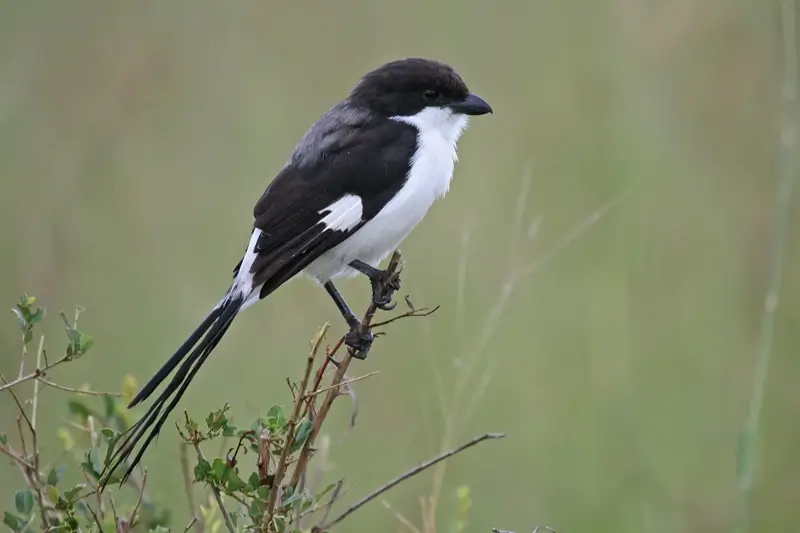
Long-tailed Fiscal (Lanius cabanisi)
The Long-tailed Fiscal is found in Kenya, Somalia, and Tanzania. IUCN Redlist Status: Least Concern
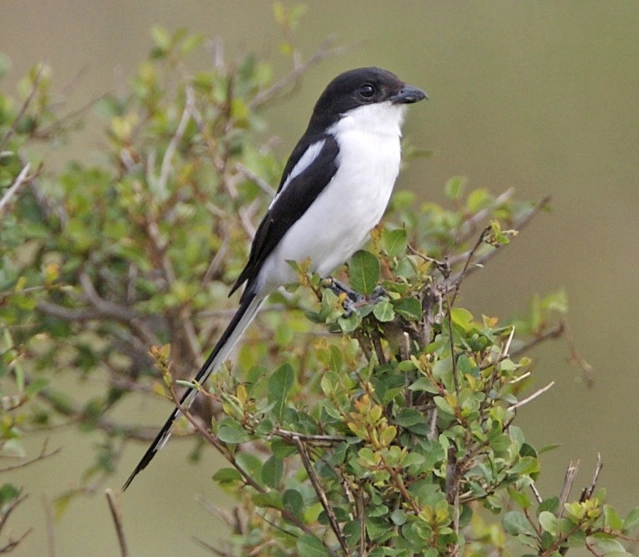
Common Fiscal (Lanius collaris)
The Common Fiscal is found across much of sub-Saharan Africa, from South Sudan and Ethiopia southward through eastern and southern Africa to South Africa. IUCN Redlist Status: Least Concern
Red-backed Shrike (Lanius collurio)
The Red-backed Shrike breeds across much of Europe and western Asia. It winters in Africa. IUCN Redlist Status: Least Concern
Burmese Shrike (Lanius collurioides)
The Burmese Shrike is found in Bangladesh, Cambodia, China, India, Laos, Myanmar, Thailand, and Viet Nam. IUCN Redlist Status: Least Concern
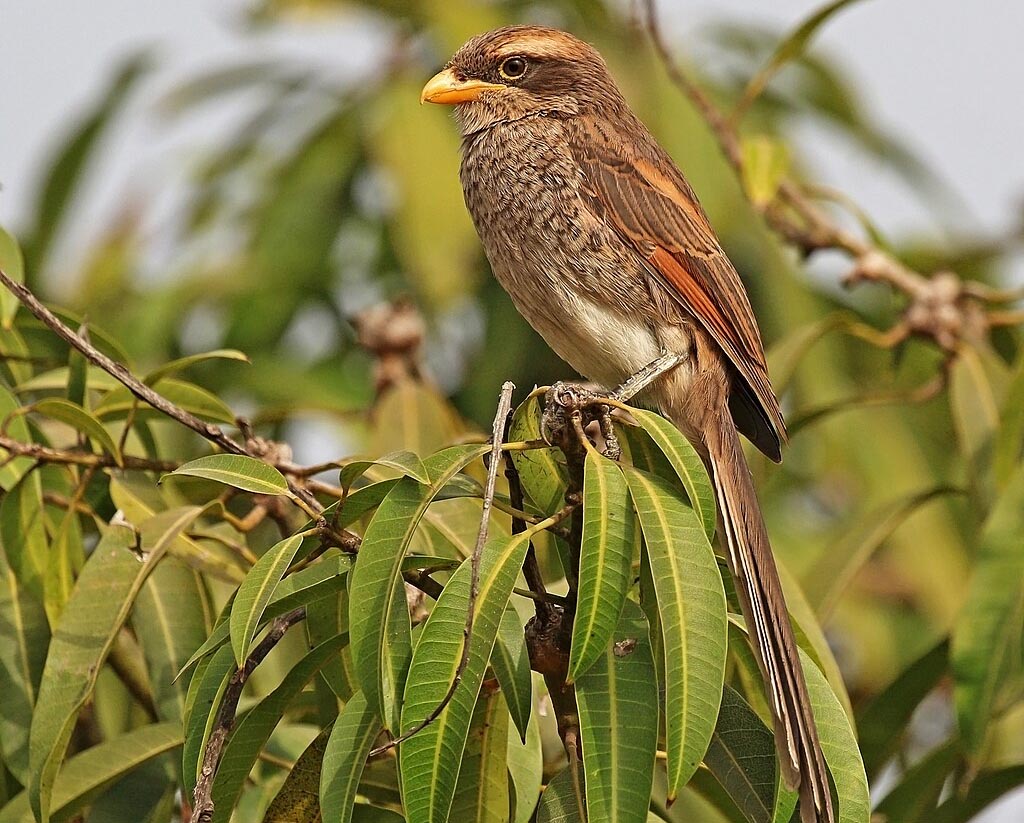
Yellow-billed Shrike (Lanius corvinus)
The Yellow-billed Shrike is found in Benin, Burkina Faso, Cameroon, Central African Republic, Chad, Congo, Côte d'Ivoire, Gambia, Ghana, Guinea, Guinea-Bissau, Kenya, Mali, Mauritania, Niger, Nigeria, Senegal, Sierra Leone, South Sudan, Sudan, Togo, and Uganda. IUCN Redlist Status: Least Concern
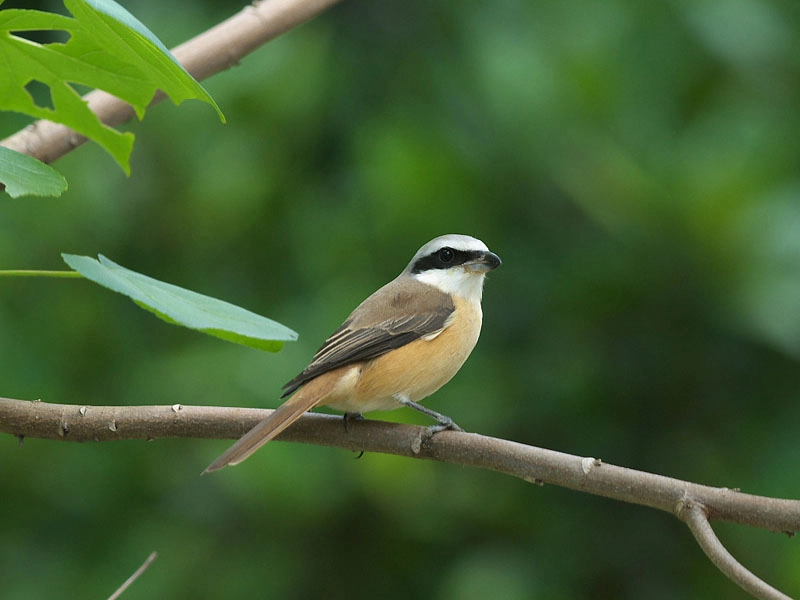
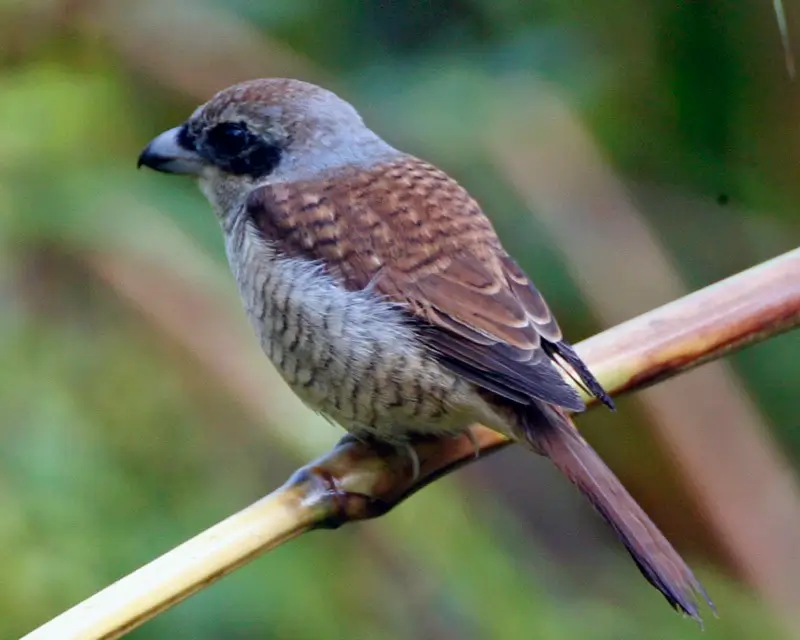
Brown Shrike (Lanius cristatus)
The Brown Shrike is found in Bangladesh, Bhutan, Brunei Darussalam, Cambodia, China, Hong Kong, India, Indonesia, Japan, Kazakhstan, North and South Korea, Laos, Malaysia, Mongolia, Myanmar, Nepal, the Philippines, Russia, Singapore, Sri Lanka, Taiwan, Thailand, and Vietnam. IUCN Redlist Status: Least Concern
Taita Fiscal (Lanius dorsalis)
The Taita Fiscal is found in Ethiopia, Kenya, Somalia, South Sudan, Sudan, Tanzania, and Uganda. IUCN Redlist Status: Least Concern
Great Gray Shrike (Lanius excubitor)
The Great Grey Shrike is found in Europe, Asia, and Africa. IUCN Redlist Status: Least Concern
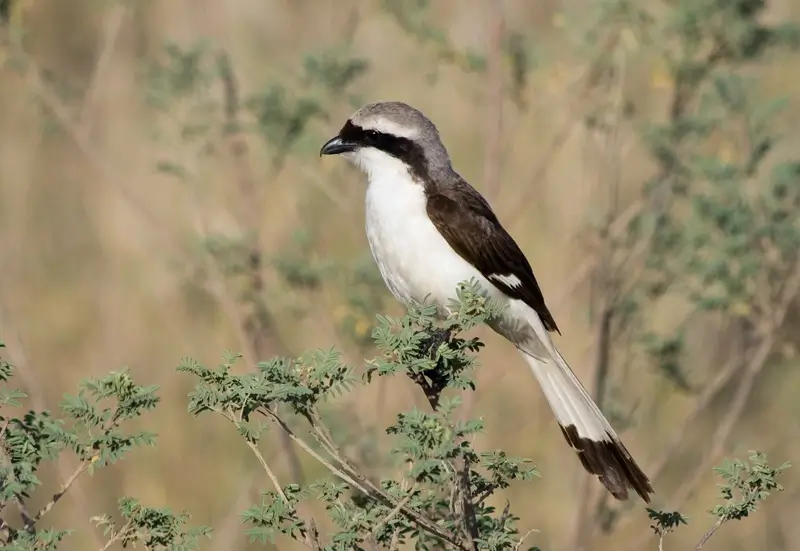
Gray-backed Fiscal (Lanius excubitoroides)
The Gray-backed Fiscal is found in Burundi, Cameroon, Central African Republic, Chad, Congo, Ethiopia, Kenya, Mali, Mauritania, Nigeria, Rwanda, South Sudan, Sudan, Tanzania, and Uganda. IUCN Redlist Status: Least Concern
Giant Gray Shrike (Lanius giganteus)
The Giant Gray Shrike is found in China. IUCN Redlist Status: Least Concern
Emin's Shrike (Lanius gubernator)
Emin's Shrike is found in Benin, Cameroon, Central African Republic, The Democratic Republic of the Congo, Côte d'Ivoire, Ghana, Mali, Nigeria, South Sudan, Sudan, and Uganda. IUCN Redlist Status: Least Concern
Isabelline Shrike (Lanius isabellinus)
The Isabelline Shrike breeds in Central Asia and parts of southern Siberia and Mongolia. It migrates south for the winter, when it can be found in Africa, the Middle East, India and Pakistan. IUCN Red List Status: Least Concern.
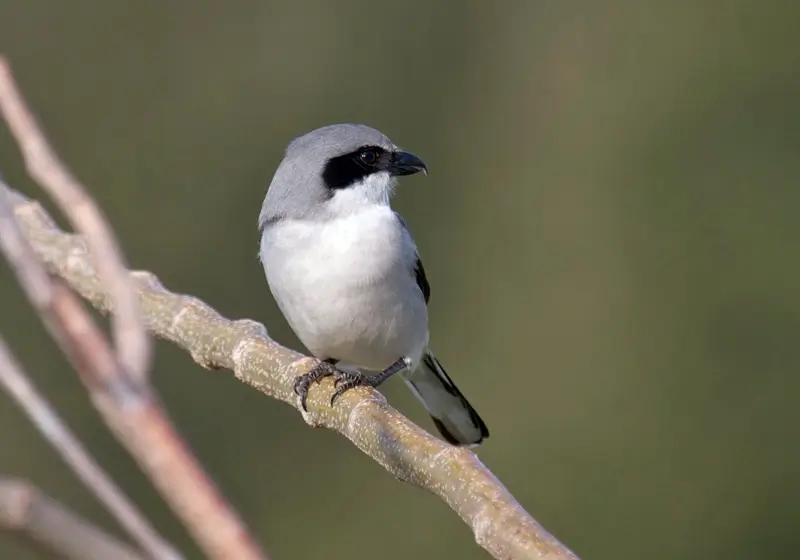
Loggerhead Shrike (Lanius ludovicianus)
The Loggerhead Shrike breeds across most of the U.S. except for the Northeast, Alaska, and Hawaii. It is also found in Canada and Mexico. IUCN Redlist Status: Near Threatened
Mackinnon's Shrike (Lanius mackinnoni)
Mackinnon's Shrike is found in Angola, Burundi, Cameroon, Congo, The Democratic Republic of the Congo, Equatorial Guinea, Gabon, Kenya, Nigeria, Rwanda, Tanzania, and Uganda. IUCN Redlist Status: Least Concern
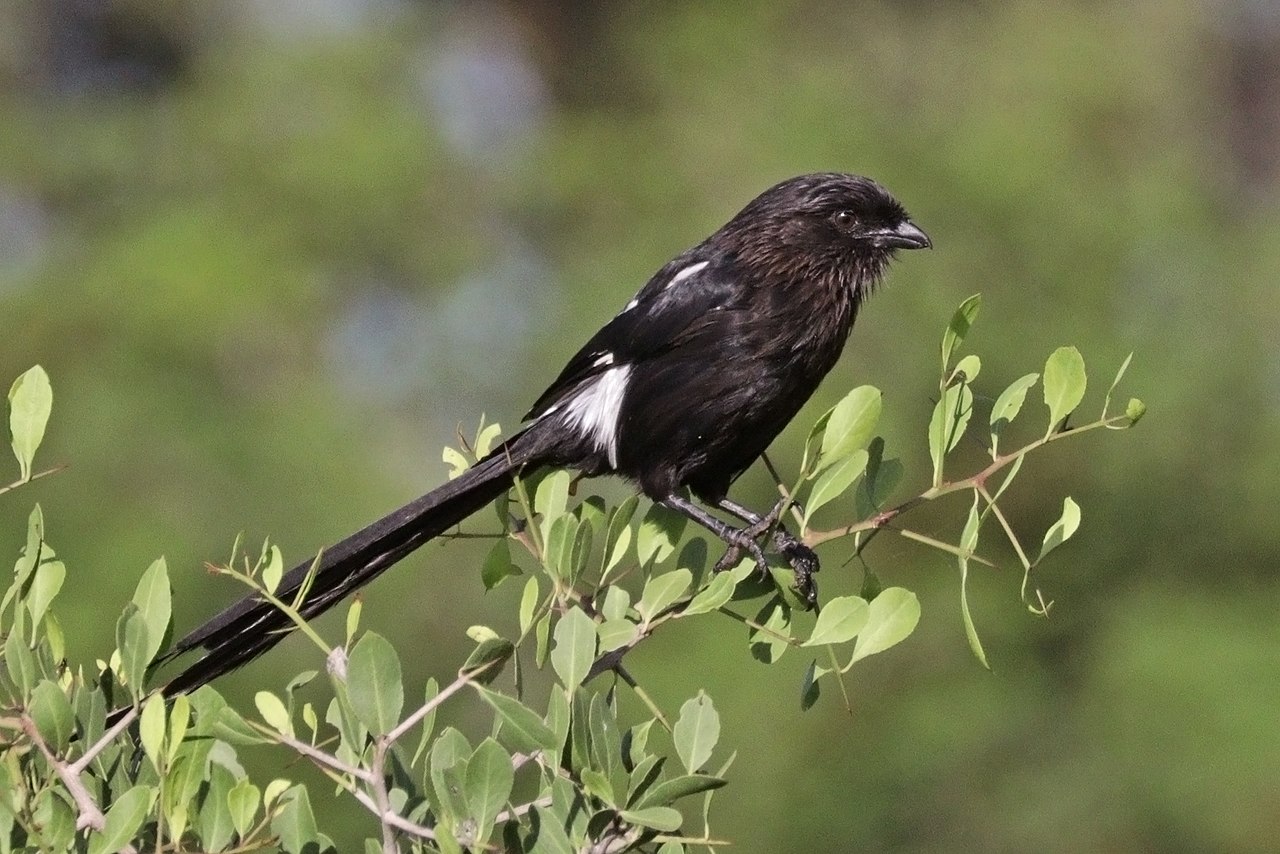
Magpie Shrike (Lanius melanoleucus)
The Magpie Shrike is found in Angola, Botswana, Kenya, Mozambique, Namibia, South Africa, Swaziland, Tanzania, Zambia, and Zimbabwe. IUCN Redlist Status: Least Concern
Iberian Gray Shrike (Lanius meridionalis)
The Iberian Gray Shrike is found in Andorra, France, Gibraltar, Portugal, and Spain. IUCN Redlist Status: Vulnerable
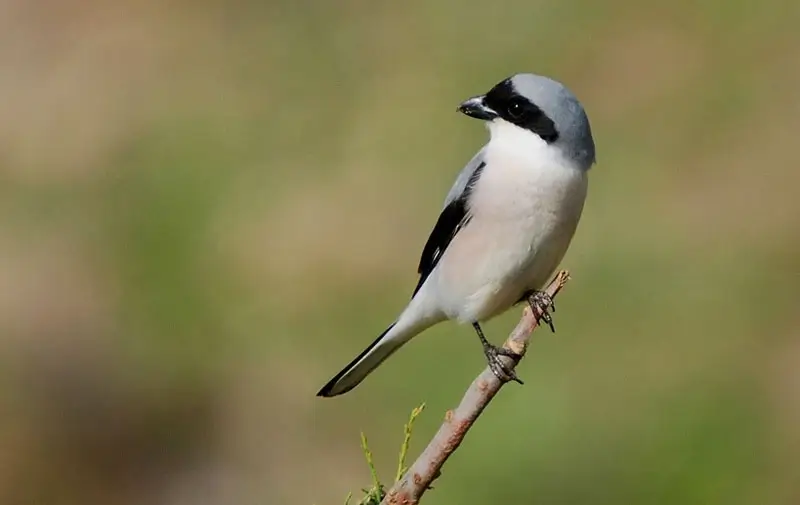
Lesser Gray Shrike (Lanius minor)
The Lesser Gray Shrike breeds in southeastern and central Europe and southwestern Asia. It winters in Africa. IUCN Redlist Status: Least Concern
Newton's Fiscal (Lanius newtoni)
Newton's Fiscal is only found on São Tomé Island in the Gulf of Guinea, off the west coast of Central Africa. It was once thought to be extinct. IUCN Redlist Status: Critically Endangered
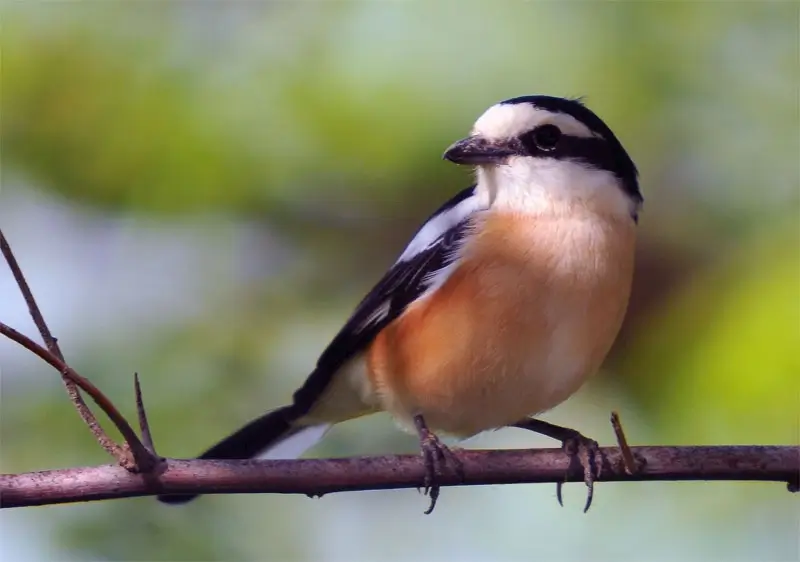
Masked Shrike (Lanius nubicus)
The Masked Shrike breeds along the eastern Mediterranean from Greece to Israel as well as in Iraq, Iran, and Türkiye. It winters in Africa. IUCN Redlist Status: Least Concern
Red-tailed Shrike (Lanius phoenicuroides)
The Red-tailed Shrike breeds across Central Asia, from the Caspian region eastward through Kazakhstan, Uzbekistan, Kyrgyzstan and parts of western China. It migrates south to East Africa, the Arabian Peninsula and the Indian subcontinent for winter. IUCN Redlist Status: Least Concern
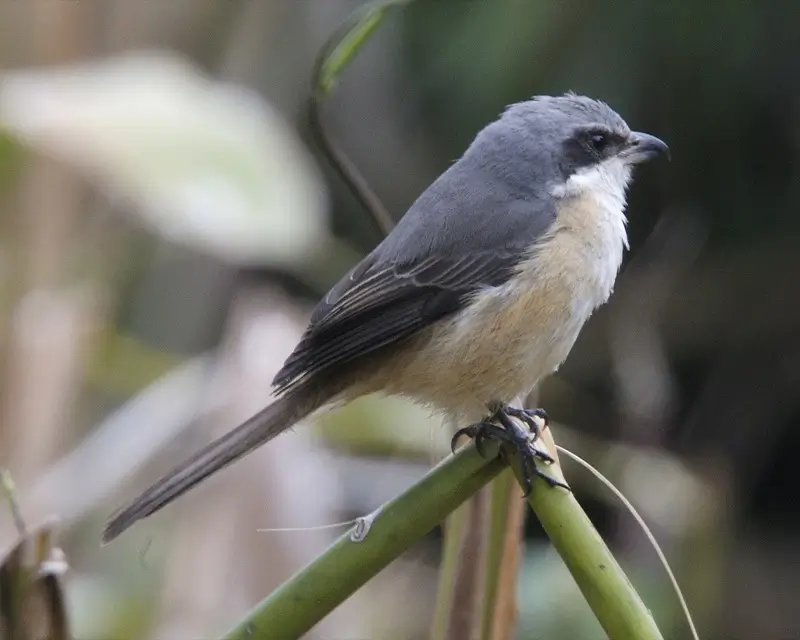
Long-tailed Shrike (Lanius schach)
The Long-tailed Shrike is found in Afghanistan, Bangladesh, Bhutan, Cambodia, China, India, Indonesia, Kazakhstan, Kyrgyzstan, Laos, Malaysia, Myanmar, Nepal, Oman, Pakistan, Papua New Guinea, the Philippines, Singapore, Sri Lanka, Taiwan, Tajikistan, Thailand, Timor-Leste, Turkmenistan, and Vietnam. IUCN Redlist Status: Least Concern
Woodchat Shrike (Lanius senator)
The Woodchat Shrike breeds in southern Europe, the Middle East, and along the Mediterranean and Black Sea. It winters in Africa. IUCN Redlist Status: Near Threatened
Somali Fiscal (Lanius somalicus)
The Somali Fiscal is found in Djibouti, Ethiopia, Kenya, Somalia, South Sudan, and Sudan. IUCN Redlist Status: Least Concern
Souza's Shrike (Lanius souzae)
Souza's Shrike is found in Namibia, Rwanda, Tanzania, and Zambia. IUCN Redlist Status: Least Concern
Chinese Gray Shrike (Lanius sphenocercus)
The Chinese Gray Shrike is found in China, Mongolia, North Korea, South Korea, and Russia. IUCN Redlist Status: Least Concern
Gray-Backed Shrike (Lanius tephronotus)
The Gray-backed Shrike is found in Bangladesh, Bhutan, Cambodia, China, India, Laos, Myanmar, Nepal, Thailand, and Vietnam. IUCN Redlist Status: Least Concern
Tiger Shrike (Lanius tigrinus)
The Tiger Shrike is found in Brunei Darussalam, Cambodia, China, Indonesia, Japan, North and South Korea, Laos, Malaysia, Myanmar, Russia, Singapore, Thailand, and Vietnam. IUCN Redlist Status: Least Concern
Mountain Shrike (Lanius validirostris)
The Mountain Shrike is found in the Philippines. IUCN Redlist Status: Least Concern
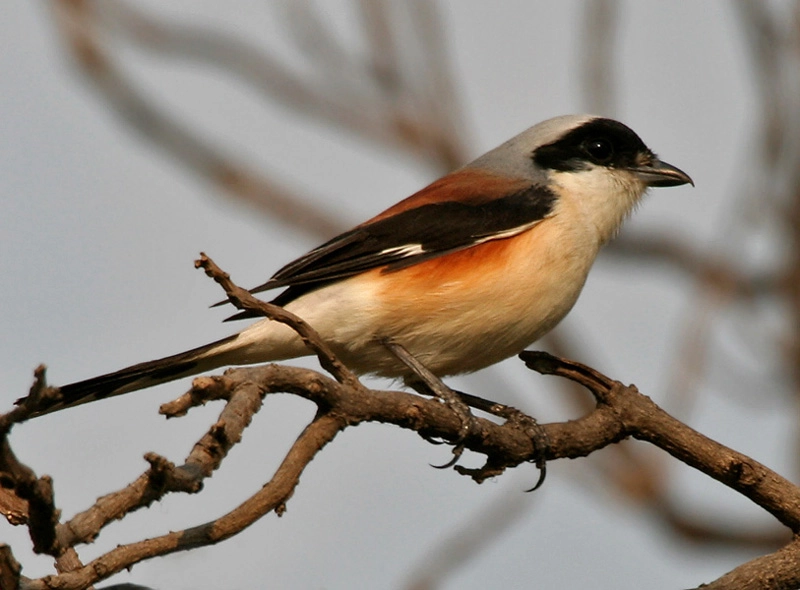
Bay-backed Shrike (Lanius vittatus)
The Bay-backed Shrike is found in Afghanistan, India, Iran, Nepal, Pakistan, Qatar, and Turkmenistan. IUCN Redlist Status: Least Concern