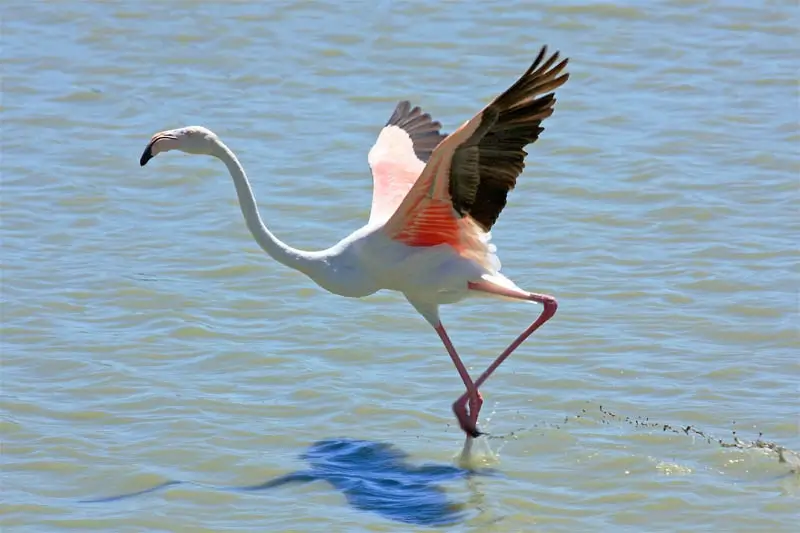
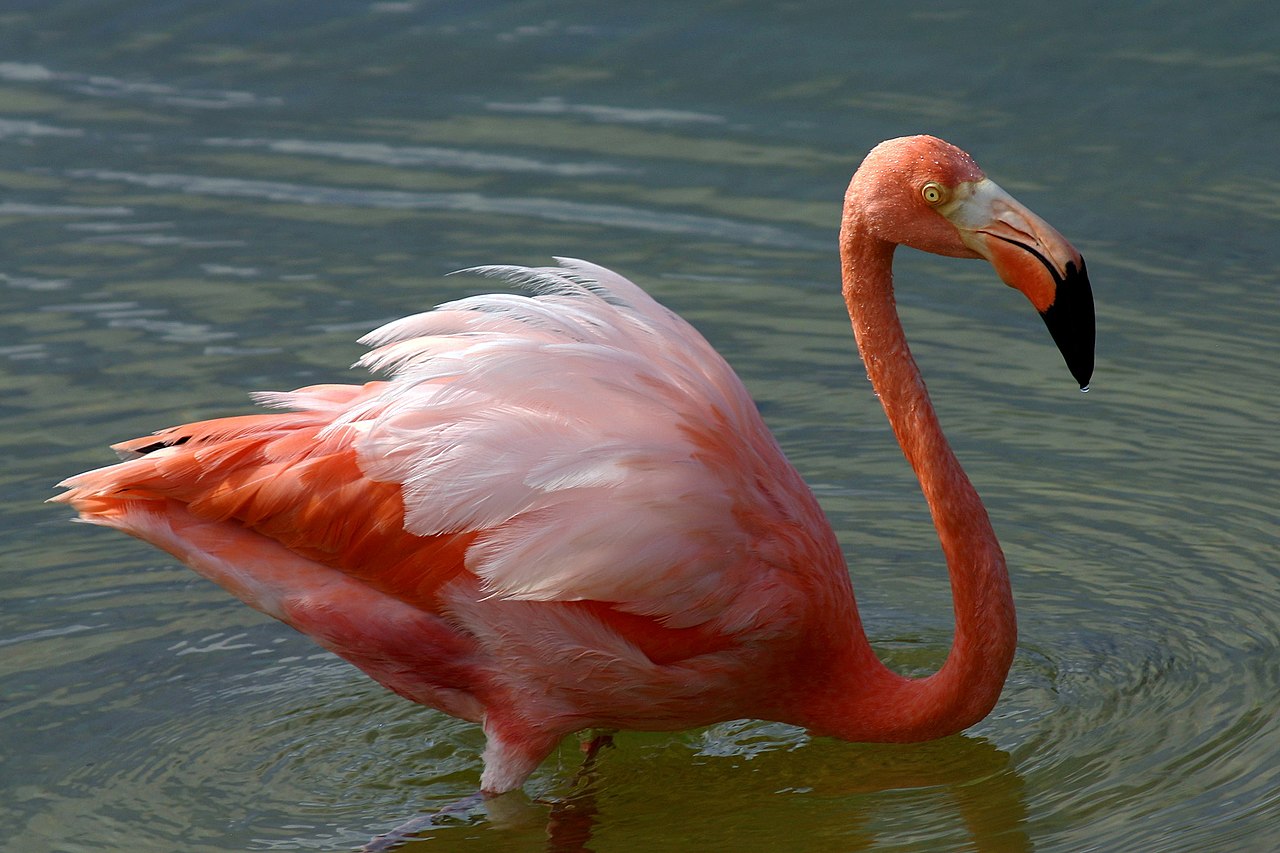
There are six species of flamingo in this family. Four species are found in the New World, and two species, the greater and the lesser flamingo, are found in the Old World.
Flamingos are large wading birds. They have long legs, long necks, and large down-curved bills.
Flamingos frequently stand on one leg. They tuck their other leg beneath their body. Scientists aren’t quite sure why they do this. Some think that it is a way for the flamingo to conserve energy.
Adult flamingos range in color from light pink to pinkish red. Their color comes from alpha– and beta-carotenoid pigments in the food they eat. (Carotenoid are the pigments found in carrots.)
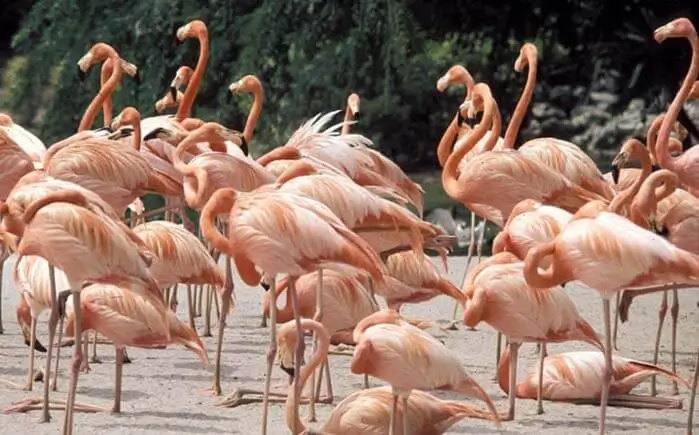
Flamingos in zoos are not as brightly colored as flamingos in the wild because it is difficult for zoos to get their diet exactly the same as it is in the wild.
Flamingos filter feed on red algae, blue-green algae, small insects, crustaceans, mollusks, and small fishes.
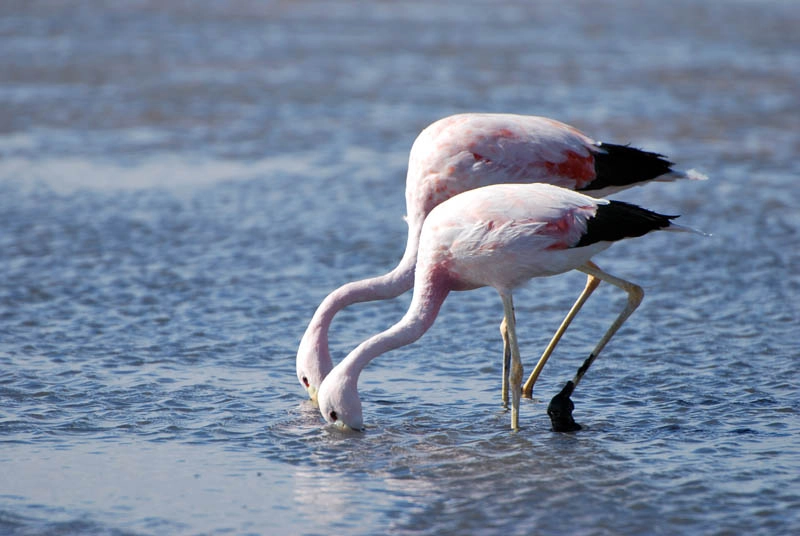
Flamingos feed by standing in shallow water and bending their head so that their bill is upside down in the water. They then sweep their head from side to side to collect food from the water or the mud.
Flamingos are very social and live in large colonies that can contain hundreds, even thousands, of birds.
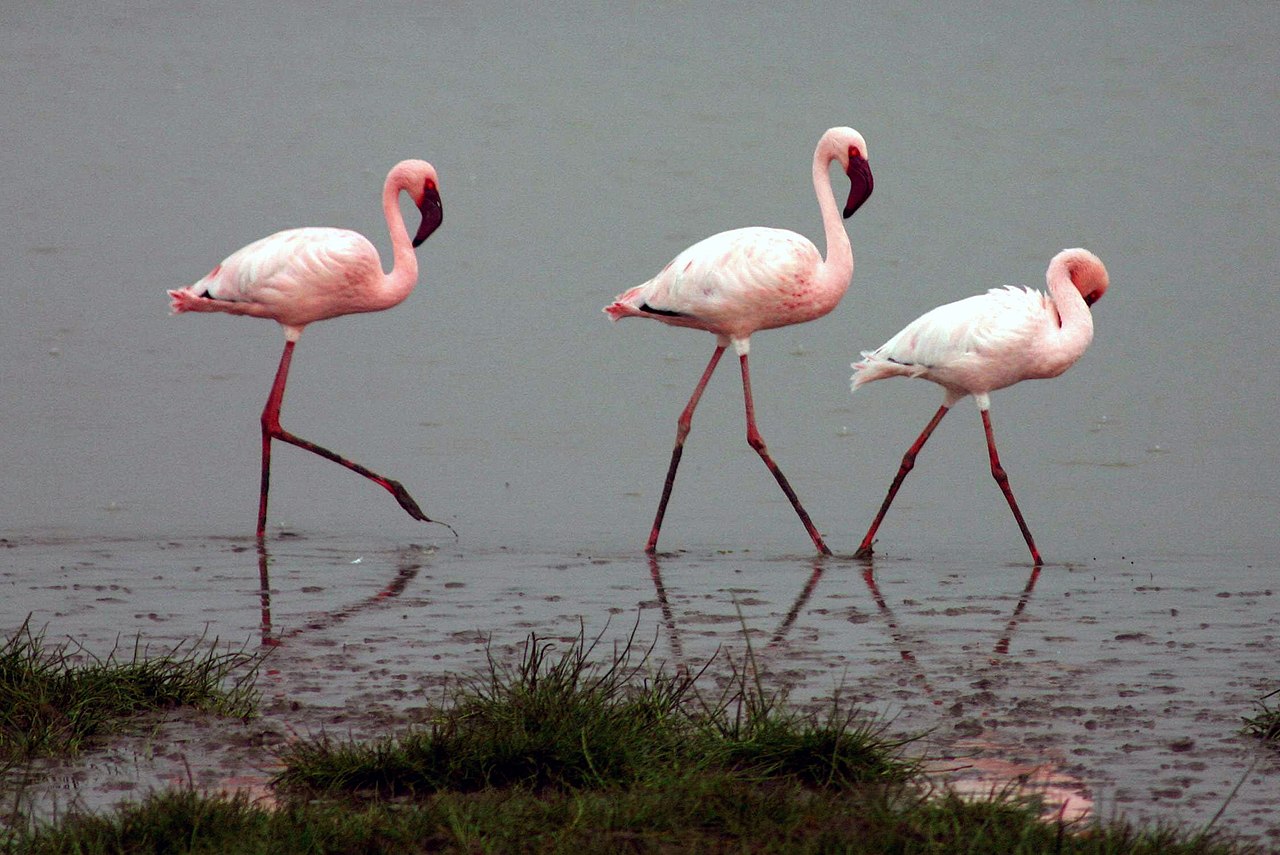
Lesser Flamingo (Phoeniconaias minor)
The lesser flamingo is found on tropical alkaline and saline lakes in Africa. IUCN Redlist Status: Near Threatened
Andean Flamingo (Phoenicoparrus andinus)
The Andean flamingo is found in mountainous areas of Peru, Chile, Bolivia, and Argentina. IUCN Redlist Status: Vulnerable
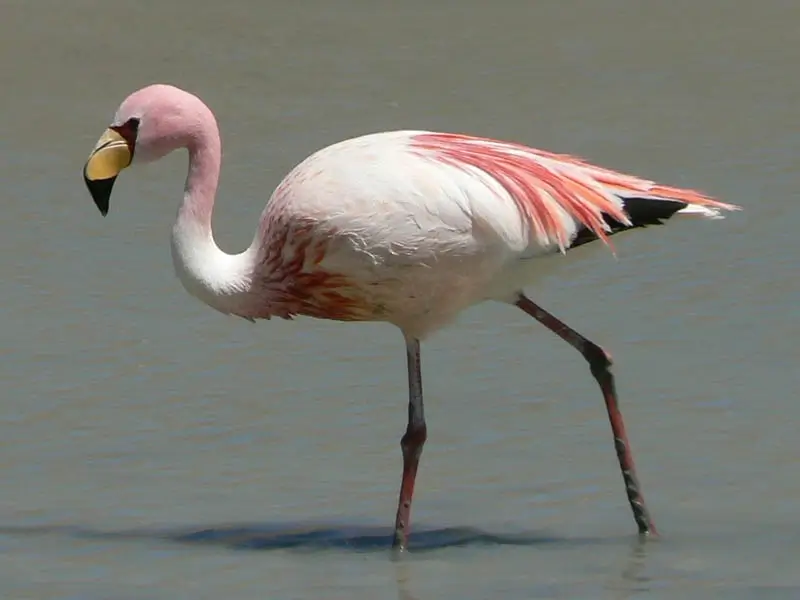
Puna Flamingo (Phoenicoparrus jamesi)
The Puna flamingo is also known as the James flamingo. It is found in the Andes, from the southern tip of Peru through western Bolivia and northwestern Argentina to northern Chile. IUCN Redlist Status: Near Threatened
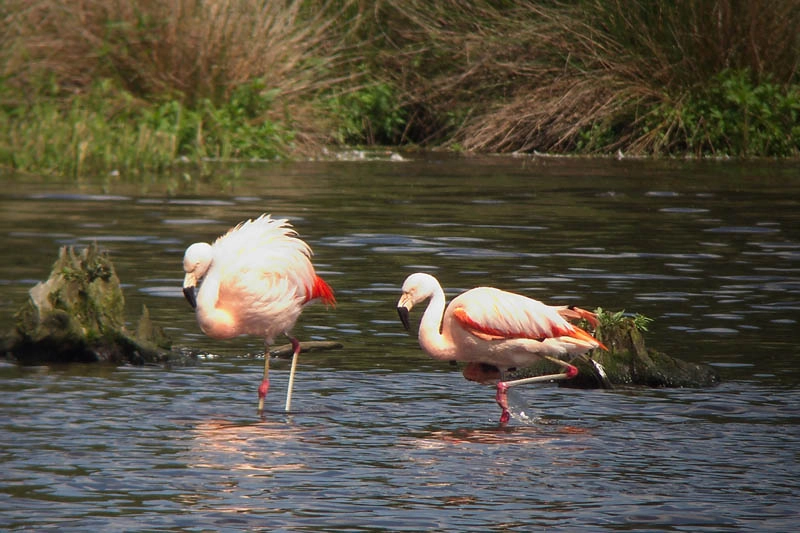
Chilean Flamingo (Phoenicopterus chilensis)
The Chilean flamingo is found in Argentina, Bolivia, Brazil, Chile, Paraguay, Peru, and Uruguay. IUCN Redlist Status: Near Threatened
Greater Flamingo (Phoenicopterus roseus)
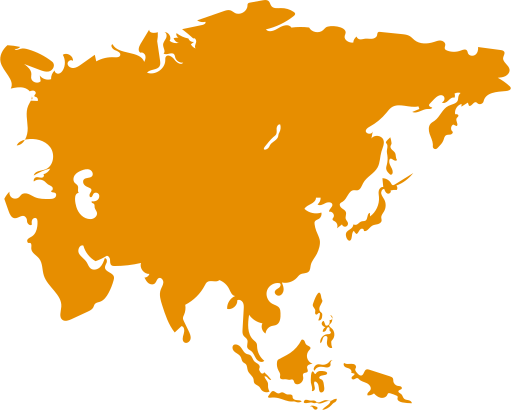
The greater flamingo is found across Africa, southern Europe, the Middle East, and into southern and southwestern Asia. IUCN Redlist Status: Least Concern
American Flamingo (Phoenicopterus ruber)
The American flamingo is found on the north coast of South America, the Yucatan Peninsula in Mexico, and a number of Caribbean islands. It is occasionally found in southern Florida, but it does not breed there. IUCN Redlist Status: Least Concern