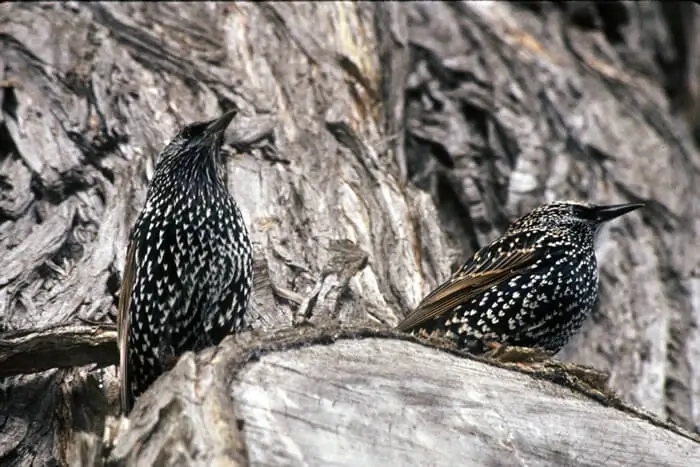
There are around 129 species of birds in this family. They are native to Africa, Asia, and Europe, but have been introduced to other parts of the world.
They range in size from 6 to 14 inches in length. The birds in this order have long, cone-shaped bills; long, pointed wings; glossy feathers with a metallic sheen; and short tails.
Most of the birds in this family gather in flocks and are very noisy. Most species forage for food on the ground and eat insects and seeds.
WELCOME TO AMERICA
The European starling was introduced to North America in the 1890s when about 100 of them were let loose in Central Park in New York City by a group that wanted to establish in North America all of the birds mentioned in Shakespeare’s works.
Since then, the European starling has spread to all parts of the United States, most of Canada, and parts of Northern Mexico. It is estimated that there are over 200 million of them in North America.