There are three species in this family: the Amazonian manatee, the West Indian manatee, and the African manatee.
The Amazonian manatee is found in lakes and lagoons in South America.
The West Indian manatee is found in coastal waters and in rivers, bays, lakes, estuaries, and canals. It is found in the southern United States, the Caribbean, and Central and South America.
The African manatee is found in coastal waters and freshwater rivers in Western Africa.
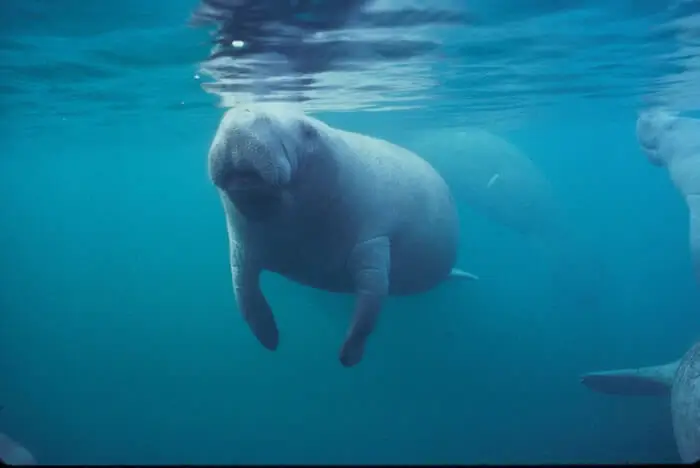
Manatees are 10-13 feet in length and have broad heads with big upper lips with short whiskers; small eyes; a large, flat, round paddle-like tail; and large front flippers. They have no hind flippers or external ears. Manatees can stay underwater for up to 15 minutes.
Manatees are herbivores. They spend about five hours a day eating aquatic plants. An adult manatee eats as much as 60 to 100 pounds of vegetation a day!