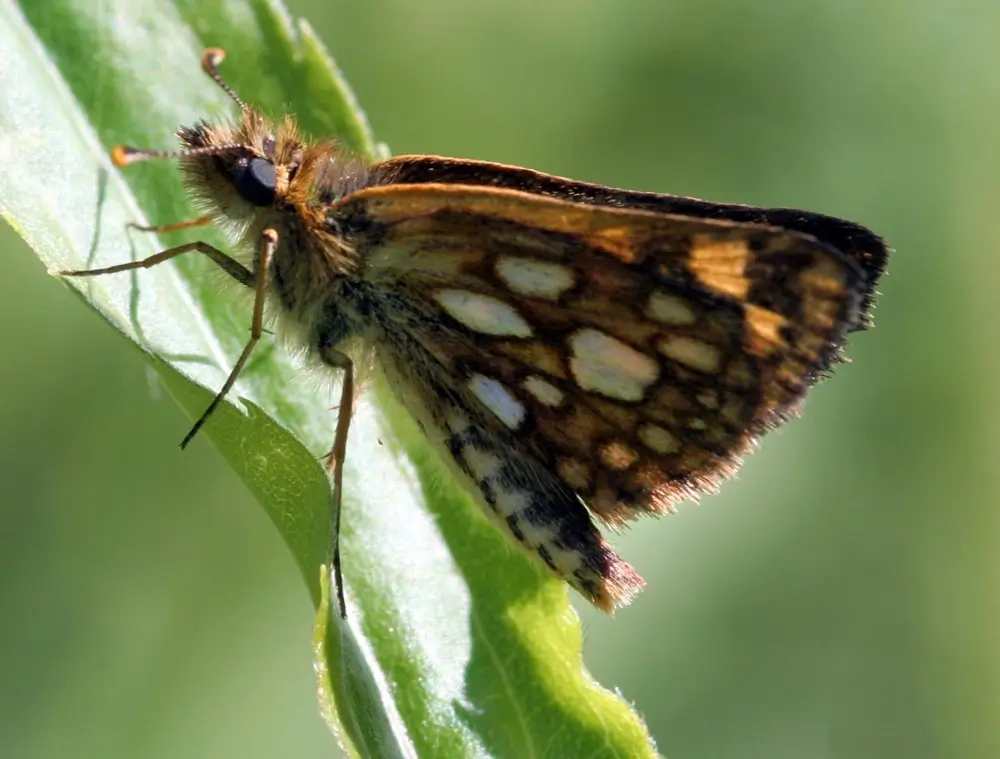
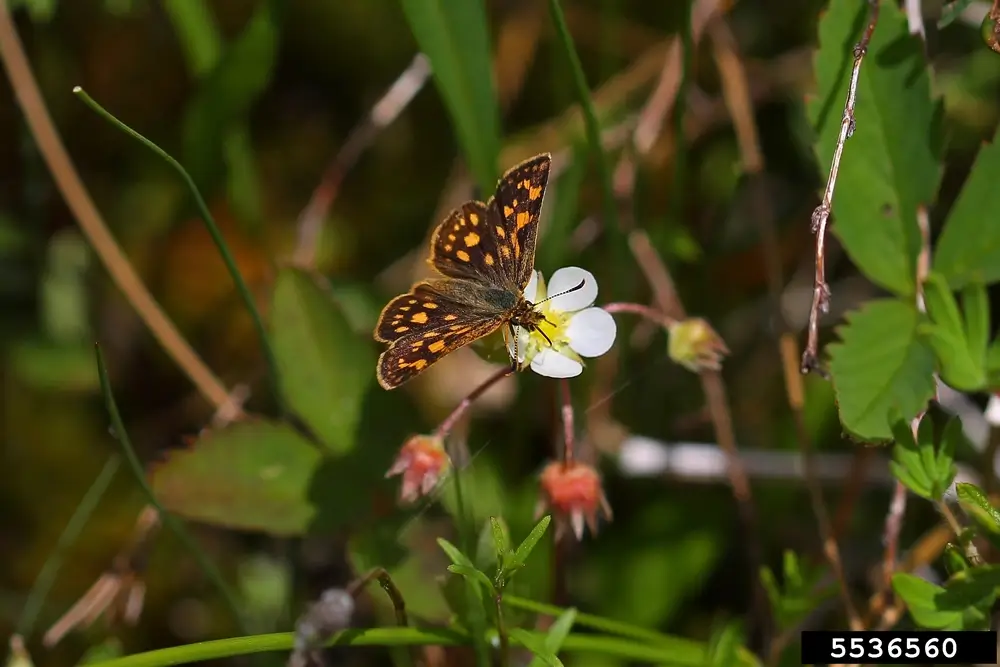
The Arctic skipper has a wingspan of 1 to 1.25 inches (2.5-3.3 cm). The uppersides of its wings are dark brown with large orange spots and patches. The underside of its wings is tan to dark brown with white to cream colored spots edged in dark brown.
Habitat
The Arctic skipper is found in moist meadows, bogs, grassy forest openings, and at the edges of streams.
Diet
The Arctic skipper caterpillar eats a variety of grasses, including purple reedgrass. The adult Arctic skipper eats nectar from flowers, including wild iris and Jacob’s ladder.
Life Cycle
The female Arctic skipper lays single eggs on the leaves of a host grass plant from May to July. The eggs hatch in around 10 days. The larvae bind together leaves from the host plant with silk to make a shelter.
The Arctic skipper overwinters encased in its leaf home. When it emerges in the spring, it may rest for up to a week before it begins pupating. It emerges as a butterfly 5-6 weeks after pupating.
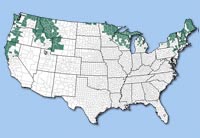
In North America, the Arctic skipper is found from central Alaska south to central California, in the Rocky Mountain region south to Wyoming, in the Great Lakes states, and in New York, New Jersey, Pennsylvania, and New England.
The Arctic skipper is also found in Europe and Asia. In Britain, it is known as the Chequered Skipper. It was once a common species, but now it is only found in a small part of western Scotland.