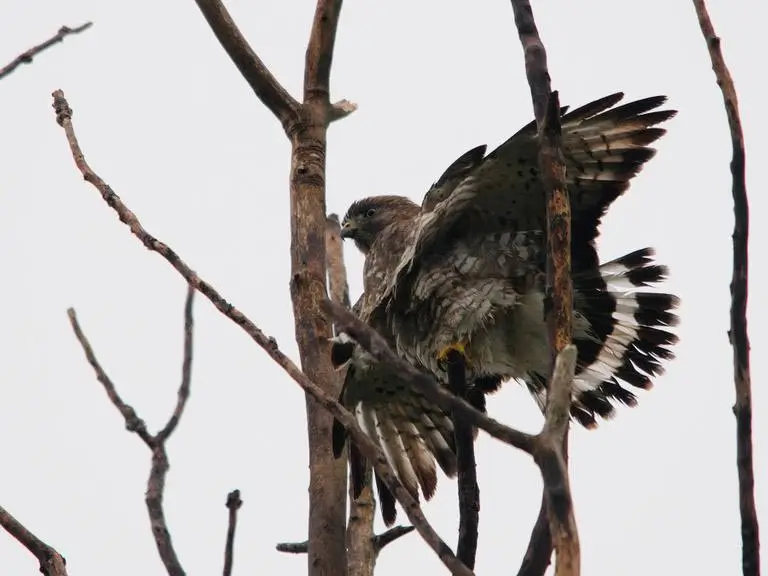
The broad-winged hawk is a stocky, crow-sized hawk. It is 13.4-17.3 inches (34-44 cm) in length with a wingspan of 31.9-39.4 inches (81-100 cm).
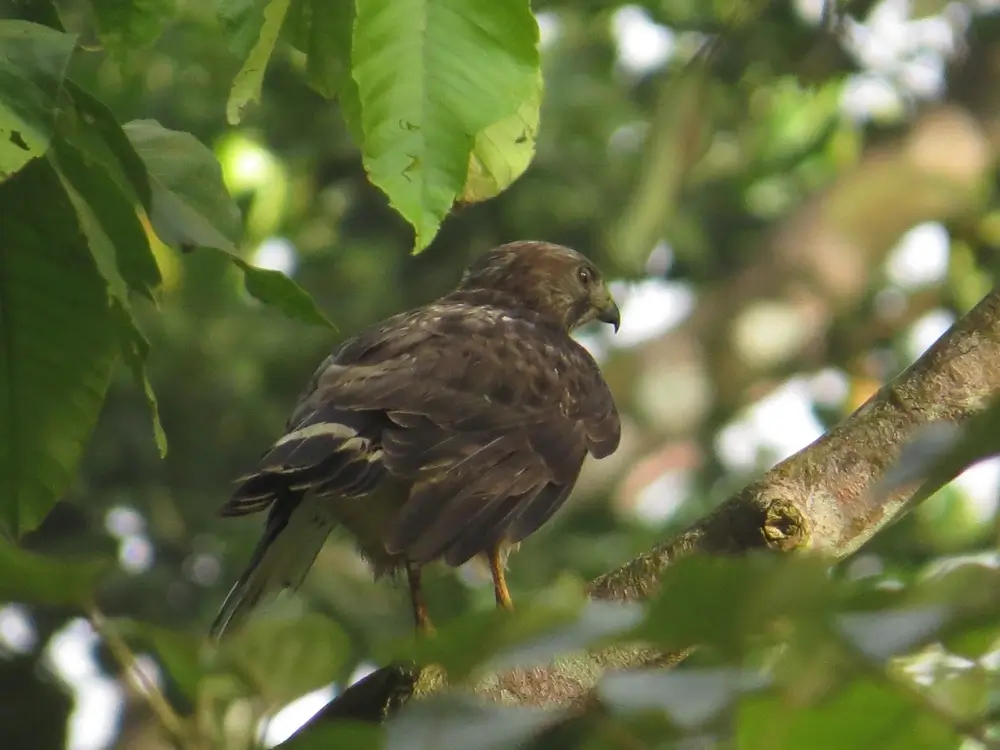
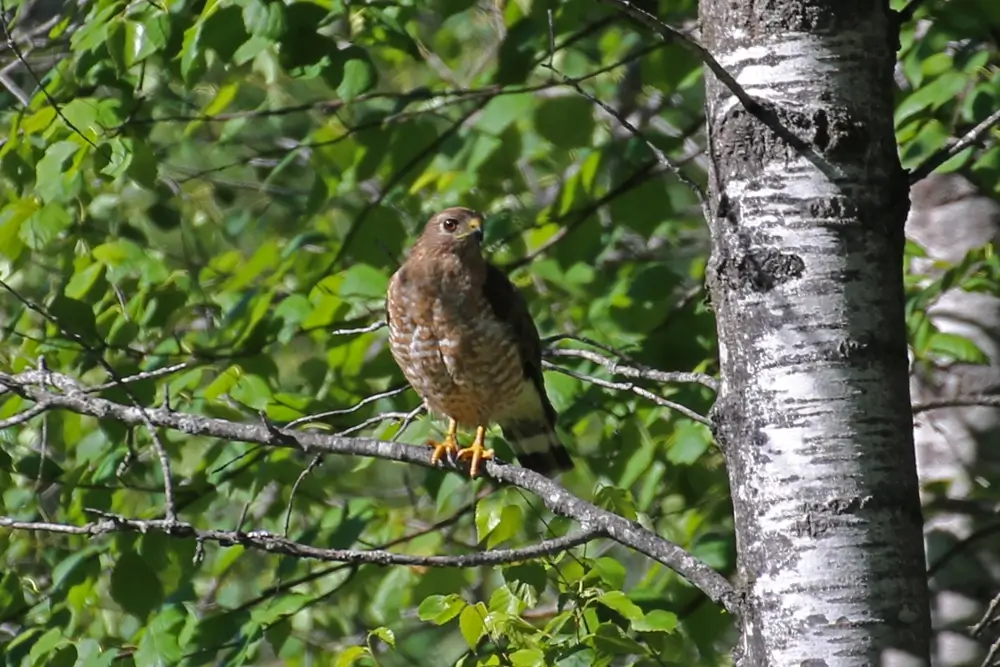
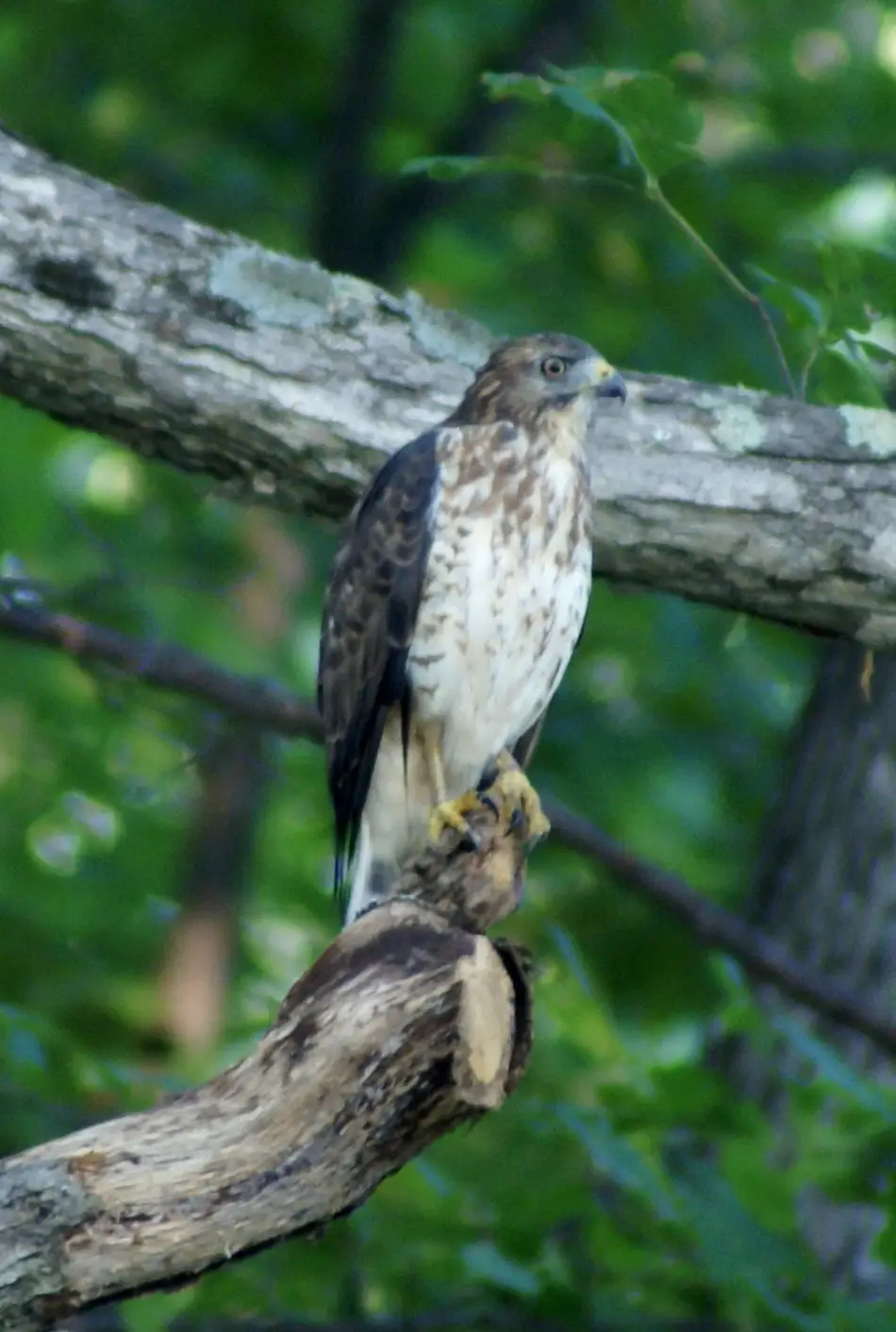
It has a black-tipped hooked bill; a dark brown head, nape, back, and upper wings. It has a white throat and a whitish breast and belly striped with horizontal cinnamon-colored bars. It has a broad, squared, dark gray to black tail with a thick white band in the middle and two thinner white bars at the base and tip.
The middle white bar is very noticeable when the hawk is gliding in the air. The broad-winged hawk gets its name from its broad wings. Males and females look alike, but females are usually a little bigger.
Young broad-winged hawks look similar to adults, but their chests and bellies have a little more white, and the cinnamon bars on their chests and bellies are more vertical than horizontal.
There is a dark morph of the broad-tailed hawk found in the northern part of its range. These hawks are entirely dark brown, except for their tail. It is the same as the typical broad-tailed hawk’s tail.
Habitat
During the breeding season, broad-winged hawks are found in deciduous or mixed deciduous-coniferous forests, usually near water and openings like roads, meadows, wetlands, or trails.
During breeding season, broad-winged hawks are hard to spot. They stay beneath the canopy, perched in trees hidden by foliage. You are more likely to know they are in the forest by their “pe-heeeeee” call.
In the winter, they are found in deciduous and mixed tropical forests in Central and South America.
Diet
Broad-winged hawks hunt small mammals like chipmunks, mice, voles, and shrews. They also hunt birds, frogs, lizards, snakes, and insects.
They eat small mammals whole, but will skin snakes and pull the feathers off of birds before eating them.
They spot their prey from perches in trees in the forest. They wait patiently and then pounce and capture their prey on the ground. Sometimes they spot their prey while gliding in the air.
Life Cycle
Male and female broad-winged hawks court each other with acrobatic flying displays. In one display, they plunge toward the earth and then veer off right before they hit the ground.
The female broad-winged hawk lays 2-4 eggs in a nest made of sticks and twigs and lined with grass, green twigs, and bark chips in the crotch of a deciduous tree, usually 20-24 feet (6.1-7.3 m) above the ground. Occasionally, broad-winged hawks will use abandoned squirrel or crow nests.
While the female broad-winged hawk is incubating the eggs, the male brings her food. The chicks hatch in 28-32 days and fledge when they are about 35 days old. Both parents care for and feed the chicks.
The chicks will stay near the nest site for up to 8 weeks after fledging. Male and female pairs may stay together for more than one breeding season.
The broad-winged hawk has a lifespan of 10 to 12 years in the wild. The oldest broad-winged lived to be 18 years, 4 months old.
Behavior
Normally, the broad-winged hawk is a solitary and territorial bird, but during migration, that changes. The broad-winged hawk is a long-distance migrator. In the fall, they gather in groups called kettles. Kettles can have tens of thousands of birds in them.
The hawks use thermals or columns for rising hot air to glide south. Using thermals to migrate helps hawks conserve energy. Soaring with your wings spread out is much easier than constantly flapping your wings.
A hawk will glide in a corkscrew pattern to the top of the thermal. When the thermal stops rising, the hawk will locate the next thermal and then the next one and the next one as it travels south.
Did You Know?
Support for NatureWorks is provided by:
The Broad-Winged Hawk in NH
The broad-winged hawk breeds throughout New Hampshire.
It can be seen in groups of up to a thousand birds during its migration in September and October.
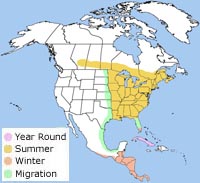
The broad-winged hawk breeds throughout the eastern United States and much of southern Canada. It is not found west of the Rocky Mountains.
It winters in extreme southern Florida, southern Mexico, Central America, and northern South America.
Some broad-winged hawks travel 10,000-11,000 miles roundtrip each year migrating to and from their breeding grounds. Populations of broad-winged hawks in southern Florida and the Caribbean do not migrate.