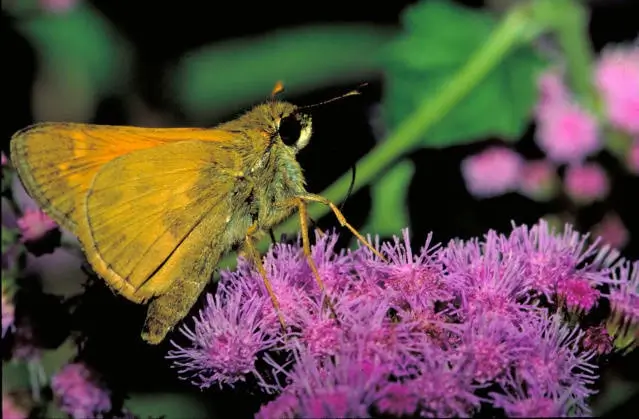
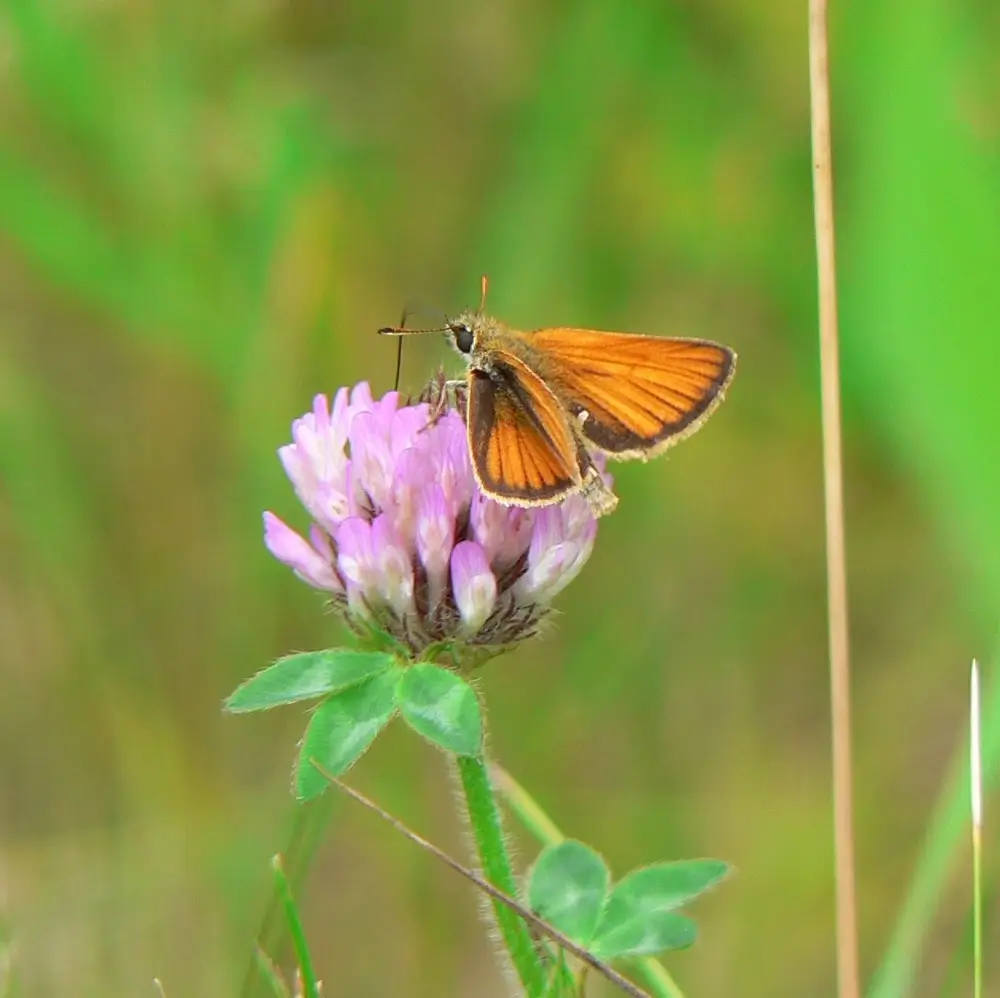
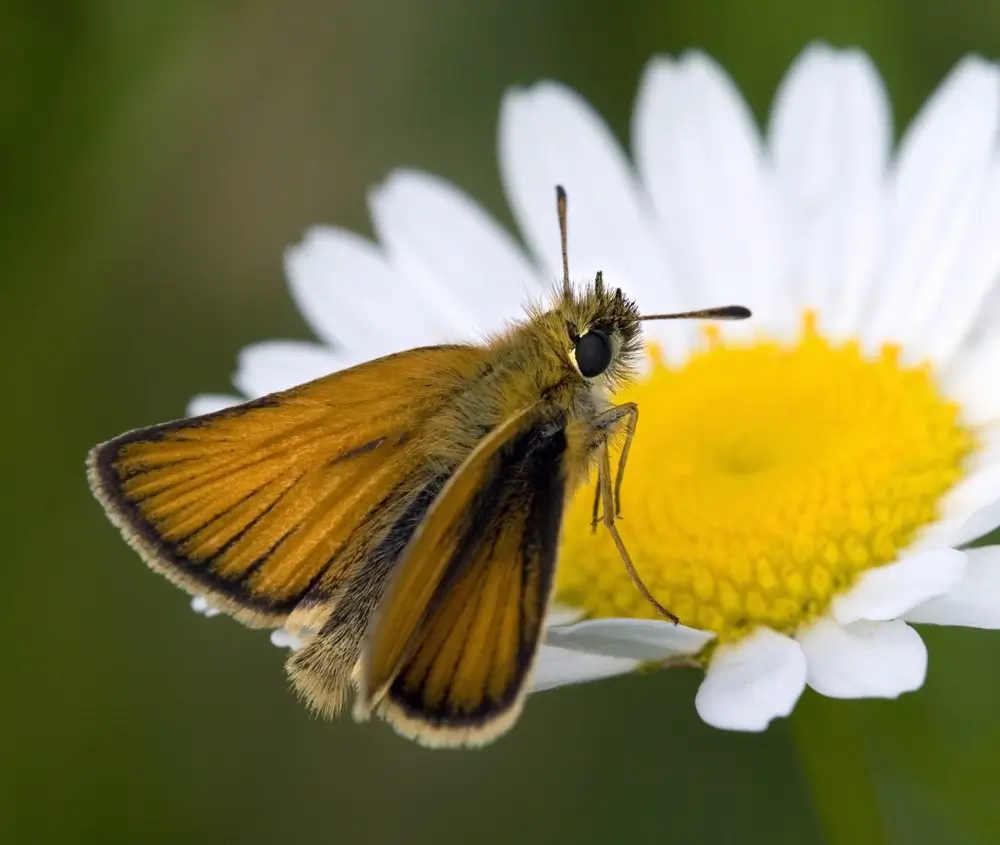
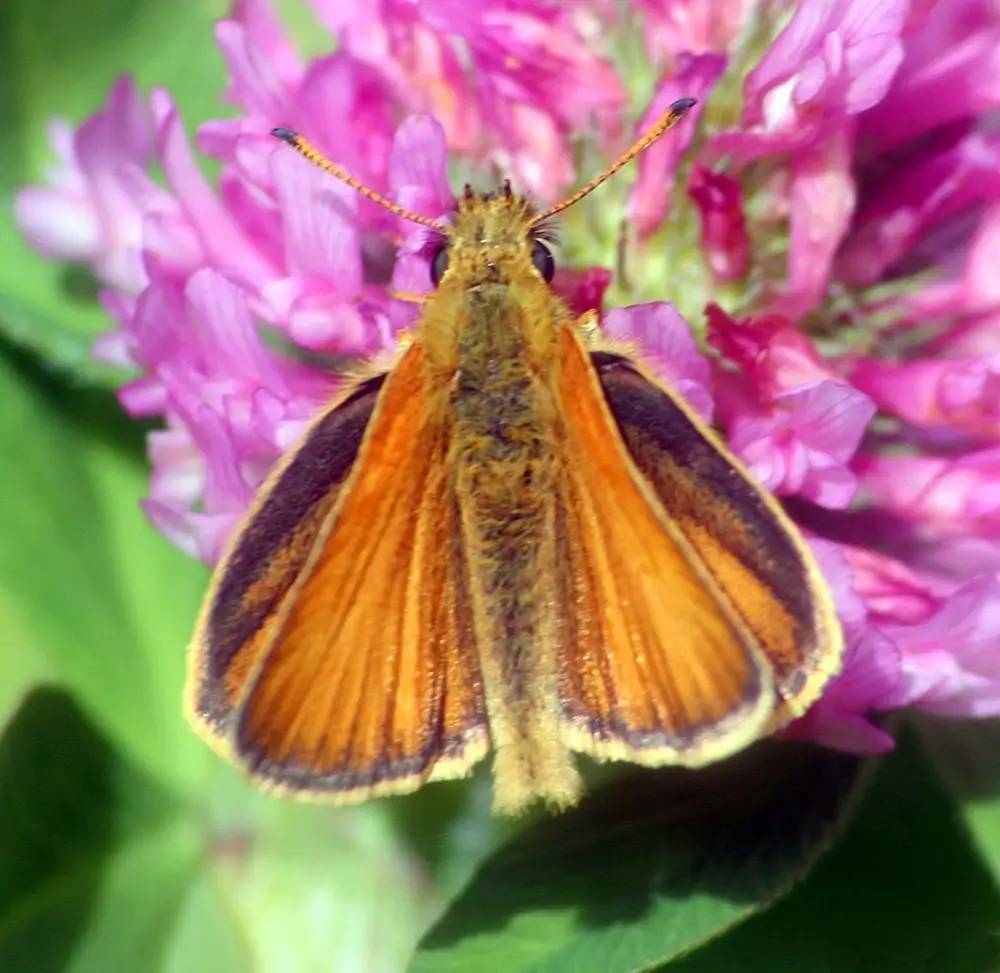
The European skipper has a wingspan of 1 inch (2.5 cm). The uppersides of its wings are burnt orange with a dark brown border. The underside of its forewings is a dull orange, and the underside of its hindwings is a grayish-brown.
The male has a small, narrow black stigma on its forewings. The stigma is a section of scent cells located on the forewings of the males of some species of butterflies.
The European skipper is found in open grassy areas like meadows, hayfields, pastures, and roadsides.
The European skipper caterpillar eats a variety of grasses, including Timothy grass, cocksfoot, and couch grass.
The adult European skipper eats nectar from low-growing flowers like thistles, ox-eye daisy, fleabane, white clover, red clover, orange hawkweed, common milkweed, and swamp milkweed.
The male European skipper hovers low to the ground searching for a mate. The female European skipper lays strings of around 30 eggs on the stem of a host plant. The eggs overwinter and hatch in the spring.
The European skipper is the only skipper species in which the eggs overwinter. The caterpillars eat the leaves of the host plant. They make a nest by rolling themselves up in leaves and tying the leaves together with silk.
The range of the European skipper is expanding, perhaps because its eggs are sometimes transported with hay deliveries.
The European skipper is an introduced species in North America. In its native range in Europe and Asia, it is called the Essex skipper.
It was accidentally brought into London, Ontario, in Canada, in 1910 in a shipment of Timothy grass seeds.

Support for NatureWorks Redesign is provided by:
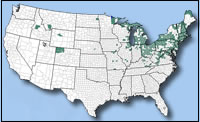
The European skipper is found in New Hampshire. It is part of the eastern population found in the U.S.
In North America, there are two populations of European skippers. The eastern population is found from Newfoundland, Canada west to eastern North Dakota and south to Missouri, Kentucky, and the Carolinas.
The western population is found in parts of Idaho, Montana, Colorado, Wyoming, and Saskatchewan, Alberta, and British Columbia , Canada. The European skipper is also found in Europe and Asia.
NHPBS inspires one million Granite Staters each month with engaging and trusted local and national programs on-air, online, in classrooms and in communities.