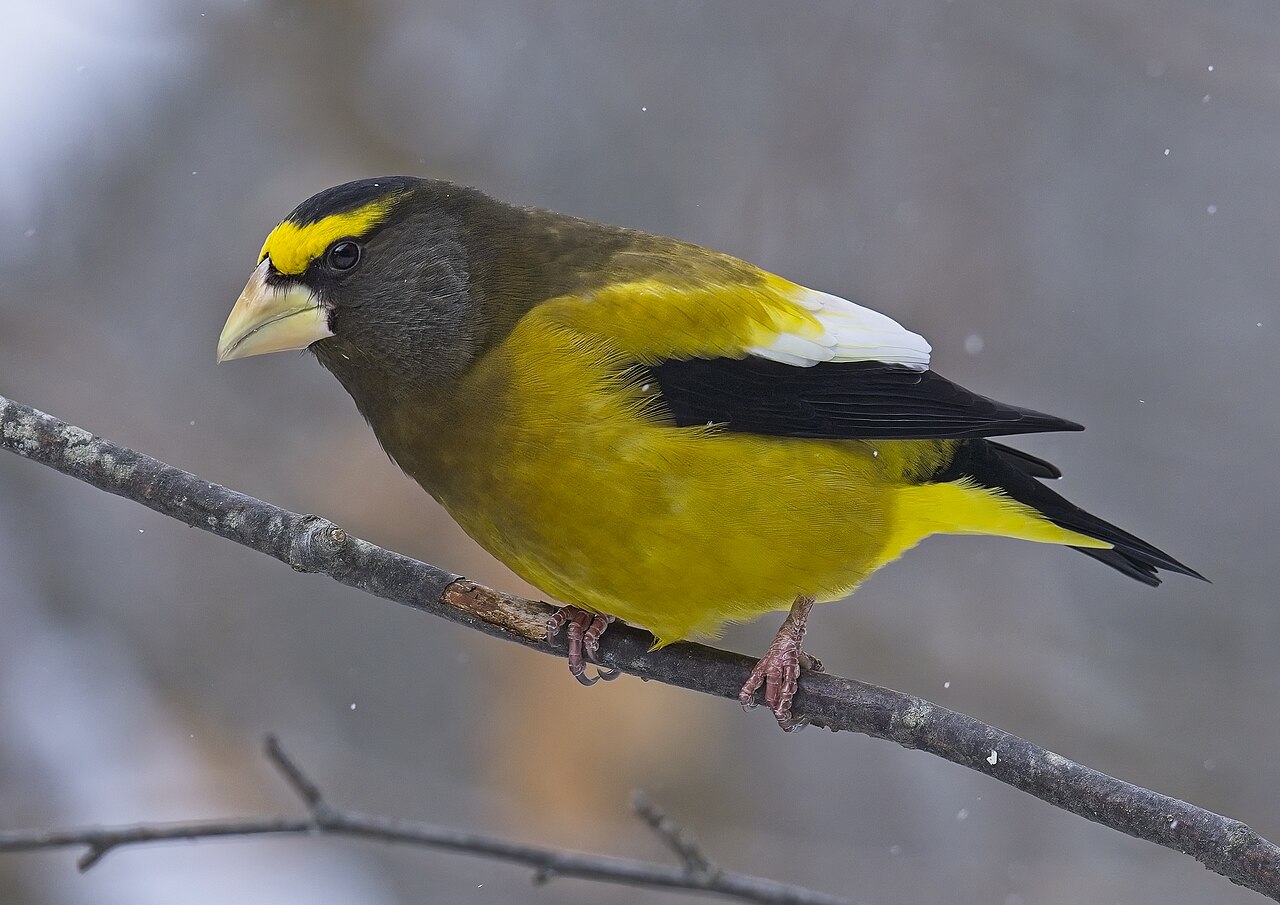
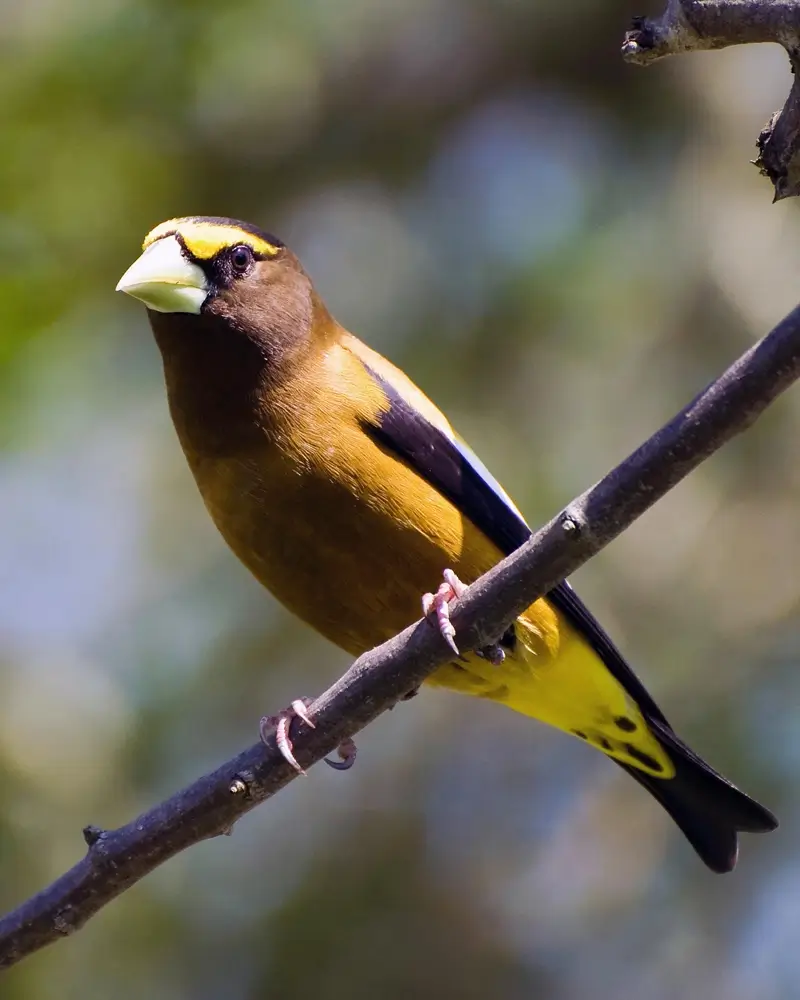
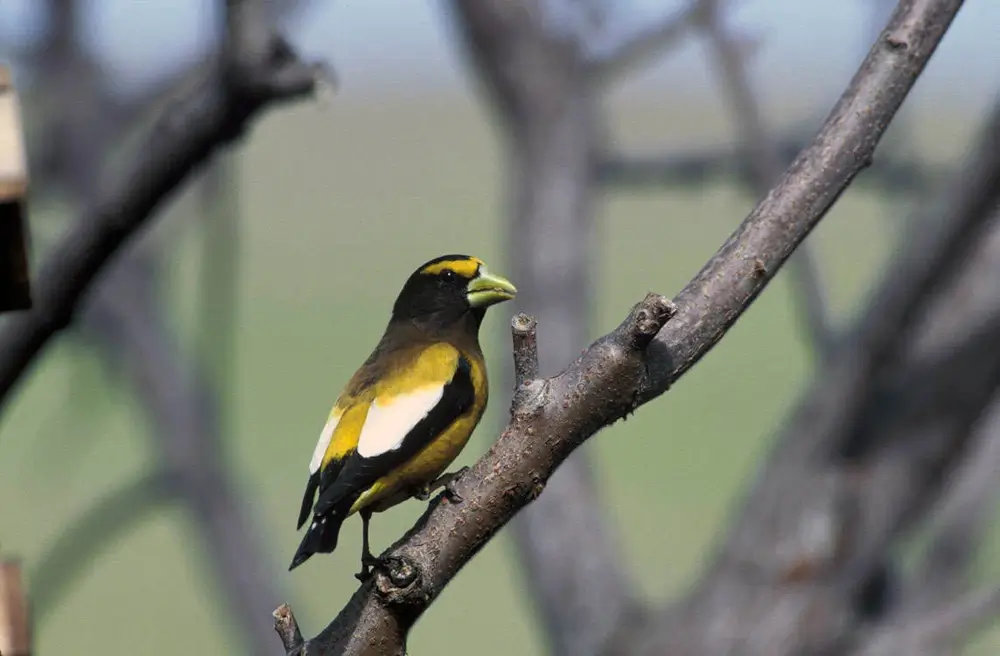
The evening grosbeak is 6.3–7.1 inches (16–18 cm) in length with a wingspan of 11.8–14.2 inches (30–36 cm).
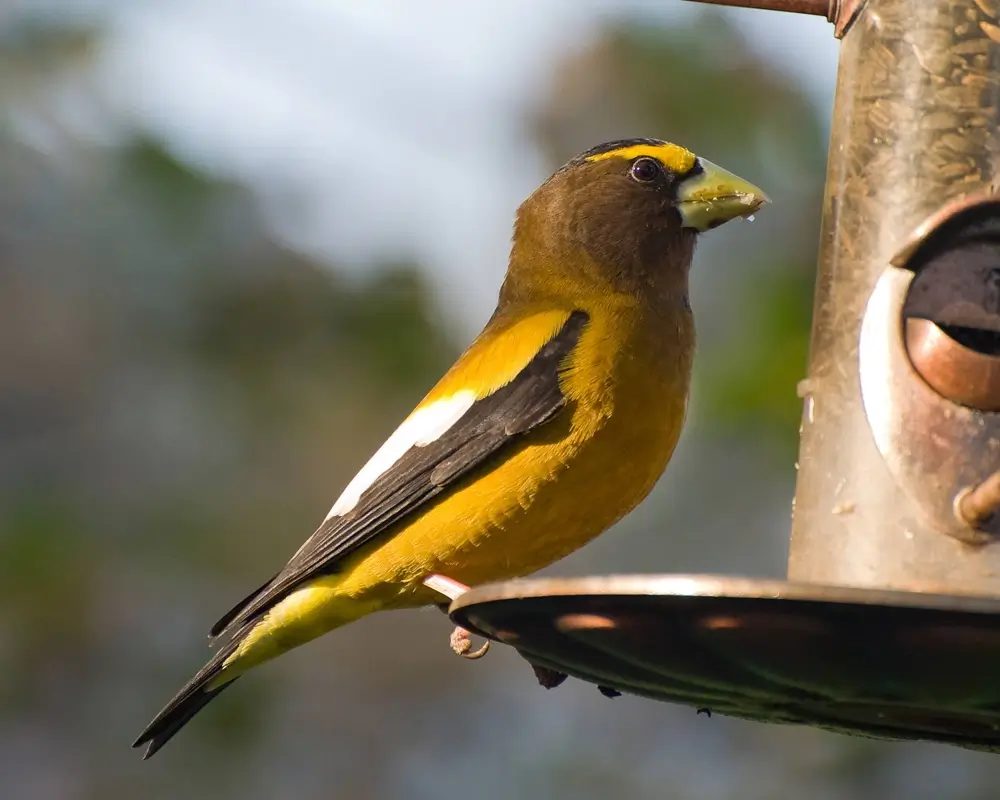
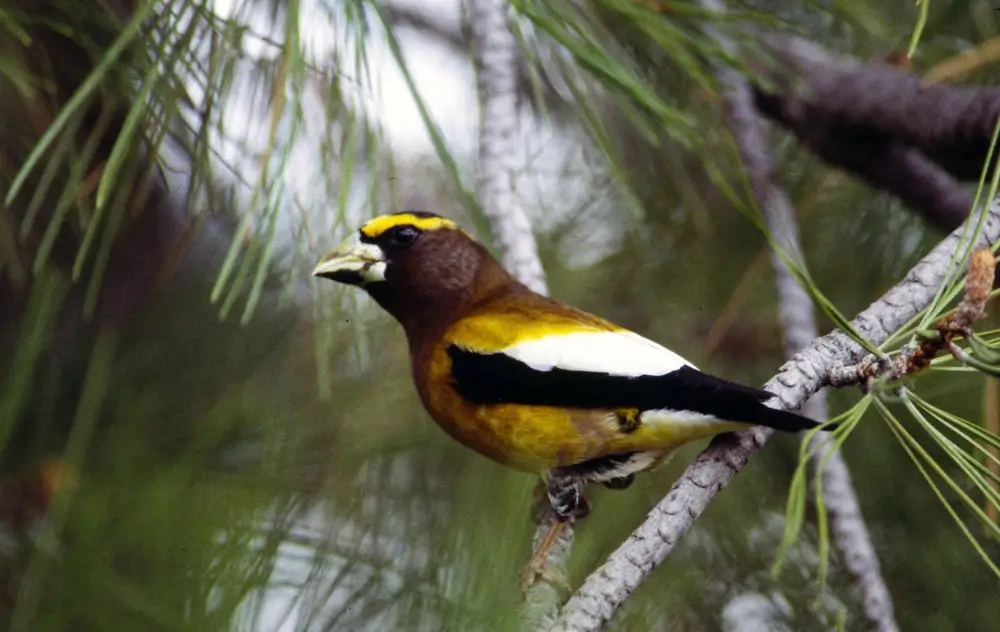
It has a strong, yellowish-green, cone-shaped bill; a short, black tail; and black wings with a white patch. The male has a yellow forehead, a dark brown cap, a lighter brown back, and a yellow breast and rump.
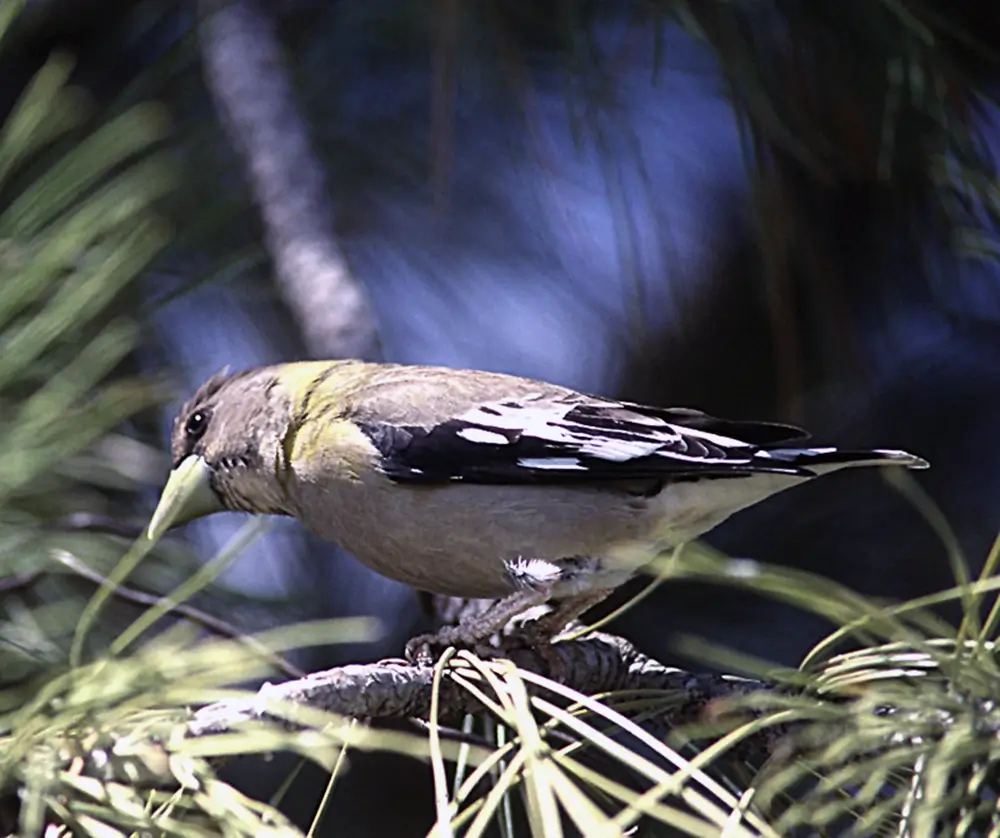
The female has a pale gray breast and rump and a darker gray back.
Habitat
The evening grosbeak breeds in coniferous forests. It winters in coniferous, deciduous, or mixed forests.
Diet
Most of the evening grosbeak’s diet is made up of seeds and fruits, but it also eats insects. It prefers the seeds of maple, spruce, pine, fir, and balsam trees.
The evening grosbeak is a common visitor to bird feeders and is especially fond of sunflower seeds.
Life Cycle
The female evening grosbeak lays 3-4 eggs in a nest of pine needles, roots, and twigs, lined with grass, lichen, and moss. The nest is built by the female and is usually placed high in a tree. The female incubates the eggs for 12-14 days. The male brings the female food while she incubates the eggs.
Both the male and the female feed the chicks. The chicks fledge when they are around two weeks old, but their parents continue to feed them for a few weeks. Male and female pairs may have two broods a year.
The evening grosbeak has a lifespan of 5-7 years in the wild. The oldest recorded evening grosbeak lived to be 16 years, 3 months old
Behavior
The evening grosbeak feeds in noisy flocks. It is a nomadic bird, if the food supply is low in an area, it will move in search of a better location. Some eastern populations migrate south in the winter. Other populations may migrate from high altitudes to lower altitudes.
Did You Know?
Support for NatureWorks is provided by:
The Evening Grosbeak in NH
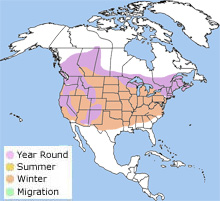
The evening grosbeak breeds in coniferous forests, usually in northen New Hampshire. In the winter, it is found across the state.
The evening grosbeak breeds across much of southern Canada south to northern California, the Rocky Mountains, the Great Lakes, and the Northeastern United States.
It winters throughout the United States, except for the southernmost parts of the southeastern United States.