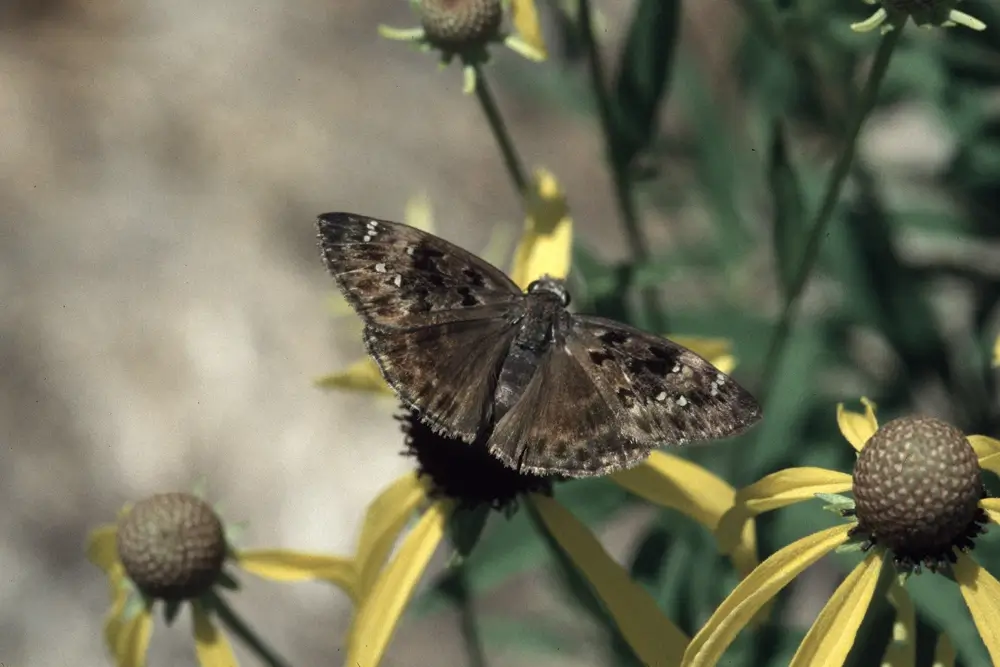
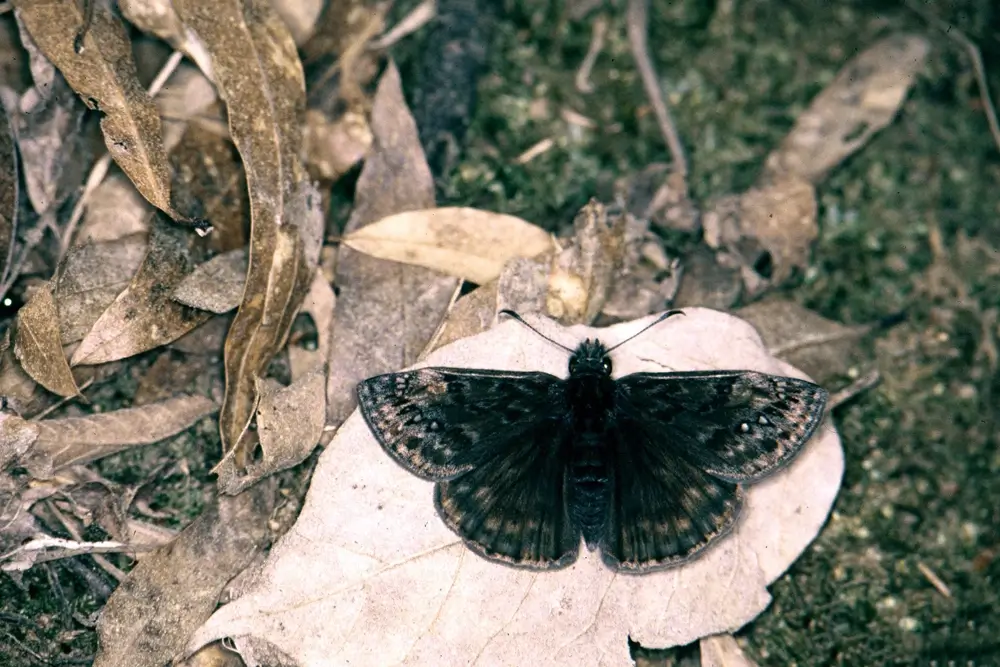
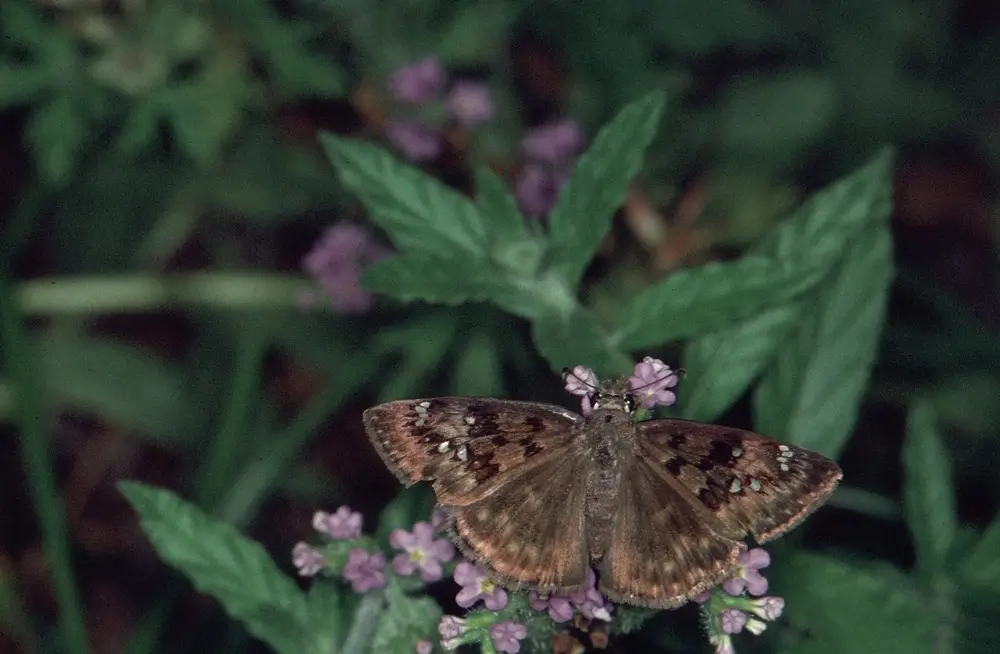
Juvenal’s duskywing is a large skipper with a wingspan of 1.25-2 inches (3.2-5.1 cm).
It has white or brown-fringed wings. The male has dark brown forewings mottled with bands of black spots, chevrons, and small white spots. Its hindwings are a lighter brown with light brown spots.
The female has lighter brown wings. Her markings are similar to the male’s markings, but they are larger. The underside of the hindwings of Juvenal’s duskywing has two pale spots.
Habitat
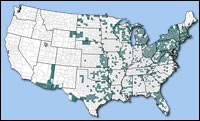
Juvenal’s duskywing is found in oak woodlands, oak scrub, roadsides, and fields near oak.
Diet
The Juvenal’s duskywing caterpillar eats the leaves of northern red oak, white oak, and black oak.
The adult eats nectar from the flowers of blueberry, winter cress, lilac, Carolina vetch, wild plum, wisteria, and dandelion.
Life Cycle
The male Juvenal’s duskywing perches on an oak branch 10-12 feet (3-3.7 m) above the ground and waits for a female.
The female lays one egg at a time on the leaves of oak trees. Juvenal’s duskywing females produce one brood a year.
The caterpillar is light green and has a red, orange, or yellow head. The caterpillar overwinters.
Behavior
Male Juvenal’s duskywings perch on bare twigs 3-12 feet (0.91-3.66 m) above the ground near the edges of the woods, waiting for females to fly by. They are very protective of their spot and will swoop out to chase away any insects that fly by.