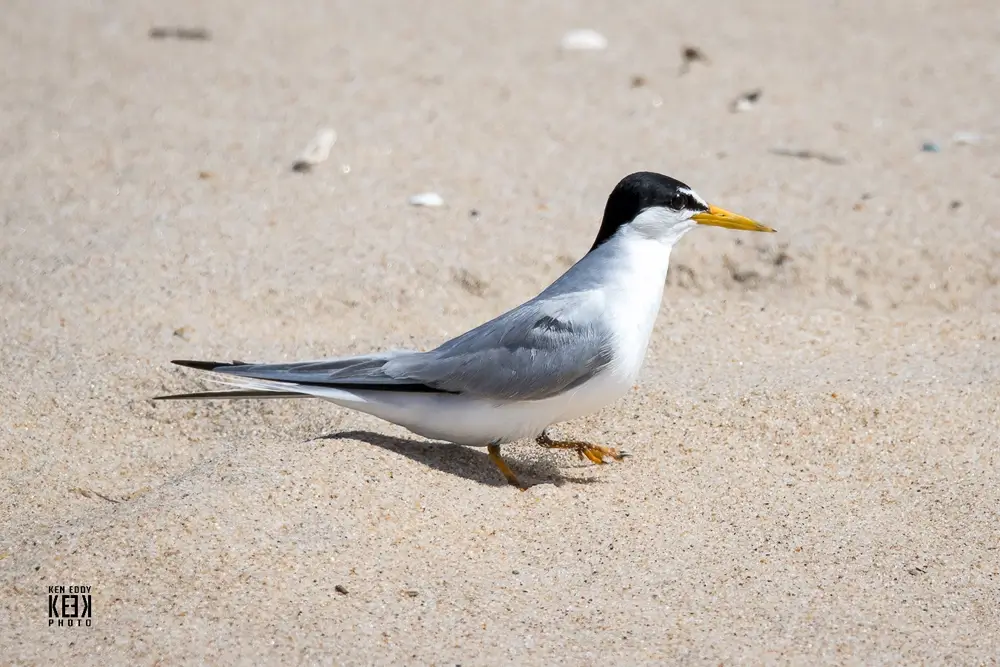
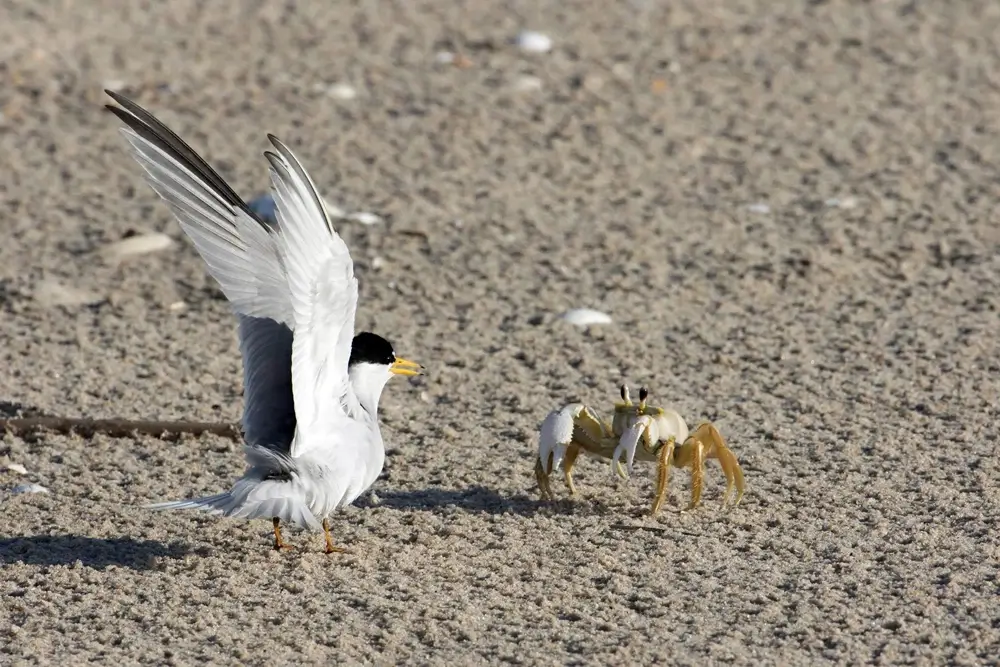
The least tern is the smallest member of the gull and tern family. It is 8-9 inches (20.3-22.9 cm) in length with a wingspan of 19-20 inches (48.3-50.8 cm).
It has a white throat, breast, and belly, and a soft gray back and wings. It has short legs, long, pointed wings, and a forked tail. In the winter, its head is a mottled gray, and it has a black eye stripe and a long, pointed black bill.
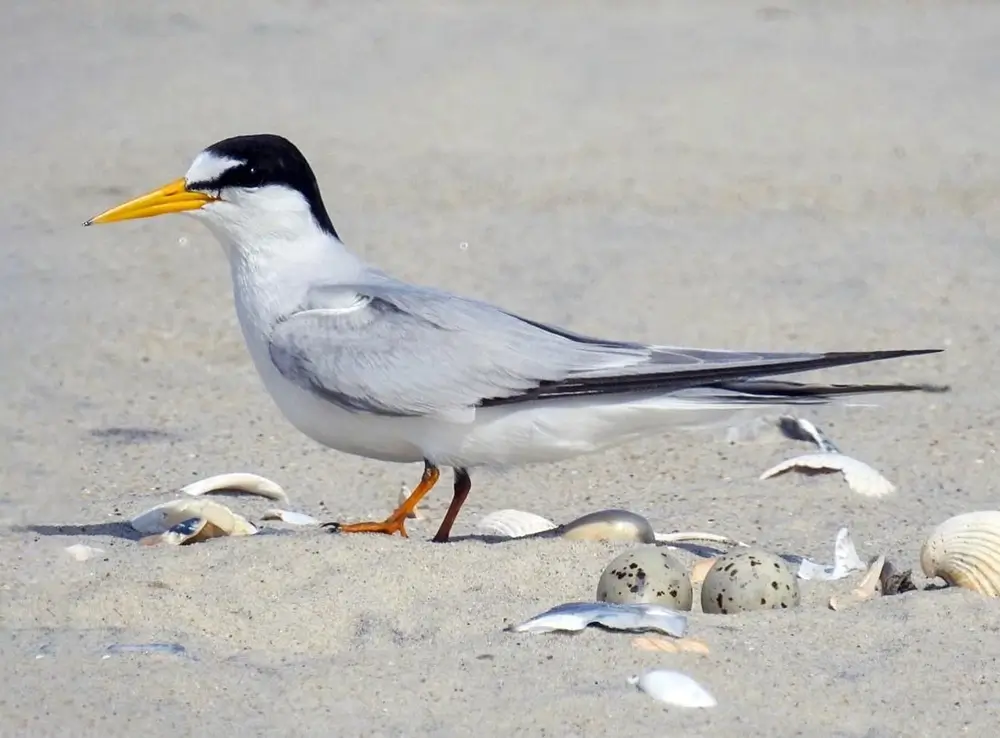
In breeding season, it has a black head, a black stripe that runs from its bill to its eyes, and a yellow bill with a black tip. Males and females look alike.
Habitat
The least tern is found on sandy and pebbly beaches and on sandbars in large rivers.
Diet
The least tern dives into the water from the air and catches small fish and invertebrates.
Life Cycle
The least tern nests in colonies on sandy or pebbly beaches or sandbars. It often nests with piping plovers. The female lays 2-3 eggs in a scrape on the ground. Sometimes, the nest is lined with broken shells. Occasionally, the least tern nests on the gravel roofs of buildings.
The eggs are incubated for 21-23 days by both parents. The parents aggressively protect their nesting site and dive and scream at intruders.
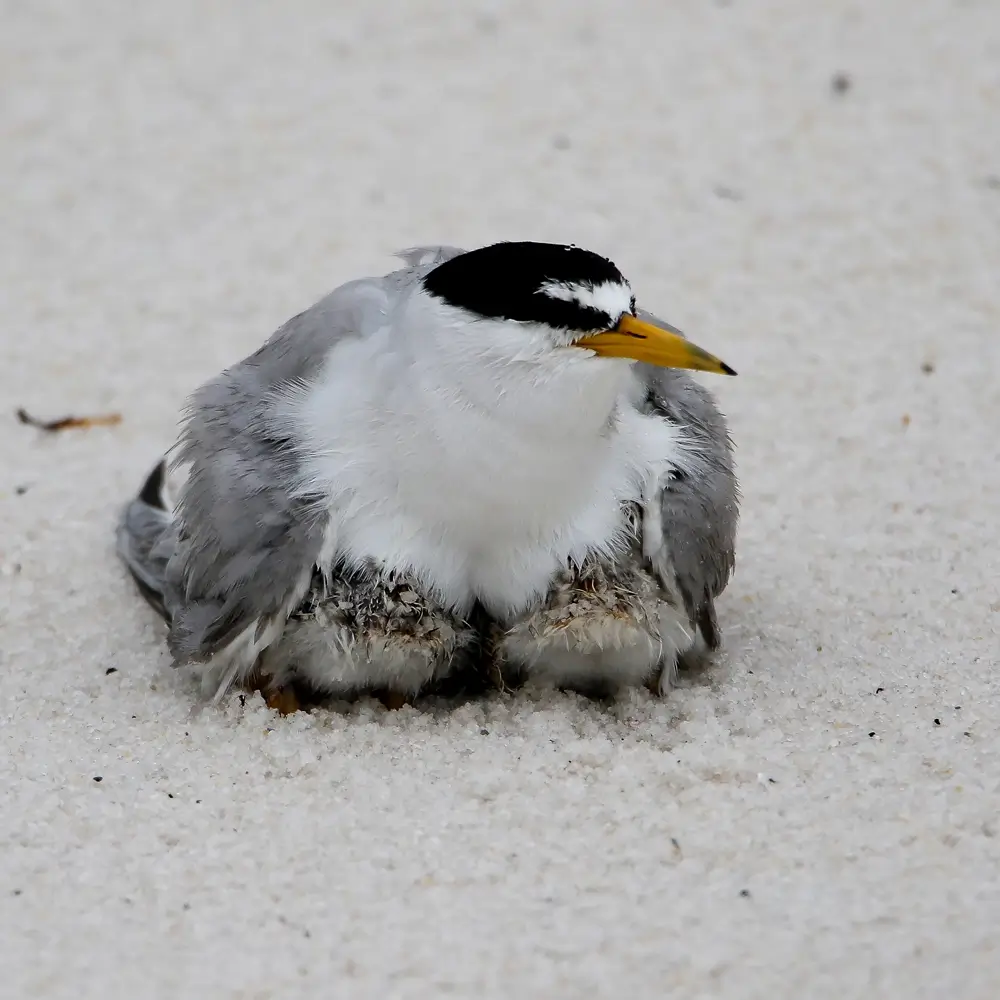
The chicks leave the nest a few days after hatching. They fledge when they are 19-20 days old, but their parents continue to feed and care for them until they migrate in the fall.
The least tern has a lifespan of 15 to 20 years in the wild.
Behavior
Today, the least tern is endangered because of where it builds its nest, from loss of nesting habitat, and from predation. The least tern nests on beaches. Much of its nesting territory has been taken over by human development. The nesting habitat that is left is often used by people for recreation and least tern eggs are sometimes destroyed when people step on them.
The least tern is easily frightened and sometimes abandons its nest if it has been disturbed. It also builds its nests on low-lying sandbars. Nests are sometimes swept away by high tides. Least tern eggs and chicks are also eaten by rats, skunks, raccoons, and even cats and dogs.
Did You Know?
The least tern was close to extinction in the late 1900s. It was hunted for its feathers, which were used to decorate ladies hats.
Support for NatureWorks Redesign is provided by:
The Least Tern in NH
The least tern is on the U.S. Endangered Species List and is an endangered species in New Hampshire.
There are records of the least tern breeding in New Hampshire in Seabrook between 1953 and 1960, and two pairs of least terns nested in New Hampshire in 2015.
Their numbers have grown since then. It is believed that as many as 20 pairs are nesting on New Hampshire’s coast.
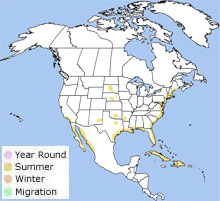
The least tern breeds along the Atlantic Coast from Maine south to Florida and along the Gulf Coast south to Mexico. It also breeds along the Pacific Coast from California south to Mexico.
It also breeds in isolated areas inland along the Missouri, Ohio, and Mississippi Rivers inland to Montana, Kentucky, and Missouri.
It is also found in scattered areas in New Mexico, Texas, Colorado, and Nebraska.
It winters along the Atlantic, Pacific, and Gulf Coasts south to Mexico. The least tern is also found in Central America and the Caribbean.