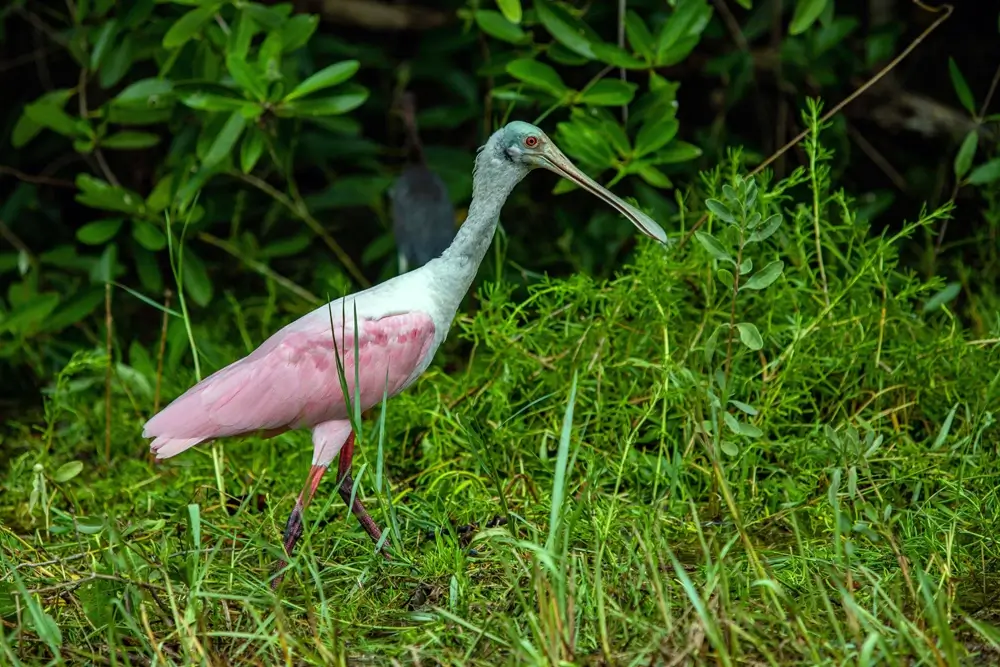
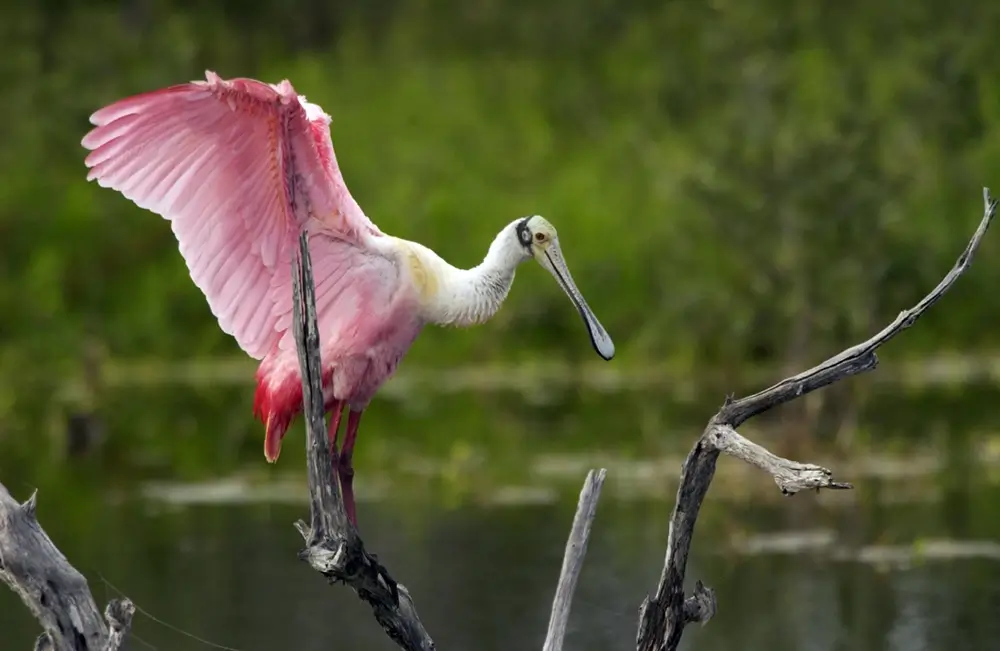
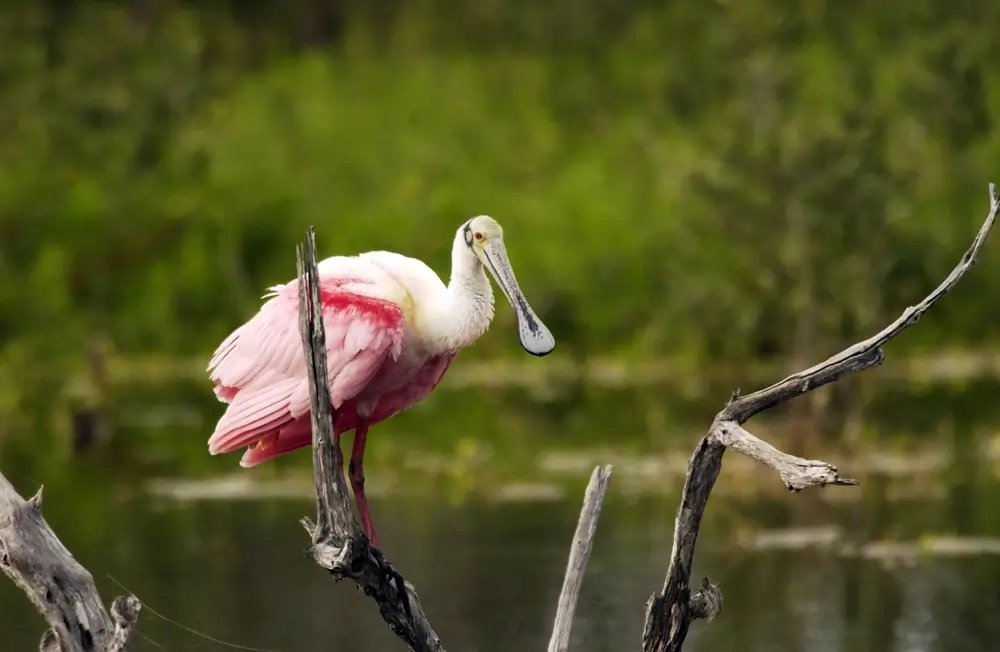
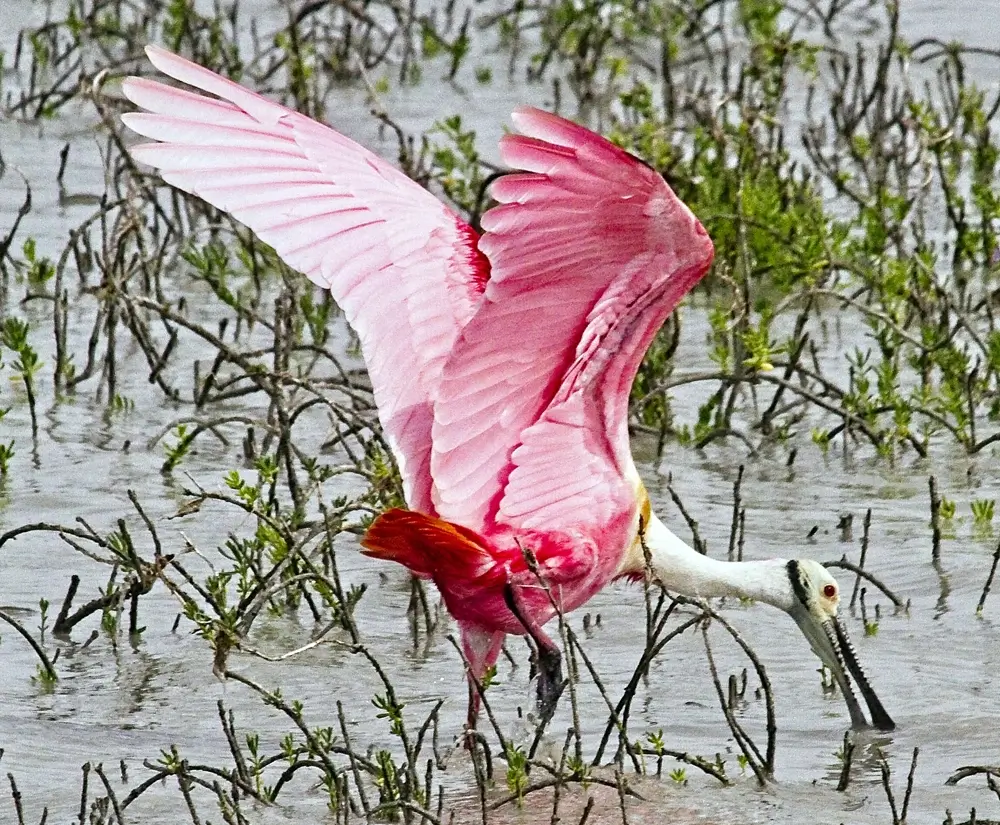
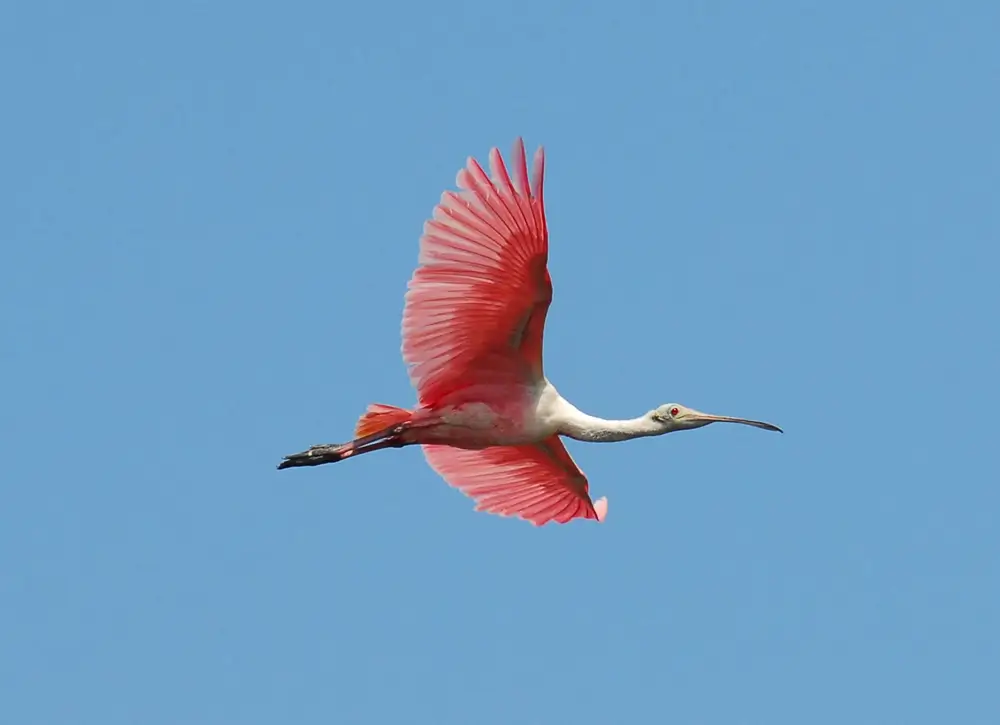
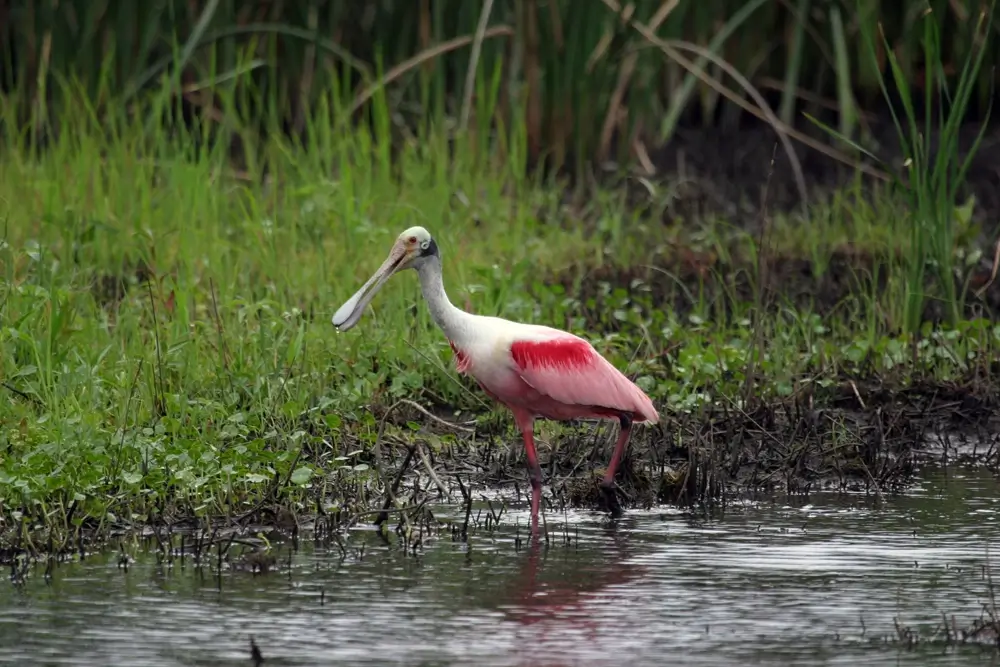
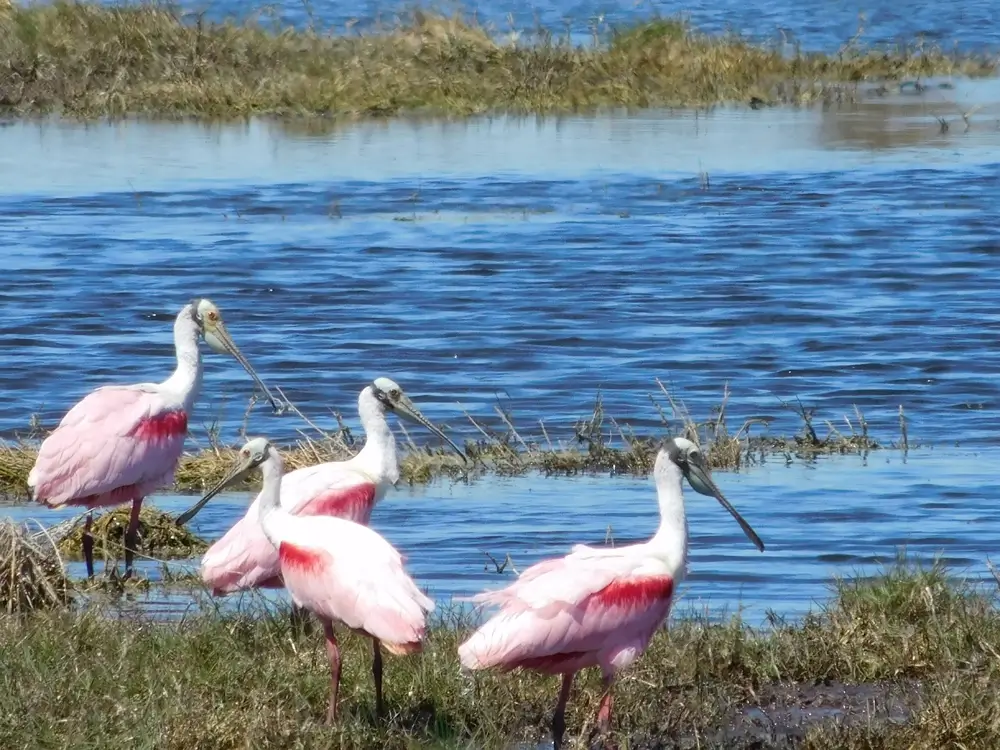
The most distinctive characteristic of the roseate spoonbill is its long, spoon-shaped bill. It has a white head and chest, light pink wings with a darker pink fringe, and very long pink legs. Both males and females have the same plumage and coloring.
The roseate spoonbill is about 2.5 feet (0.76 m) in length with a wingspan of about 4.2 feet (1.27 m). The male is slightly larger than the female, and his bill is a little longer.
The roseate spoonbill spends a lot of its time in shallow water feeding. It sweeps its open bill from side to side in the water to sift up food like small fish, shrimp, mollusks, snails, and insects. It has touch receptors in its bill that help it feel its prey.
Like the flamingo, the roseate spoonbill’s pink color comes from the food it eats. Some of the crustaceans it feeds on eat algae that give the spoonbill’s feathers their rosy pink color.
The roseate spoonbill nests in colonies. Males and females pair off for the breeding season and build a large nest in a tree. The nest is made of sticks and lined with grass and leaves. The female spoonbill lays 2-4 eggs.
Both the female and the male incubate the eggs. The chicks hatch in about 3 weeks and fledge in around 35-42 days. Both the male and female feed the chicks until they are about 8 weeks old.
Young roseate spoonbills have white feathers with a slight pink tinge on the wings. They don’t reach maturity until they are 3 years old.
The roseate spoonbill has a lifespan of up to 10 years in the wild. In captivity, it can live to be 15 years old.
The roseate spoonbill is very social. It lives in large colonies with other spoonbills, ibises, storks, herons, egrets, and cormorants.
Roseate spoonbills fly in flocks in long diagonal lines with their legs and neck stretched out.
The roseate spoonbill population was once threatened by hunting. In the mid-to-late 1800s, its feathers were used in ladies’ hats and fans. The population was also threatened by loss of habitat due to drainage and pollution.
By the early 20th century, the population had shrunk to only a few dozen nesting pairs in the United States. Specially protected areas were set aside for them, and in the 1940s, they were made a protected species.
Over time, the population recovered, and today the roseate spoonbill is no longer a protected species.

Support for NatureWorks Redesign is provided by:
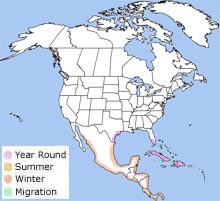
The roseate spoonbill is found on the coasts of Texas, Louisiana, and southern Florida.
It is also found in the Caribbean and in Central and South America.
NHPBS inspires one million Granite Staters each month with engaging and trusted local and national programs on-air, online, in classrooms and in communities.