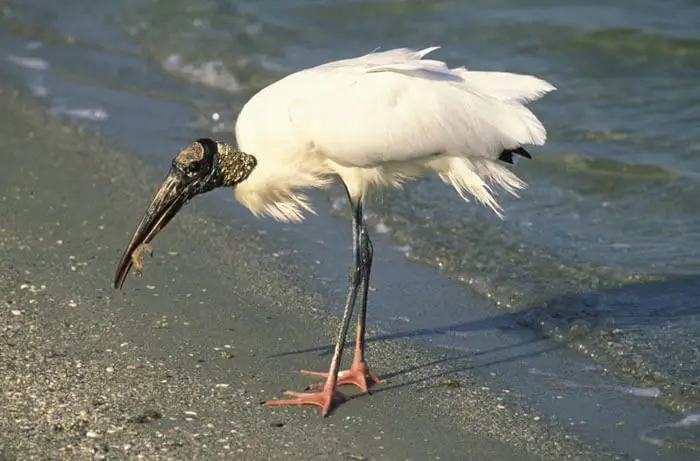
There are around 19 species of storks in the world, all found in a single family, Ciconiidae.
Storks are large wading birds with long legs, long necks, long bills, and broad wings. Many species have bare skin on their heads or necks.
Unlike most birds, storks do not have a well-developed voice box (syrinx), so they are mostly silent. Instead of singing or calling, they often communicate by clattering or clacking their bills together.
Most storks build large stick nests and return to the same nesting site year after year. Mated pairs often add new material to their nests each breeding season. Some nests can grow to more than 6 feet (1.8 m) across and 10 feet (3 m) deep.
The only stork that regularly breeds in the United States is the Wood Stork. Breeding populations are found mainly in Florida, Georgia, and South Carolina, with some nesting occurring in North Carolina. The wood stork is also found in parts of Central America, the Caribbean, and South America.