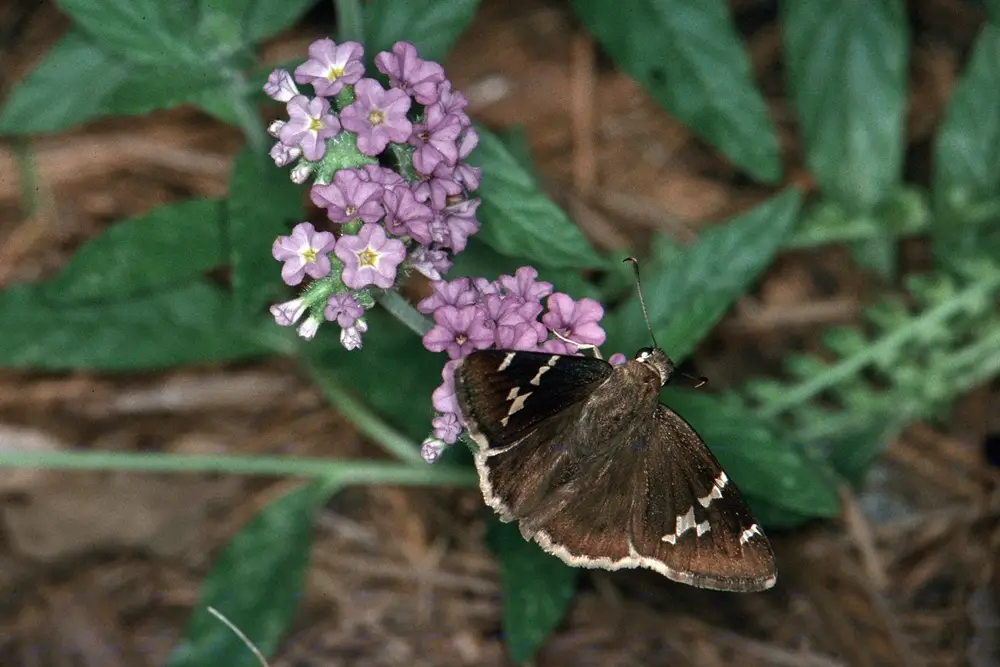
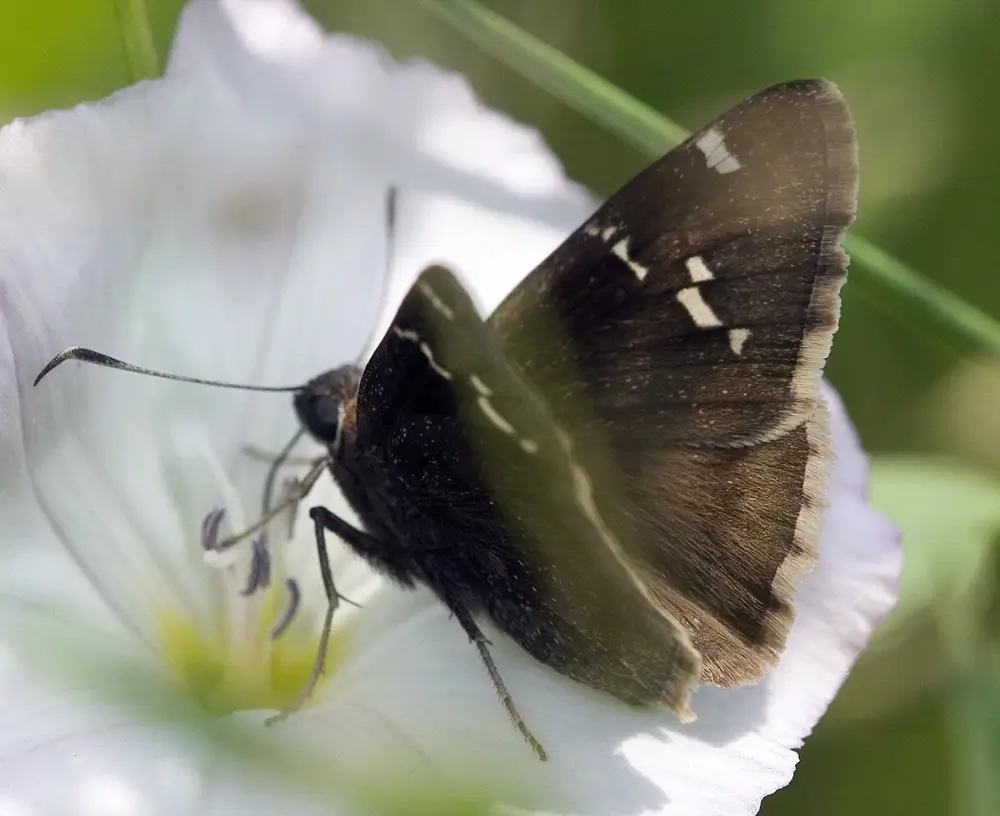
The southern cloudywing has a wingspan of 1.5 inches (3.8 cm). It has rounded brown wings with a light tan fringe. It has white spots on its forewings that form diagonal streaks. It has brown bands on the underside of its hind wings.
The southern cloudywing is found in open scrub areas including woodland edges, powerline clearings, meadows, prairies, and burned areas.
The southern cloudywing caterpillar eats plants in the legume or Fabaceae family including tick-trefoil and bush clover. The adult eats the nectar of white, purple, pink, or blue flowers, including milkweed, thistles, dogbane, and crown vetch.
The male southern cloudywing perches on vegetation and waits for a female to pass by. The female lays a single egg at a time on the underside of a leaf on a host plant.
In the northern part of its range, the southern cloudywing produces one brood a year. In the southern part of its range, it produces two broods a year. The larvae are brown with a black head.
Unlike most other male butterflies, the male southern cloudywing does not have a costal fold. The costal fold is found along the leading edge of the forewing of a male butterfly and often has scent scales or androconia used to attract other butterflies.

Support for NatureWorks Redesign is provided by:
The southern cloudywing is found in New Hampshire.
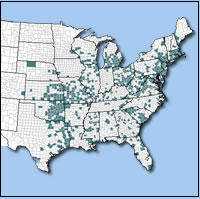
The southern cloudywing is found across much of the eastern United States from Minnesota east to New England and south to Texas and Florida.
NHPBS inspires one million Granite Staters each month with engaging and trusted local and national programs on-air, online, in classrooms and in communities.