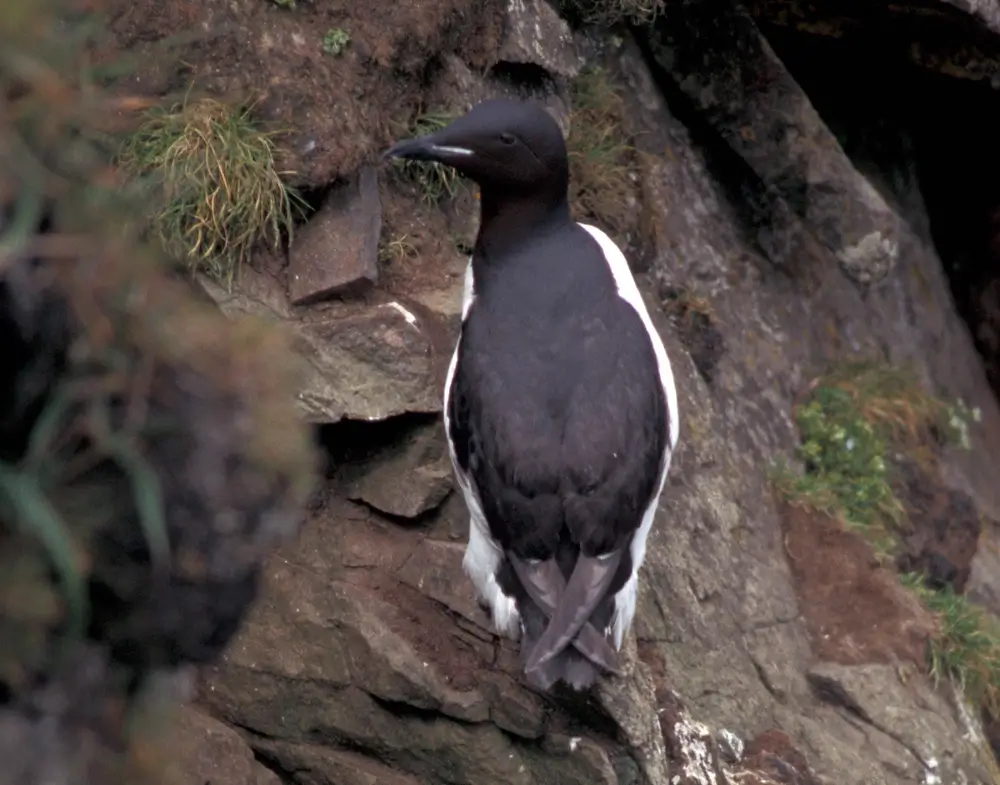
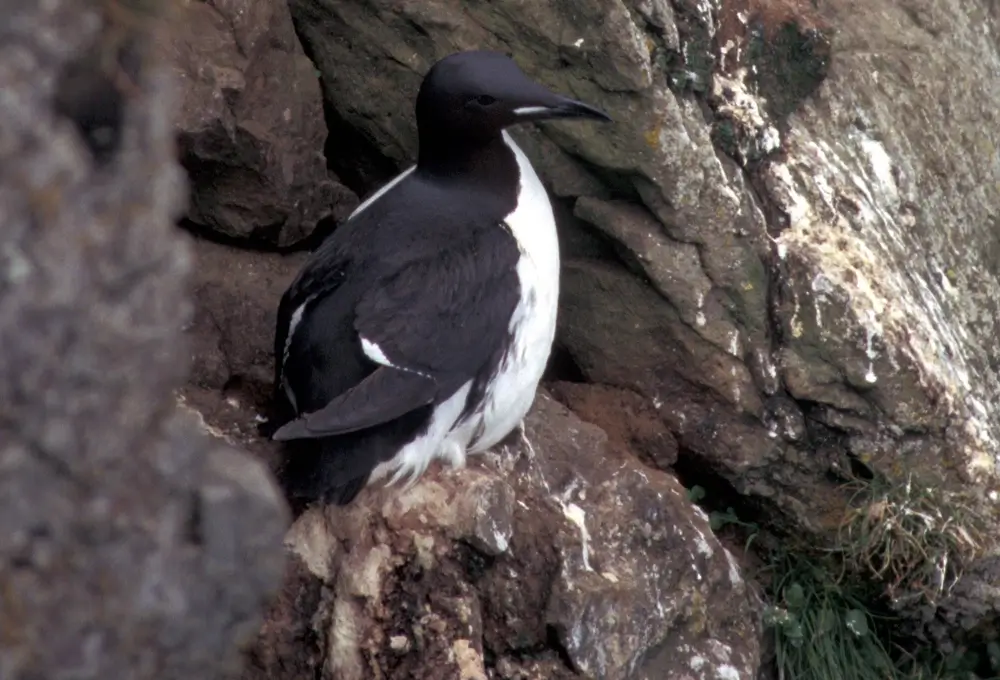
The thick-billed murre is 14-19 inches (40-48 cm) in length and has a wingspan of 25-32 inches (64-81 cm).
It has a white line on its upper jaw; a short, rounded tail; black webbed feet; and a short, pointed black bill. It has a black head, neck, back, and wings, and a white breast and belly.
Both sexes look alike, but males are a little larger than females.
Habitat
The thick-billed murre lives on rocky coasts and on open water.
Diet
The thick-billed murre eats fish, squid, and various crustaceans. It dives under the water to pursue its prey.
Life Cycle
The thick-billed murre nests in large colonies on cliff ledges. The female thick-billed murre lays a single, large, bluish-green egg on a narrow ledge. The thick-billed murre doesn’t build a nest, but it may move rocks and pebbles to its nesting site. The rocks and pebbles may become stuck together by the thick-billed murre’s droppings and form a barrier that helps keep the egg from rolling off the cliff.
Both parents incubate the egg. The egg hatches in 30-35 days. Both parents feed the chick. One parent will stay with the chick while the other parent looks for food.
The chick leaves the nest when it is around 20 days old. The male will stay with it for a few weeks after it leaves the nest.
The thick-billed murre has a lifespan of up to 25 years in the wild.
Behavior
The thick-billed murre can dive to depths of close to 600 feet (183 m). It uses its short, stubby wings to “fly” through the water.
Did You Know?
The thick-billed murre is much better at swimming than it is at flying.
Support for NatureWorks is provided by:
The Thick-billed Murre in NH
The thick-billed murre does not breed in New Hampshire, but it can be seen in ocean waters off of the coast of the state in the winter.