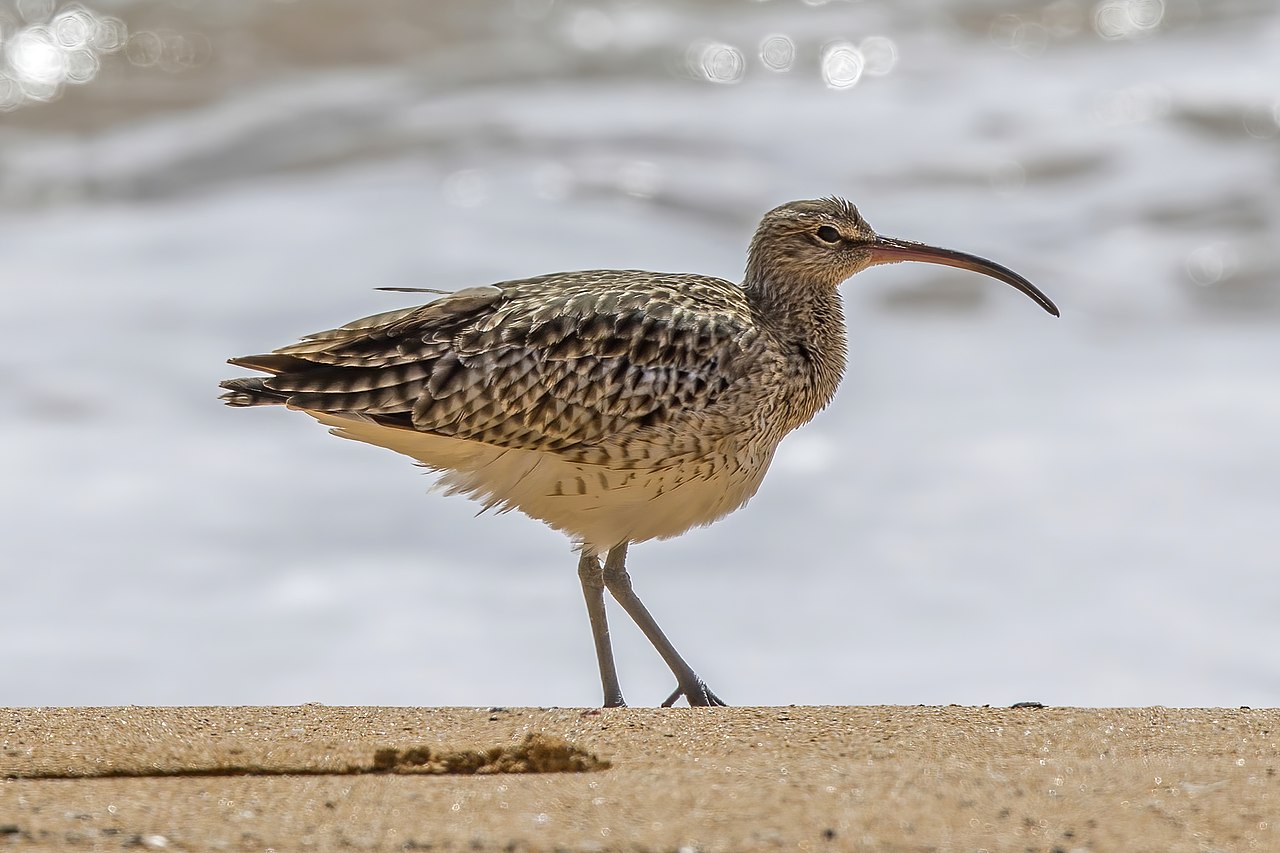
The whimbrel is a large shorebird that is 1.4-1.5 feet (0.43-0.46 m) in length with a wingspan of 2.6-2.7 feet (0.8-0.83 m).
It has a long, down-curved dark brown bill and long gray legs. It is streaked brown on its uppersides, neck, and breast, and white on its belly and rump. It has a dark brown crown, a grayish line above its eye, and a dark brown line that runs over its eyes like a mask.
Habitat
The whimbrel lives on the tundra in the breeding season. In the winter, it is found in coastal areas on mudflats, marshes, and shorelines.
Diet
The whimbrel uses its long, curved bill to probe deep in the sand and mud for food. It wades in shallow water in search of crabs, fish, worms, and mollusks. It also eats insects, seeds, berries, and leaves.
Life Cycle
The male whimbrel flies in circles over the breeding territory and sings as he tries to attract a mate.
The female lays 3-5 eggs in a depression on the ground that is lined with moss, grass, and lichen. Both parents incubate the eggs. Incubation takes 27-28 days.
The chicks are precocial and leave the nest and feed themselves shortly after they are born. Both parents care for the chicks until they fledge (develop flight feathers) 34-42 days after hatching.
The whimbrel has a lifespan of 12-24 years.
Behavior
Whimbrels aggressively protect their nesting areas and may even attack humans if they come too close to their nest.
Did You Know?
Support for NatureWorks is provided by:
The Whimbrel in NH
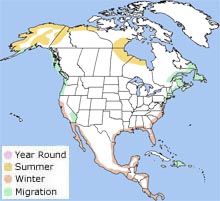
The whimbrel does not breed in New Hampshire.
It can be found in the state from July to September, almost exclusively in the Hampton‐Seabrook Estuary.
The whimbrel breeds on the tundra in Alaska and Canada, east to the Hudson Bay. It migrates south along both the Pacific and Atlantic coasts and winters on the southern coasts of the United States south to South America.
The whimbrel is also found in Europe, Asia, Africa, and Australia and Oceania.