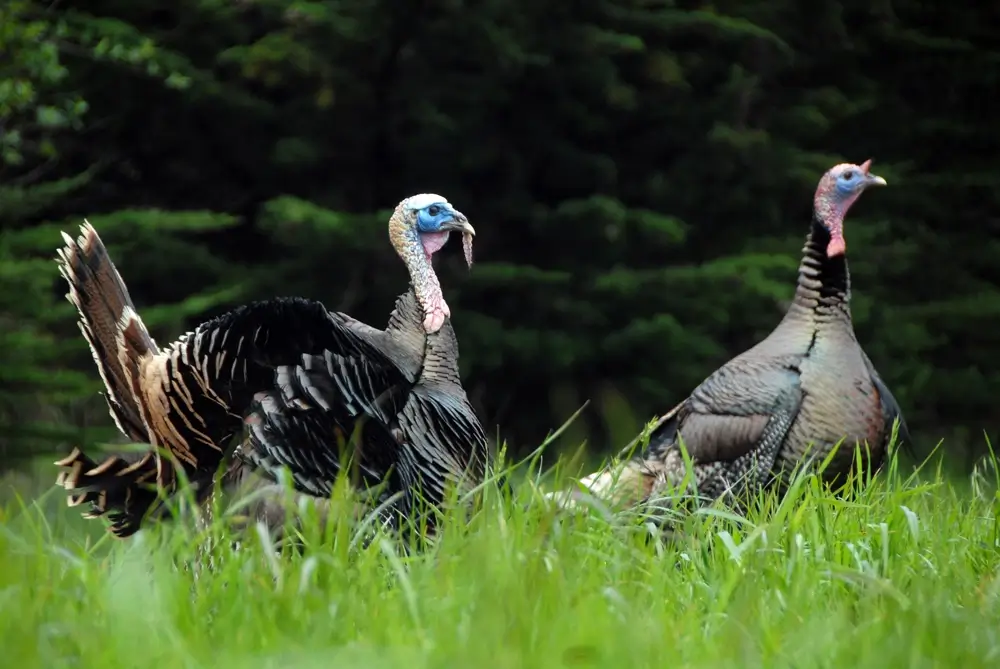
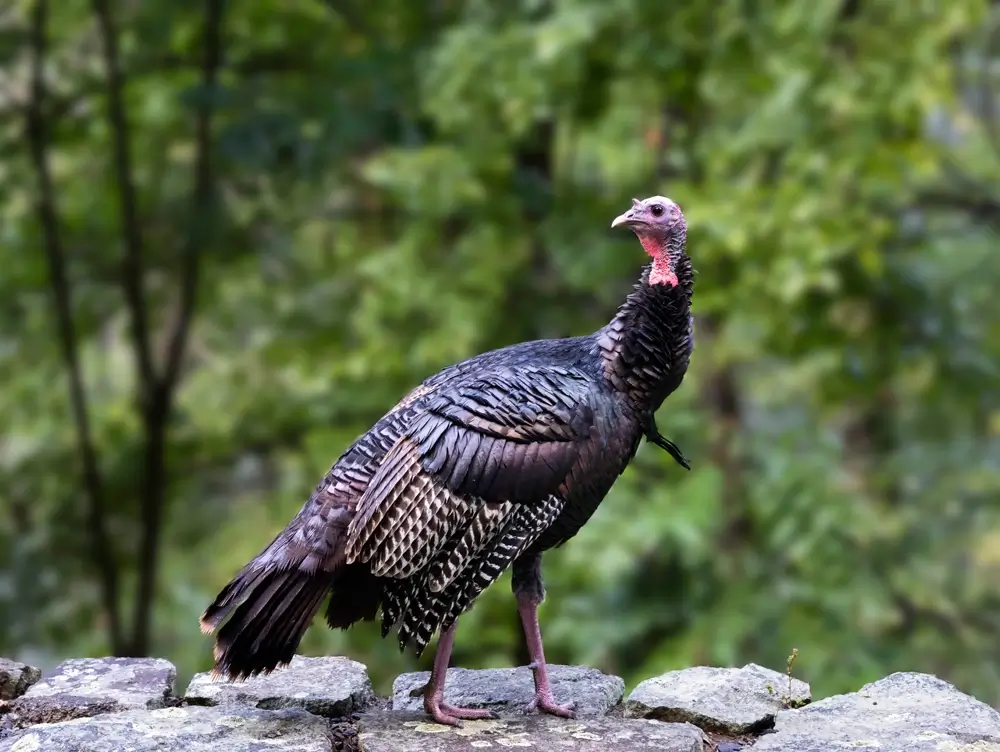
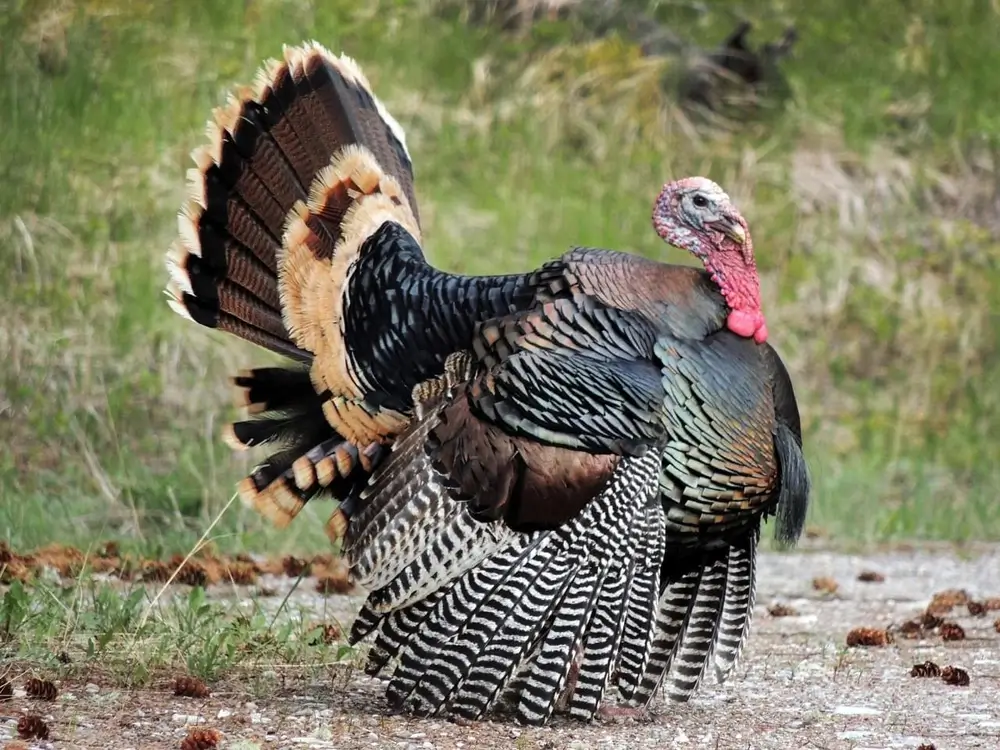
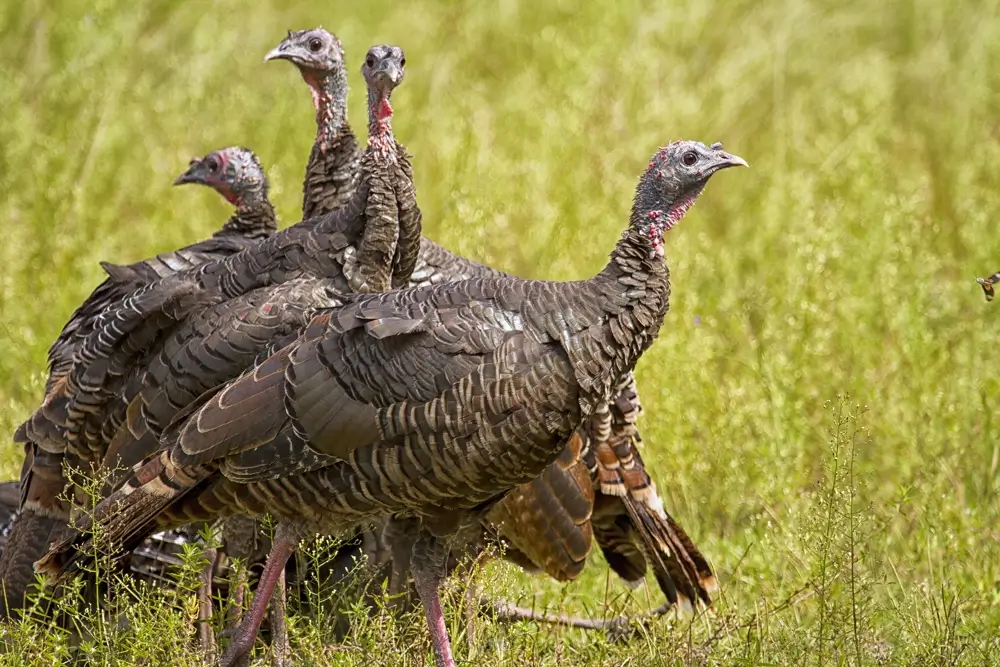
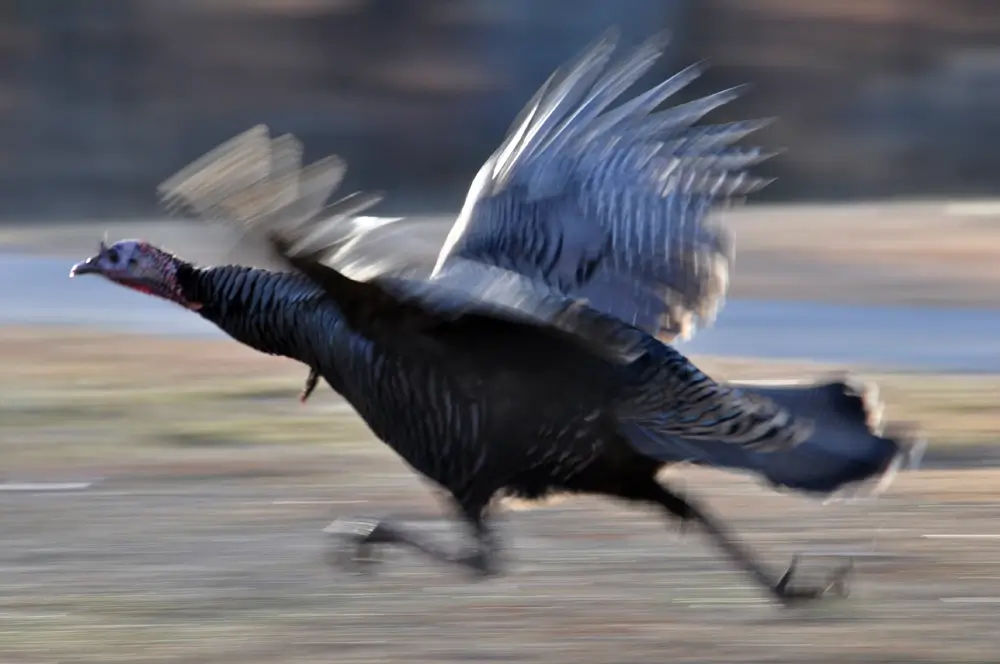
The wild turkey is a large, ground-dwelling bird that is 3-3.6 feet (0.91-1.1 m) in length. It has a large, fan-shaped tail; long, stocky pink or gray legs; short, rounded wings; a bare head and neck; and a small, down-curving bill.
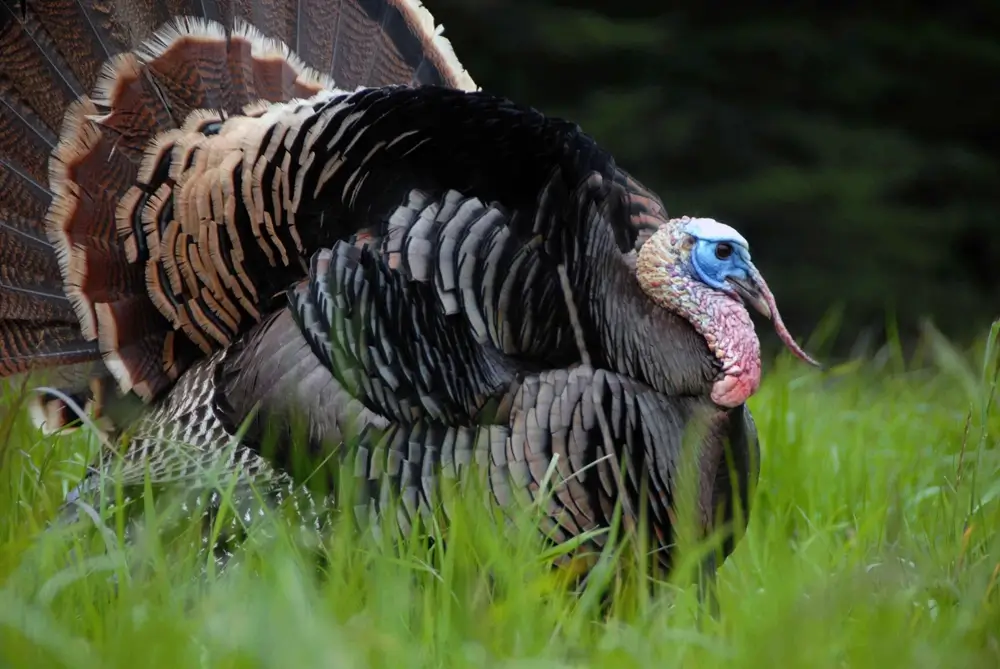
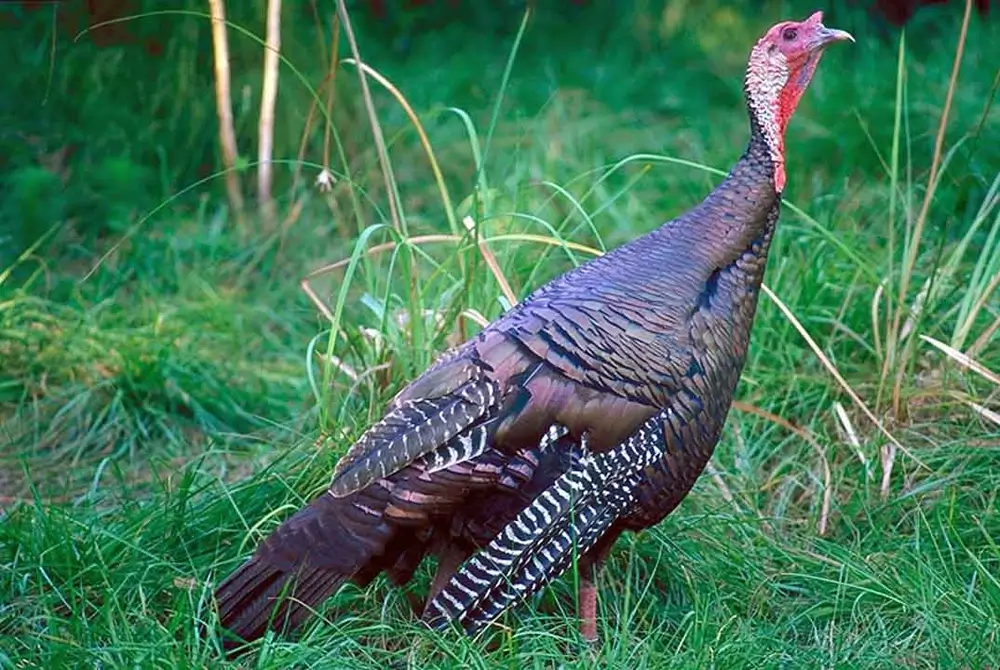
The male wild turkey has a tuft of feathers, called a beard, on his chest and an upwardly curving spur on his lower legs. His breast feathers are tipped with black, and he has a bluish-gray neck and a red wattle – a fleshy lobe of skin that hangs from the neck or chin. The male’s bare head and neck are red, blue, or white depending on the season.
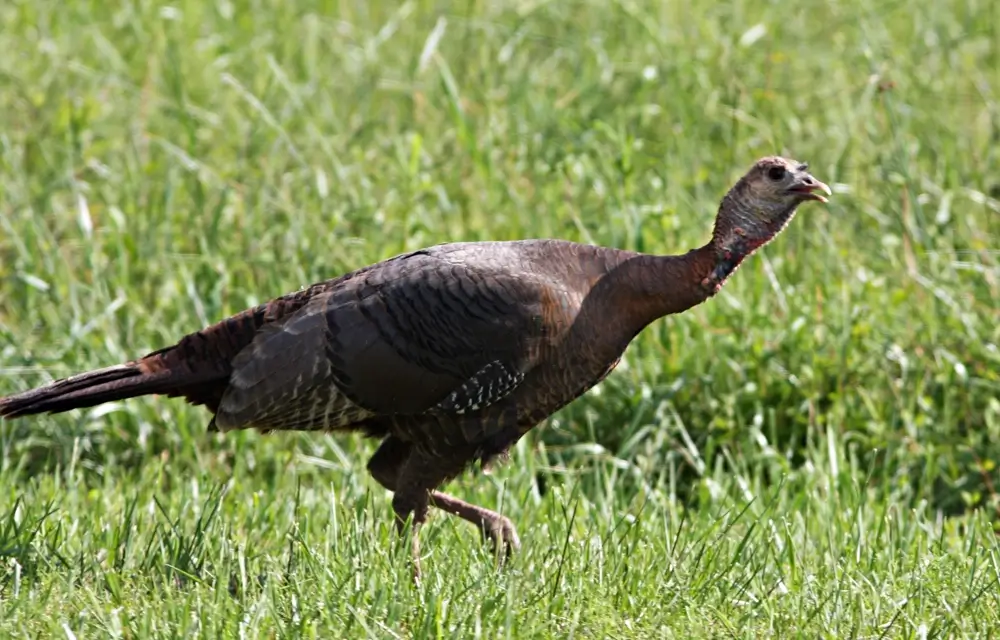
The female’s breast feathers are tipped with brown, white, or gray. She doesn’t have spurs, and she usually doesn’t have a beard. She has a gray head and a feathered neck.
Males are usually larger than females. In the east, the tip of the turkey’s tail is brown. In the southwest, the tail tip is white.
The wild turkey’s call is called a gobble.
Habitat
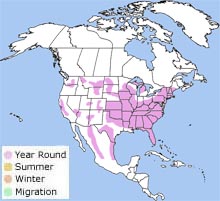
The wild turkey lives in hardwood and mixed conifer-hardwood forests with openings like fields, pastures, orchards, and marshes.
Diet
The wild turkey is an omnivore. It eats acorns, nuts, seeds, fruits, insects, buds, fern fronds, and salamanders.
It usually forages on the ground in flocks, scratching in the earth to uncover food. The wild turkey feeds during the day. It roosts in trees at night.
Life Cycle
The wild turkey mates in the early spring. The male wild turkey gobbles to attract a female. He fans out his tail, struts around the female, lowers his wings, and drags the tips on the ground. The male’s gobble is so loud it can often be heard a mile (1.6 km) away.
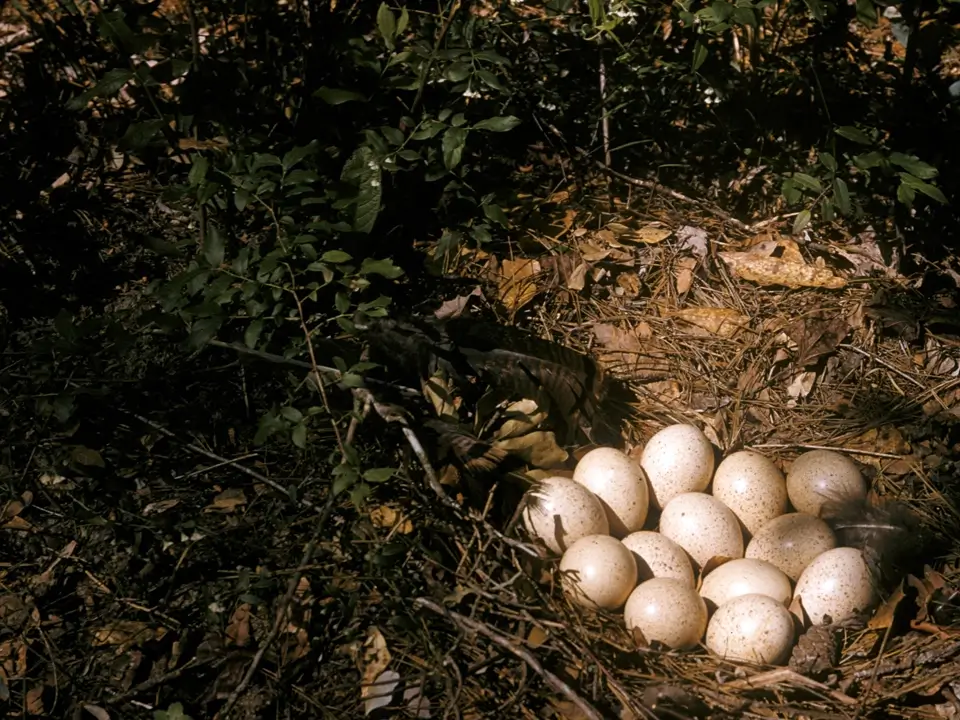
The male mates with more than one female. The female lays 8-15 buff-colored eggs in a shallow depression on the ground that is hidden by brush, grass, vines, or other vegetation. She incubates the eggs for 25-31 days.
The chicks or poults are covered with down at birth and leave the nest shortly after hatching. The chicks are precocial and feed themselves shortly after birth. The male chicks stay with their mother through the fall. Female chicks stay with their mother until the next spring.
The wild turkey has a lifespan of 3-5 years in the wild.
Behavior
The wild turkey is one of only two native North American birds that have been domesticated. The other is the Muscovy duck.
By the end of the 19th century, the wild turkey had been hunted almost to extinction in much of its original range. Today, the wild turkey has been re-established in much of its original range.
Did You Know?
If Benjamin Franklin had had his way, the wild turkey might have been the symbol of the United States instead of the bald eagle. He thought the wild turkey was much more dignified than the eagle.
Support for NatureWorks is provided by:
The Wild Turkey in NH
The wild turkey had totally disappeared from New Hampshire by the late 1800s due to habitat loss and overhunting.
NH Fish and Game began bringing wild turkeys into the state in the 1970s in an attempt to re-establish the wild turkey in the state.
Today, the population in New Hampshire is thought to be around 25,000 birds, and it is found in all 10 New Hampshire counties.