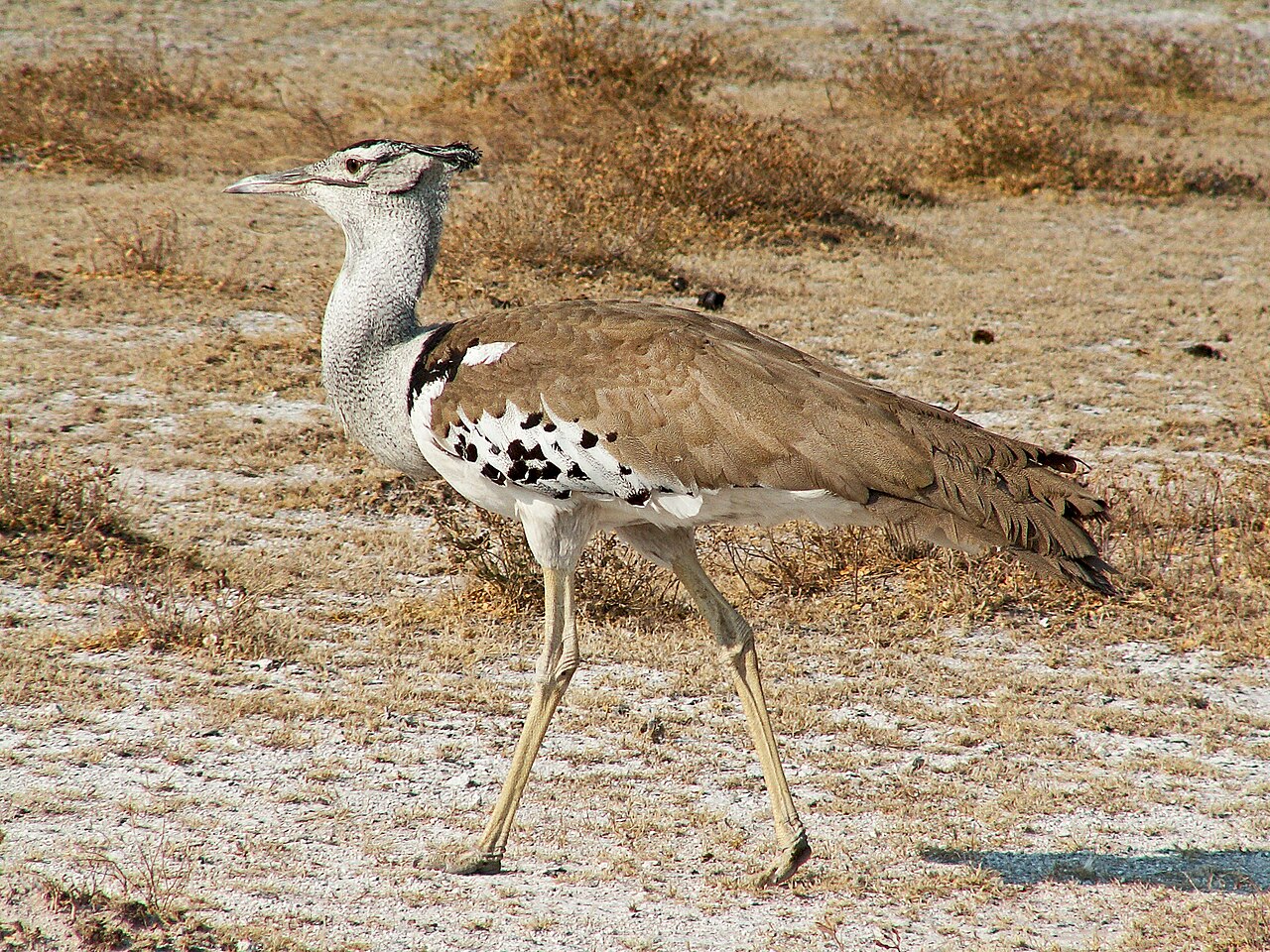
There are 26 species in this order. Most live in the grasslands, savannas, and dry plains of Africa and Asia. A few species are found in Europe, and one species, the Australian Bustard (Ardeotis australis), lives in Australia.
The birds in this order are large, ground-dwelling birds with long legs, long toes, long necks, and broad, pointed wings. Unlike most birds, they lack a hind toe, so they cannot perch in trees.
Although they are strong fliers, they spend most of their time on the ground. They usually walk through tall grasses or stand quietly while searching for food. They eat a wide variety of foods, including seeds, grasses, leaves, insects, lizards, small snakes, rodents, and other small animals. Because they eat both plants and animals, they are omnivores.
Most birds have brown or gray feathers with spots and streaks on their upperparts, which help them blend in with dry grasslands. Their underparts are usually lighter in color, providing excellent camouflage from predators.
They usually nest on the ground. The female lays one to three eggs in a shallow scrape hidden among grasses or other plants. In most species, she incubates the eggs and raises the chicks by herself. The chicks leave the nest soon after hatching and follow their mother as she searches for food.
FAMILIES
Otididae (bustards, floricans, korhaans)