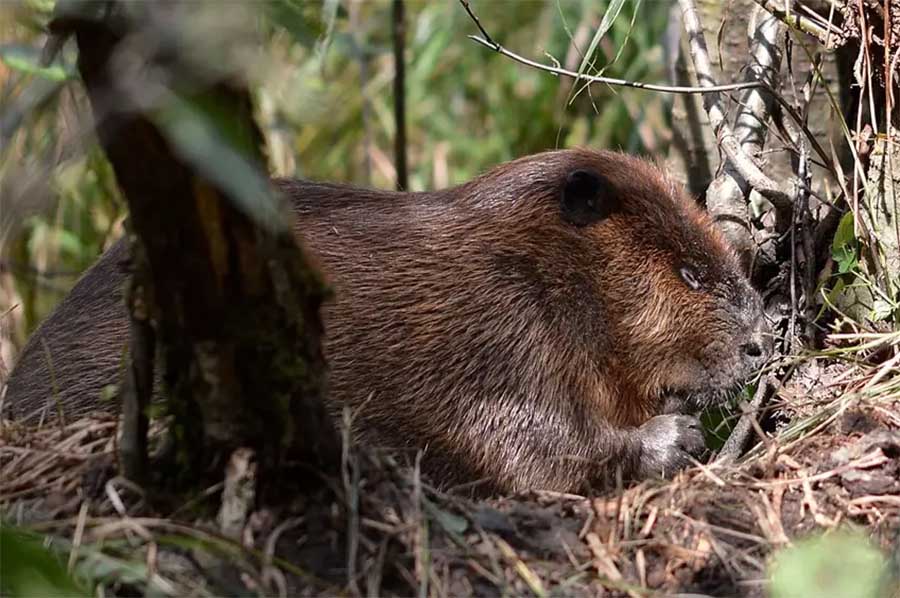
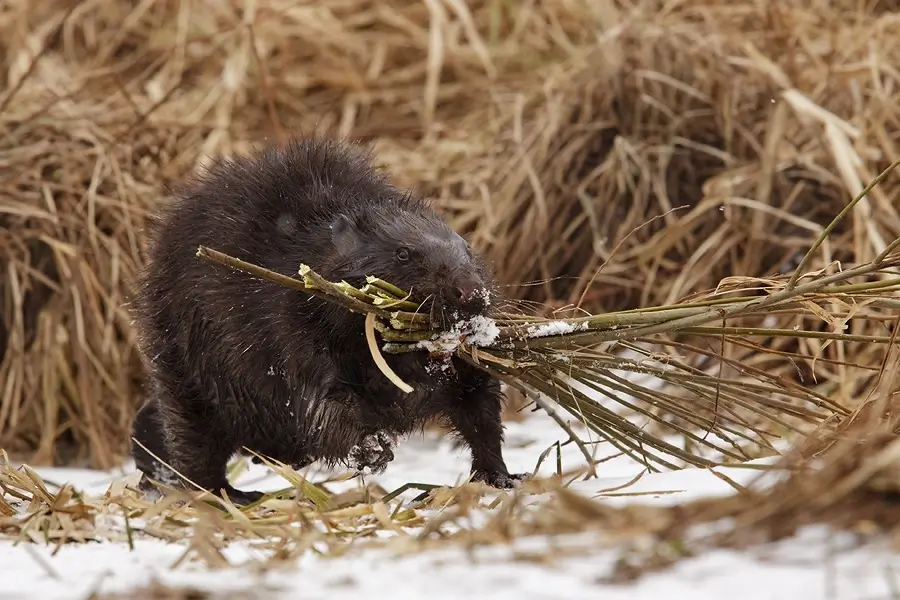
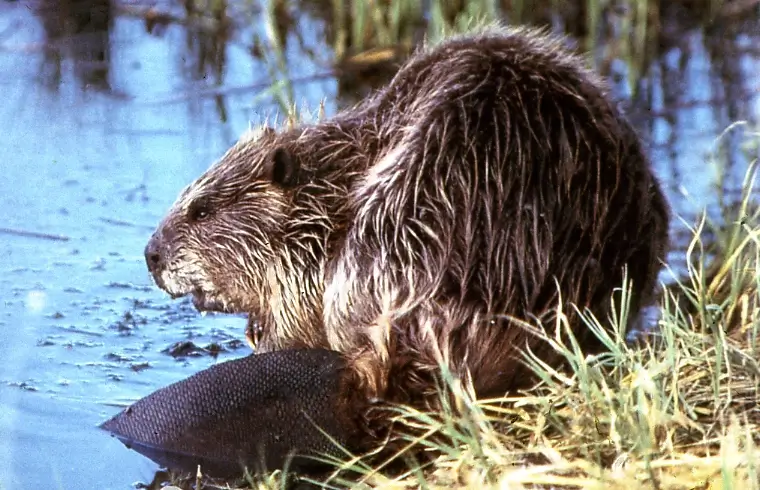
There are two species in this family, the American beaver and the Eurasian beaver.
Beavers spend much of their time in the water and have many adaptations that help them thrive in an aquatic environment. They have thick, waterproof fur and webbed hind feet that they use to propel themselves through the water. When the beaver is underwater, its nose and ears close up, and a special membrane covers its eyes.
Beavers have flat tails and long, sharp upper and lower incisor teeth that they use to cut into trees and woody vegetation. Like the incisors in all rodents, these teeth grow throughout the beaver’s life.
The American beaver is North America’s largest rodent. It is found throughout North America, except for the northernmost parts of Canada, parts of Florida, the desert Southwest, and Mexico.
The Eurasian beaver is found from northern Europe east to Siberia. It is the largest rodent in Europe. It looks like the American beaver. The Eurasian beaver is more likely to live in a burrow than a lodge.
American Beaver (Castor canadensis)
The American beaver usually rises at sundown and returns to its lodge at sunrise. IUCN Redlist Status: Least Concern
Eurasian Beaver (Castor fiber)
The Eurasian beaver was once found throughout Europe and Asia. It was almost hunted to extinction for its fur and castoreum. IUCN Redlist Status: Least Concern