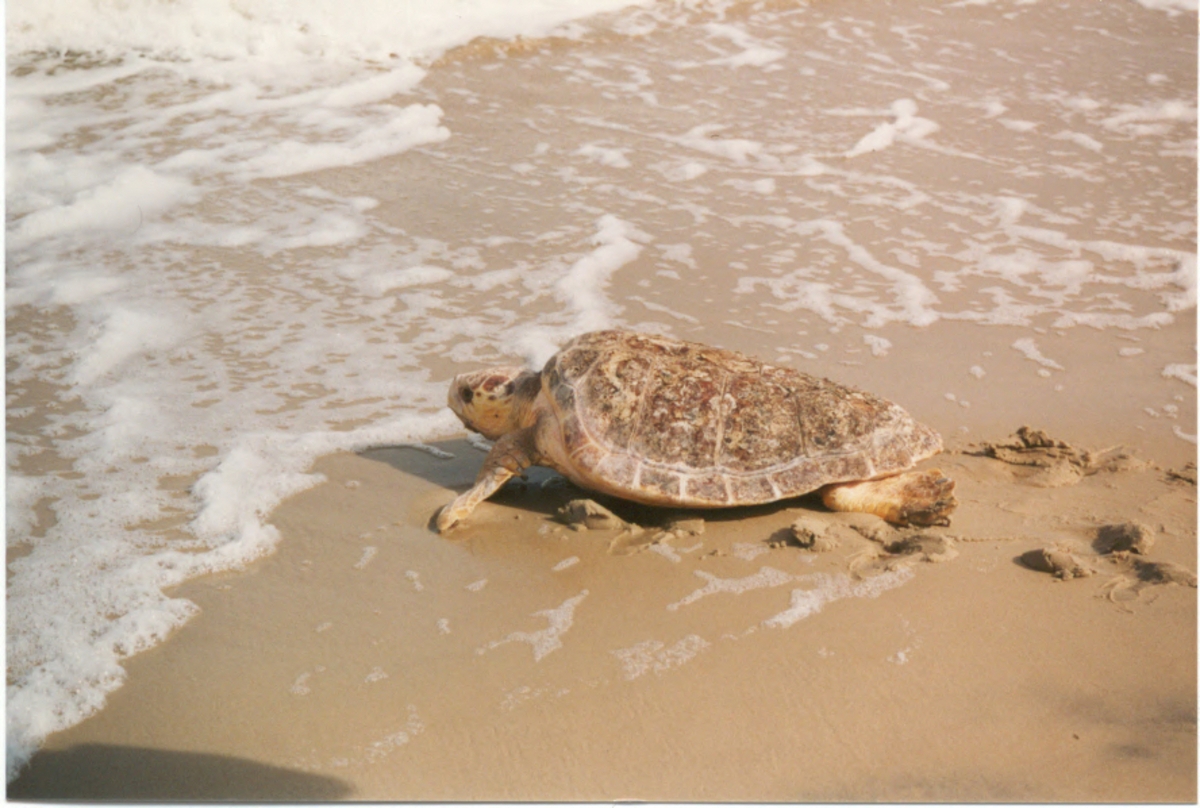
There are 6 extant (living) species of marine turtles in this family. They have streamlined bodies, large paddle-like front flippers for swimming, and a bony shell covered in tough scutes (scales). Unlike their freshwater relatives, Cheloniids are fully adapted to life in the ocean and cannot retract their heads or their flippers into their shells.
They are found in warm and temperate oceans around the world, including the Atlantic, Pacific, and Indian Oceans. They are highly migratory and often travel thousands of miles or kilometers between their feeding grounds and nesting beaches.
Hard-shelled sea turtles are strong swimmers and spend most of their lives in the open ocean or coastal waters. They are usually solitary, except during nesting. Females return to sandy beaches—often the same ones where they were born—to lay eggs. Most species are herbivores or omnivores as adults, feeding on seagrasses, algae, jellyfish, and invertebrates, depending on the species.
Species in this family include the green sea turtle, the Loggerhead sea turtle, the Hawksbill sea turtle, the Kemp’s Ridley sea turtle, the flatback sea turtle, and the Olive Ridley sea turtle.
Learn more about the Kemp’s Ridley Sea Turtle
NatureWorks Episode One – Adaptation
Cody and Octave visit the New England Aquarium’s critical care ward and learn how they are treating Kemp’s Ridley sea turtles that have washed ashore on Cape Cod, Massachusetts. VIEW