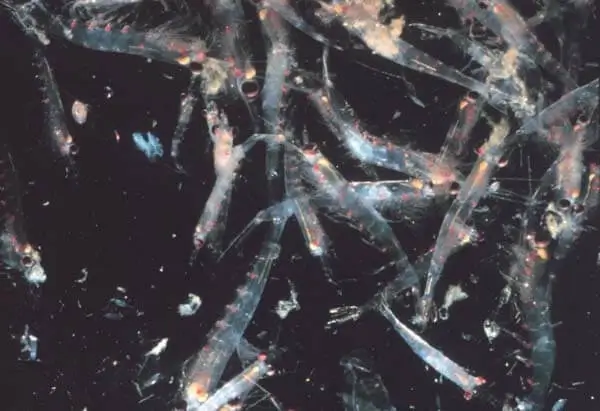
Krill are small, pinkish, translucent shrimp-like crustaceans. They range in size from less than an inch to five inches in length. Krill are found in all the world’s oceans.
During the day, krill are found deep in the ocean where they are safe from predators. At night, they rise to the surface to feed on phytoplankton and zooplankton. Krill live, swim, and feed in large groups or swarms.
Like all crustaceans, krill have an exoskeleton that they shed as they grow. They have segmented bodies and pairs of branched appendages on each body segment. Krill have two pairs of antennae, nine mouthparts that they use for holding and grinding up food, and six to eight pairs of legs that they use to gather and trap food.
They have five pairs of swimming legs on their abdomen. Krill also have photophores that glow at the base of their swimming legs.
Many species of fish, seals, birds, and baleen whales feed on krill. Krill comes from the Norwegian word for “young fish.”