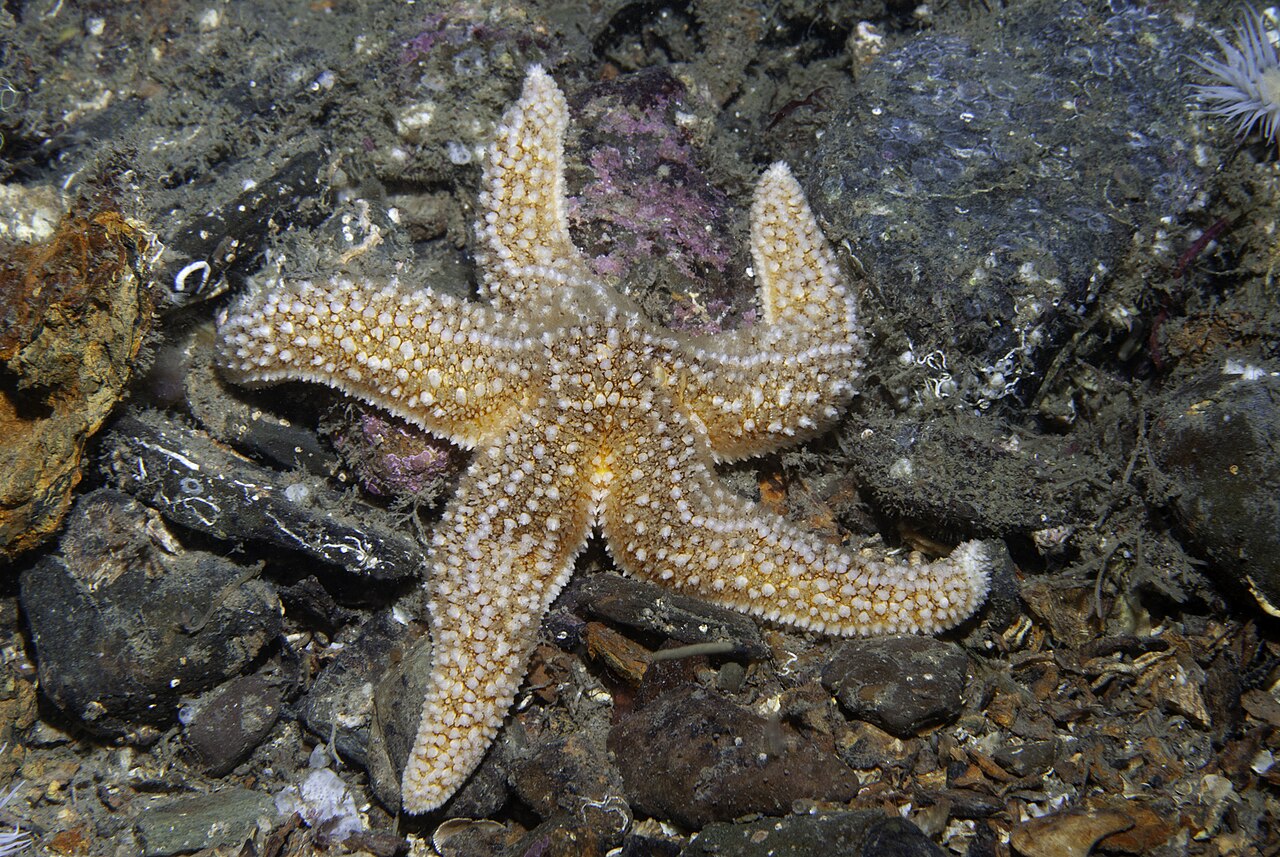
There are about 7,600 living (extant) species of echinoderms and around 11,000 species that are now extinct.
-
Spiny skin: Most echinoderms have a rough or spiny outer covering that protects them from predators.
-
Radial symmetry: As adults, their bodies are usually arranged in a circle or star shape, like a starfish. However, when they are young, they have bilateral symmetry, just like humans, meaning their bodies can be divided into two mirror-image halves.
-
Water vascular system: This is a special network of water-filled tubes that helps them move, breathe, and catch food.
-
Tube feet: Tiny, flexible feet connected to the water system allow them to grip surfaces, move slowly, and even pry open shells of prey.
-
No brain: Echinoderms don’t have a brain. Instead, a nerve ring around their central body helps coordinate movement.
-
Asexual reproduction and regeneration: Many echinoderms can reproduce without mating. They can also regrow lost tissue, organs, or limbs—and in some cases, a single limb can grow into a whole new body.