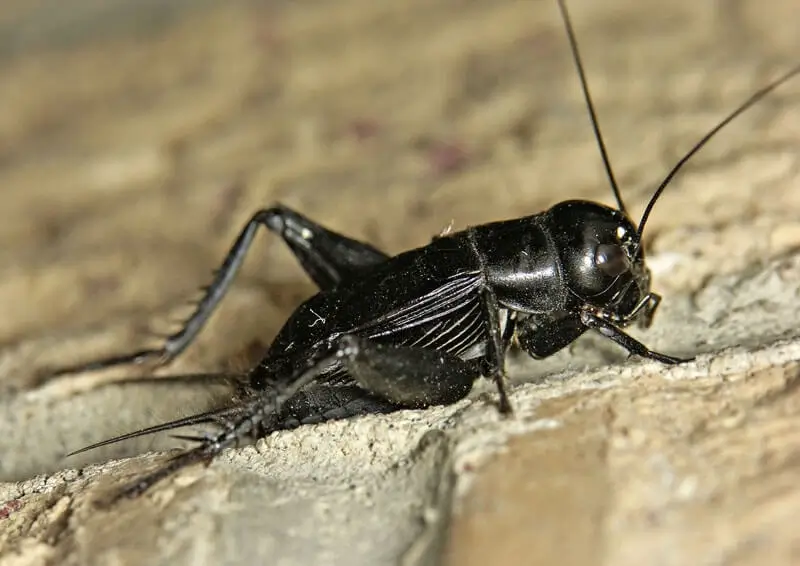
There are around 900 species of crickets in this family. Around 100 species are found in the United States.
True crickets have flattened bodies, antennae that are as long as or longer than their bodies, and two pairs of wings. They also have powerful hind legs that help them jump long distances.
Most species of true crickets are nocturnal. Crickets are famous for their chirping, but only the male makes sounds. Many people think that crickets make sounds by rubbing their legs together. That is not true.
Crickets make sound by rubbing their wings together. Male crickets have ridges on their front wings that look a little like teeth and a hardened edge on each front wing.
When a male cricket is trying to attract a mate or warn away a rival, he rubs the ridges on one wing against the hardened area of his other wing. This creates the chirping sound.
The tone of the chirping will depend on how close together the ridges are on his wings. Male and female crickets have a special auditory organ on their forelegs that helps them hear the chirps.
Different cricket species have different chirps. Temperature can also affect a cricket’s chirp. When the temperature is warm, the chirp is usually faster.
True crickets are omnivores and scavengers. They eat decaying plants, fungi, and sometimes dead or injured crickets.