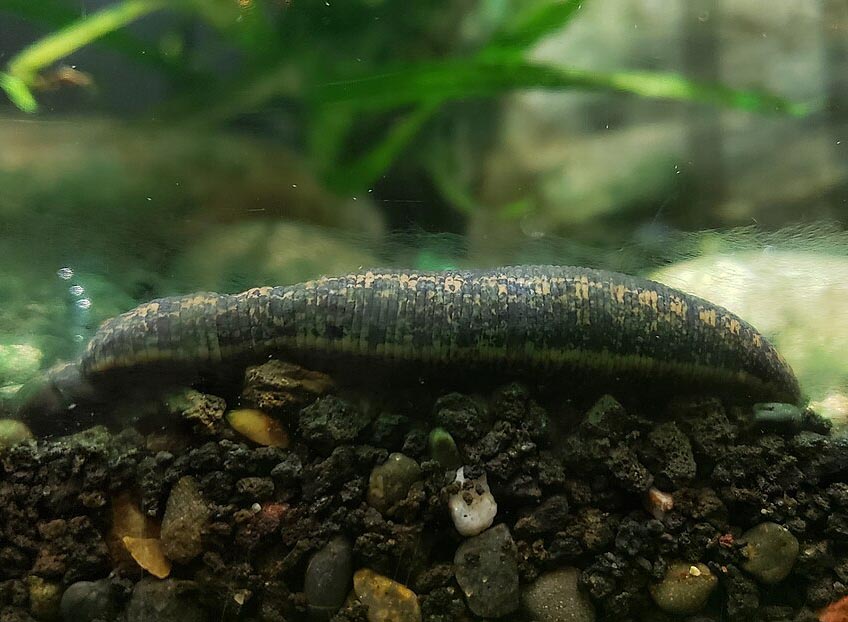
Scientists recognize about 15–25 families and roughly 700–1,000 species of leeched worldwide found in 15-25 families.
Leeches vary widely in size depending on the species. Most are about 0.2-10 inches (0.5-25 cm) long, but some giant tropical species can grow up to about 16 inches (40 cm). They move using two suckers—one at each end of their body—in a slow “inchworm-like” motion. Many species are nocturnal, meaning they are most active at night.
Leeches are found all over the world in many habitats, including freshwater environments such as ponds, lakes, and streams, as well as marine habitats and moist land environments like wet soil and rainforests. They are most common in warm, damp regions.
Leeches have different feeding strategies depending on the species. Many are blood-feeders and attach to fish, amphibians, reptiles, birds, or mammals. When feeding, they can swell significantly as they take in a large blood meal, which they digest slowly over time. Other species are predators, feeding on small invertebrates such as worms, insect larvae, or snails. A few species feed on decaying organic matter.
Blood-feeding leeches attach to their hosts using either small jaws or a tube-like mouth called a proboscis, depending on the species. Their saliva contains special chemicals, including anticoagulants (such as hirudin), that prevent blood from clotting so they can feed more easily.
Leeches have also played an important role in medical history. The practice of using leeches, called leech therapy, dates back thousands of years. In ancient Egypt, Greece, India, and later medieval Europe, doctors used leeches based on the belief that illness was caused by an imbalance of bodily fluids. During the 18th and 19th centuries in Europe, leeching became extremely common and was used to treat many conditions by removing what was thought to be “excess blood.”
Today, leeches are still used in modern medicine, but in a careful and controlled way. Sterile medical leeches (often the species Hirudo medicinalis) are sometimes used in reconstructive surgery to improve blood flow in reattached tissues, such as skin grafts, ears, or fingers. Their saliva contains compounds that prevent clotting and can help reduce swelling and support healing in specific medical situations.