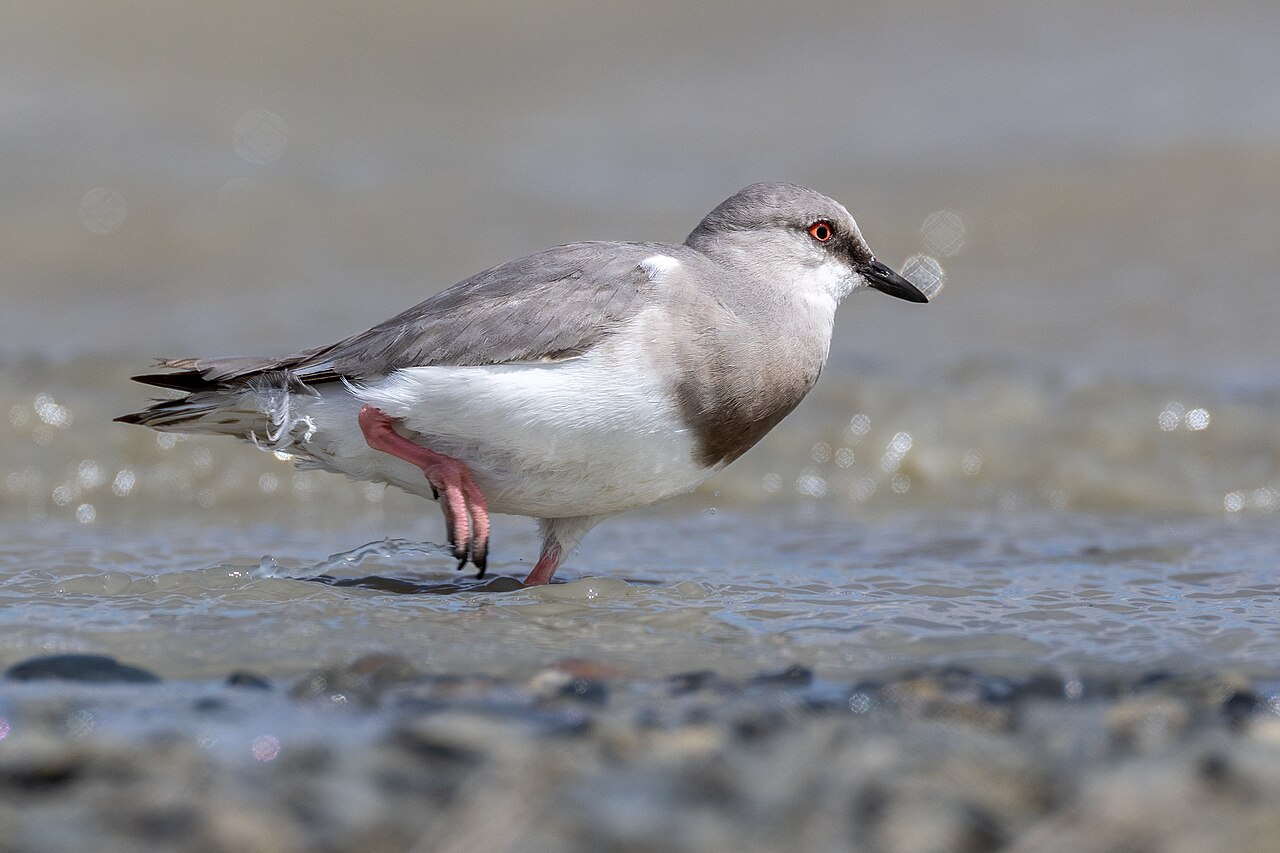
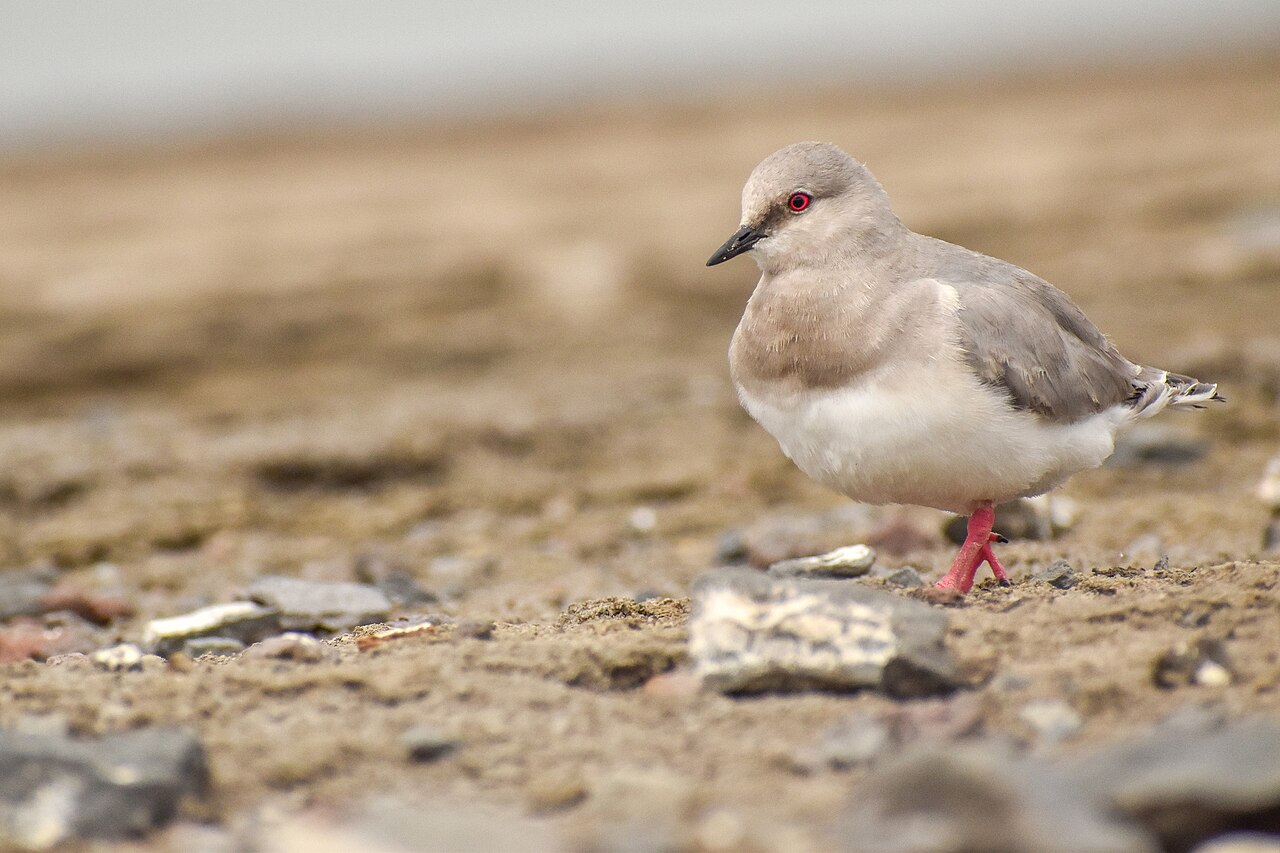
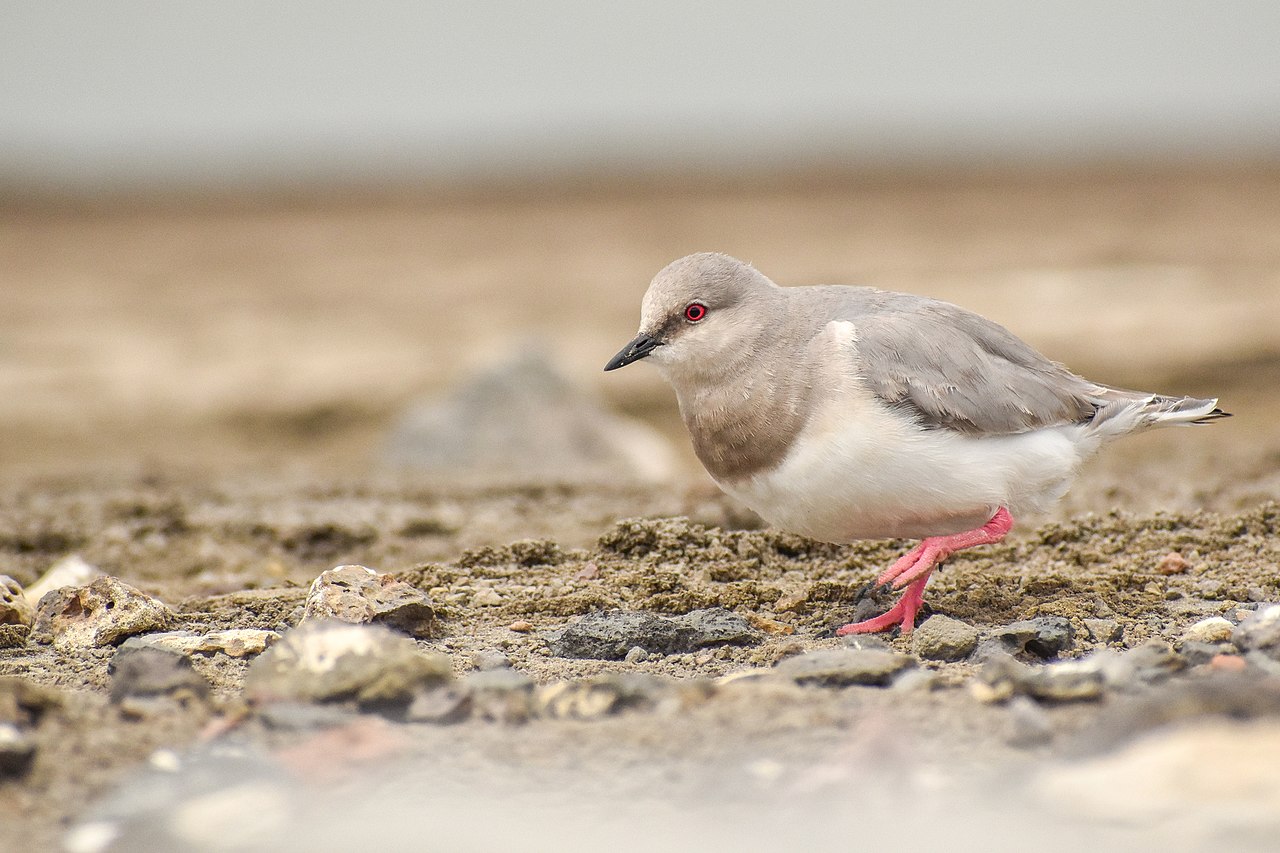
The only member of this family is the Magellanic plover Pluvianellus socialis). It is only found in southernmost South America.
It has characteristics that have confused scientists about how it should be classified.
It is not a plover, although it was placed in the Charadriidae family once. Some thought it was a sandpiper because of its bill and that it should be in the Scolopacidae family. Others thought that the way it feeds its young made it part of the dove or Columbidae family.
Using DNA analysis, scientists discovered that it was most closely related to the sheathbills in the Chionidae family, but that it was different enough to deserve a family of its own.
The Magellanic plover is a wading bird. It is a soft dove-gray on its uppersides and white on its belly. It has a black bill, pink legs, and red eyes.
It feeds on small invertebrates that it finds on the shore. It often turns over stones and pebbles looking for food, like the ruddy turnstone. It also uses its legs to dig in the mud and sand for prey.
Magellanic plovers nest on the ground. The female lays two eggs, but usually only one survives. Both parents incubate the eggs and feed, and care for the chick. The parents feed the chick crop milk like doves feed their chicks.
The Magellanic plover is the only wading bird that uses this method to feed its chicks.
Magellanic Plover (Pluvianellus socialis)
The Magellanic plover is only found in southern most South America in Chile and Argentina. IUCN Redlist Status: Vulnerable
Magellanic Plover (Pluvianellus socialis)
The Magellanic plover is not a plover. IUCN Redlist Status: Vulnerable
Magellanic Plover (Pluvianellus socialis)
The Magellanic plover feeds on small invertebrates that it finds on the shore. IUCN Redlist Status: Vulnerable