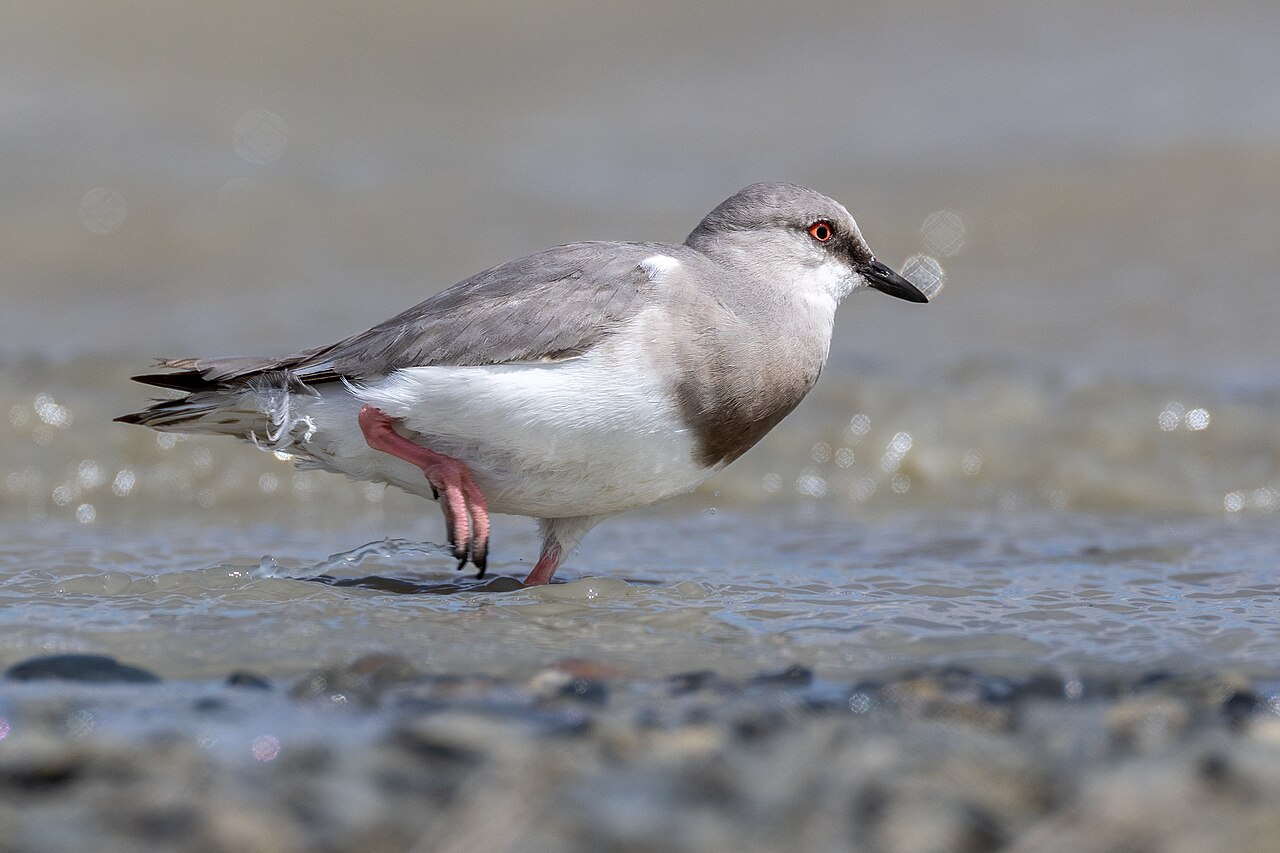
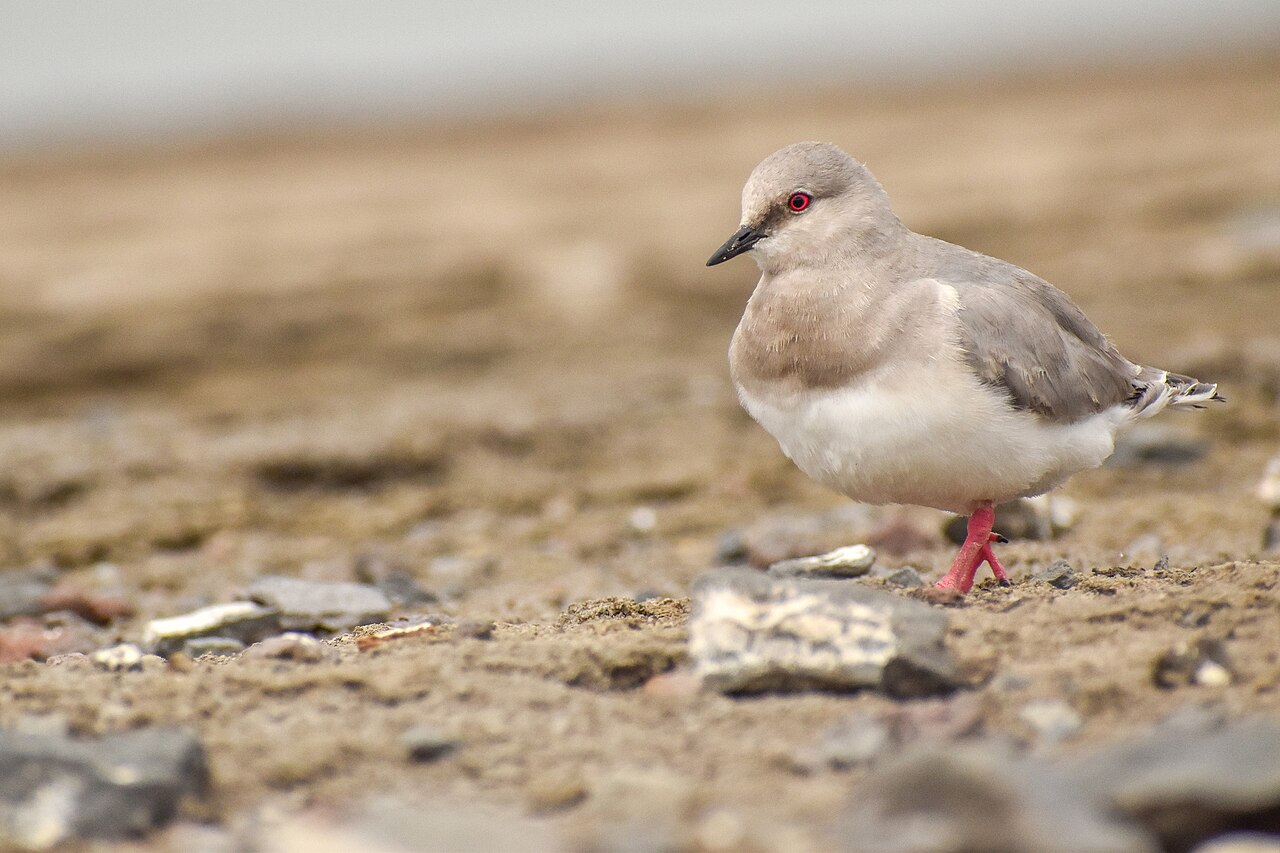
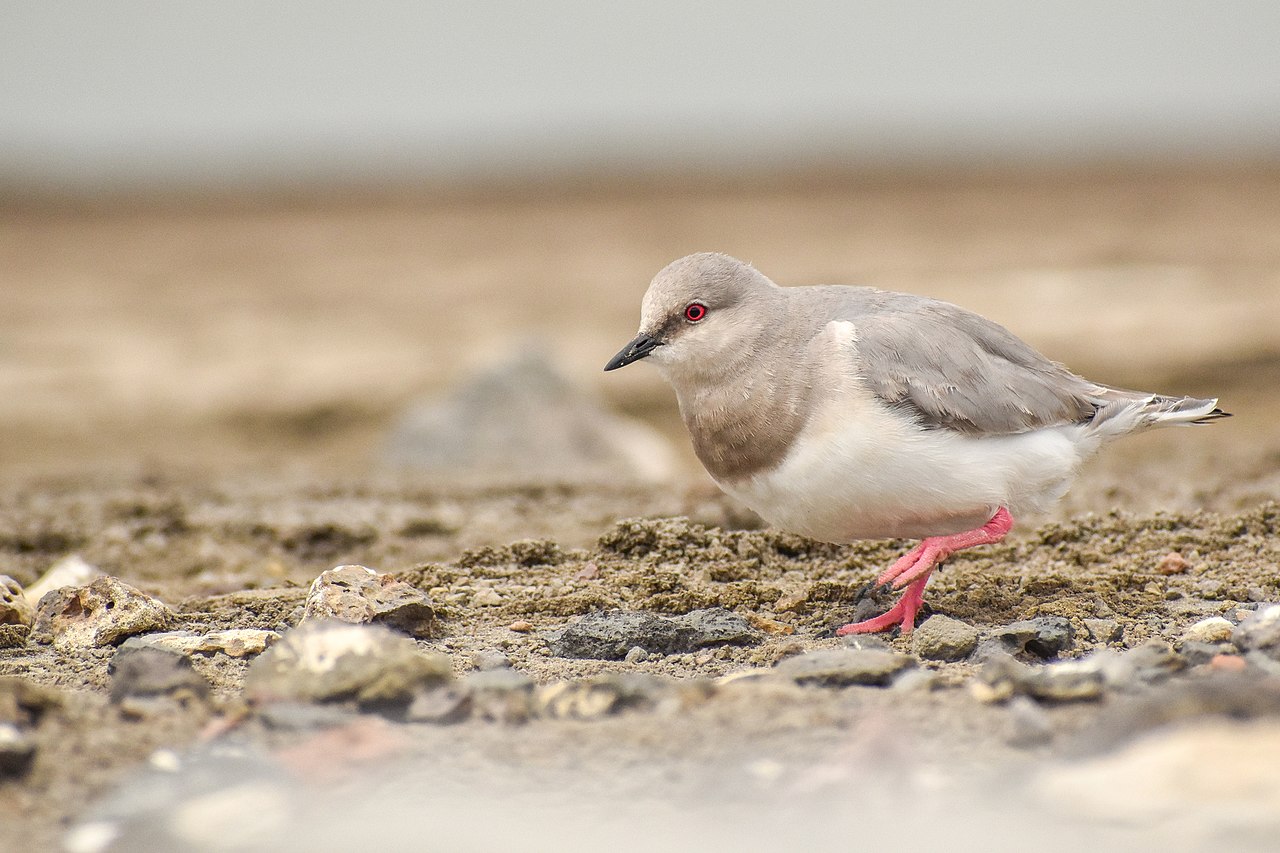
The only member of this family is the Magellanic Plover (Pluvianellus socialis). It is found in the southernmost parts of South America, especially in Argentina and Chile.
The Magellanic Plover is a shorebird that lives near lakes, lagoons*, estuaries, and coastal areas. It has soft dove-gray upperparts, a white belly, a black bill, pink legs, and striking red eyes.
It feeds mainly on small invertebrates such as insects, worms, and crustaceans. While searching for food, it often flips over stones and pebbles, much like the Ruddy Turnstone (Arenaria interpres). It may also use its feet to stir up mud and sand to uncover hidden prey.
Magellanic Plovers nest on the ground, usually near lakeshores. The female typically lays two eggs, although often only one chick survives to fledging. Both parents share incubation duties and care for the chick after it hatches.
One of the most unusual features of this bird is the way it feeds its young. The parents produce a nutritious substance called crop milk, which they feed directly to the chick. This behavior is common in doves but is unique among shorebirds. The Magellanic Plover is the only known shorebird that feeds its chicks in this way.
For many years, scientists were unsure how to classify this unusual bird because it shares characteristics with several different bird groups.
Despite its name, the Magellanic Plover is not a true plover. It was once placed in the plover family (Charadriidae). Some scientists thought its bill and appearance suggested a relationship with sandpipers (Scolopacidae), while others noted that its use of crop milk resembled that of doves (Columbidae).
Modern DNA studies eventually showed that the Magellanic Plover is most closely related to the sheathbills (Chionidae). However, it is different enough from other bird groups that it is placed in its own family, Pluvianellidae.
* A lagoon is shallow water separated from the sea by land.