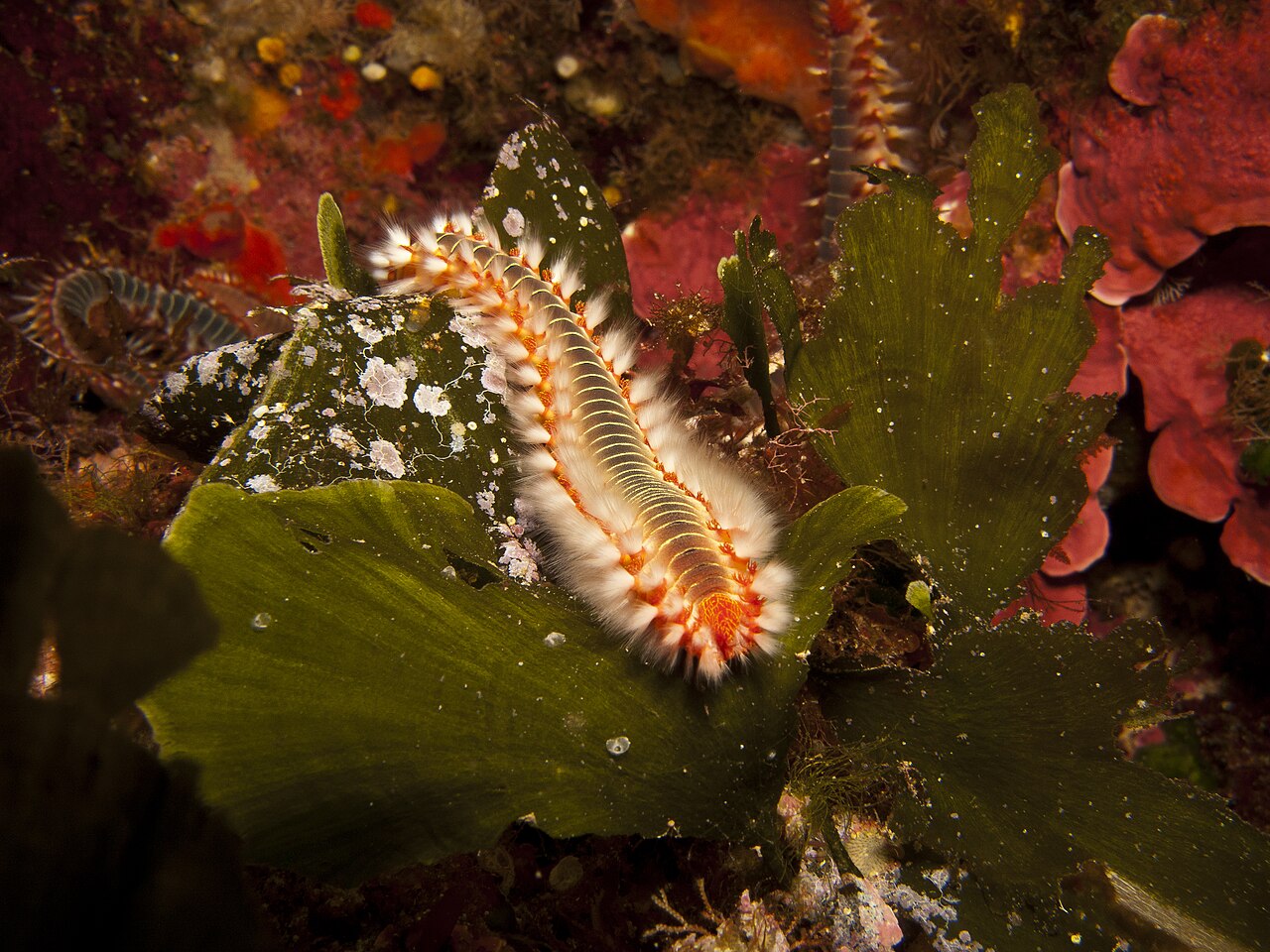
There are about 10,000-13,000 known species of bristle worms, grouped into roughly 80-90 families.
Polychaetes are called “bristle worms” because they have many tiny, hair-like structures called chaetae (bristles) sticking out from their bodies. These bristles help them move, dig, and defend themselves. Some species, such as fireworms, have bristles that can sting predators—and even humans.
Most bristle worms are marine animals, meaning they live in saltwater. They can be found in many ocean habitats—buried in sand or mud, crawling along the seafloor, living inside tubes they build, or even swimming freely in the water.
Like all annelids, bristle worms have long, segmented bodies. Each segment typically has a pair of paddle-like structures called parapodia, which have bristles attached. They also have well-developed heads, often with eyes, antennae, and sometimes jaws.
Bristle worms have different feeding styles:
- Some are predators that hunt small animals
- Some are filter feeders that catch tiny particles from the water
- Others are detritivores that eat dead organic matter
Most bristle worms are about 2 to 10 inches (5.1 to 25.4 cm) long, though some small species are less than 1 inch (under 2.5 cm). Larger species can grow over 12 inches (30.5 cm).
A few giants, such as the bobbit worm, can reach lengths of up to about 10 feet (3 m). The bobbit worm lives in warm marine waters, especially in the Atlantic Ocean and parts of the Indo-Pacific.
The bobbit worm is an ambush predator. It buries most of its long body in soft sediment on the ocean floor, leaving only its antennae exposed. When the antennae sense movement, it quickly strikes, using powerful jaws to grab prey. It is most often found in sandy or muddy seafloors but can also live near coral reefs.