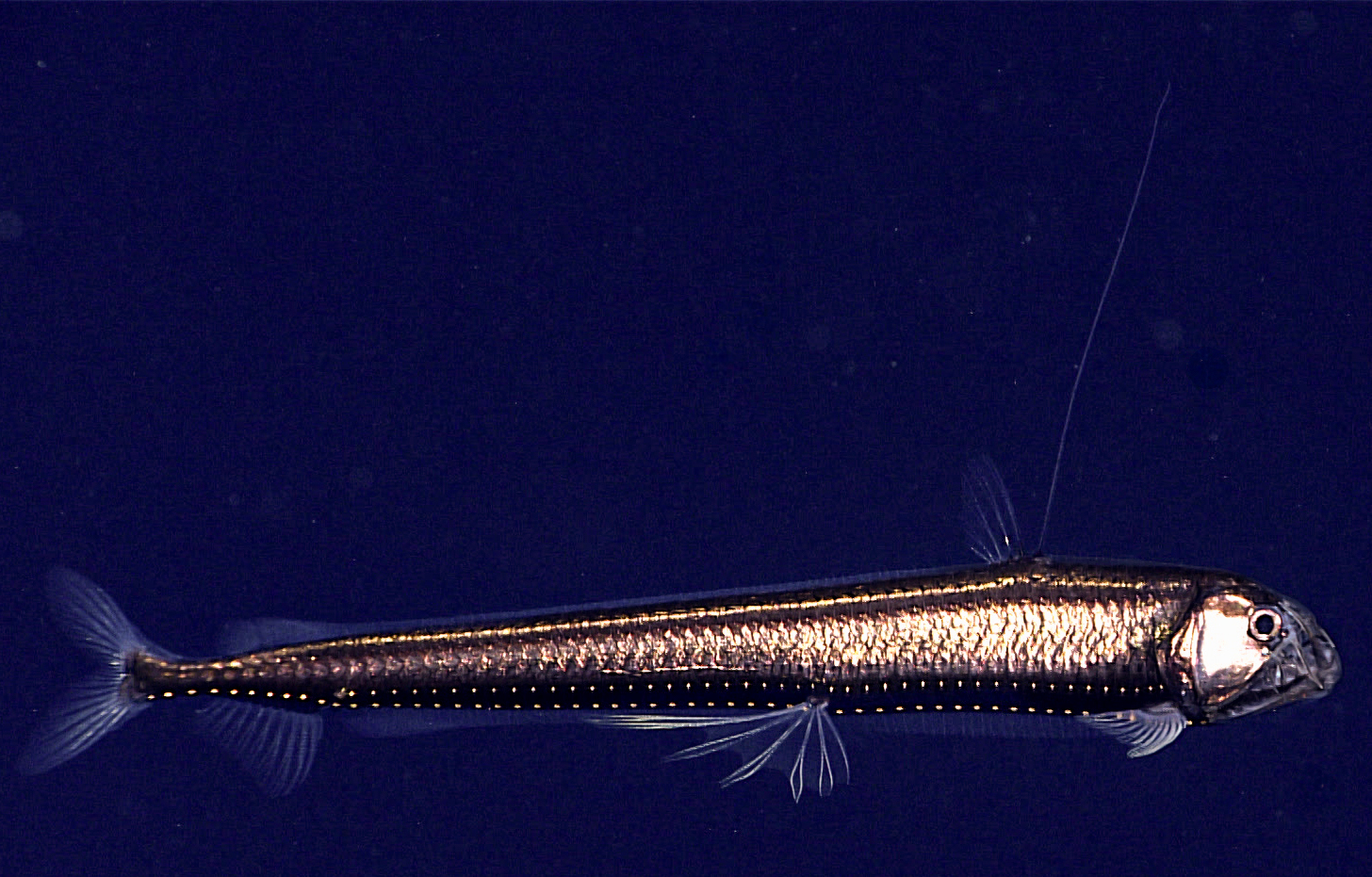
There are 410 species in four families in this order of deep-sea fishes, living in some of the darkest parts of the ocean. These mysterious fish are specially adapted to survive far below the surface, where sunlight can’t reach. They live in oceans all over the world—from subtropical and temperate waters to subarctic and even Antarctic regions.
One of the most amazing features of Stomiiformes is their ability to produce light, a trick called bioluminescence. Tiny light-producing organs called photophores run along their bodies. These glowing lights help them attract prey and communicate with other fish in the pitch-black deep sea.
Stomiiformes usually have long, slender bodies, big mouths, and sharp teeth. Some have teeth so large that they can’t close their mouths all the way—perfect for catching and holding onto prey in a place where food is hard to find. Many also have large eyes, helping them spot even the faintest glimmers of light.
Although most are small, these fish are vital to ocean ecosystems. For example, bristlemouths are thought to be among the most abundant vertebrates on Earth.
They live in the mesopelagic and bathypelagic zones—about 556 to 3,281 feet (200–1,000 meters) deep. Many species migrate closer to the surface at night to feed and return to deeper water during the day, a pattern called vertical migration.
The smallest species is the bristlemouth (Cyclothone pygmaea), just 0.6 inches (1.5 cm) long, found in the Mediterranean Sea. The largest species is the barbeled dragonfish (Opostomias micripnus), about 20 inches (50 cm) long, found in the Atlantic, Indian, and Pacific Oceans.