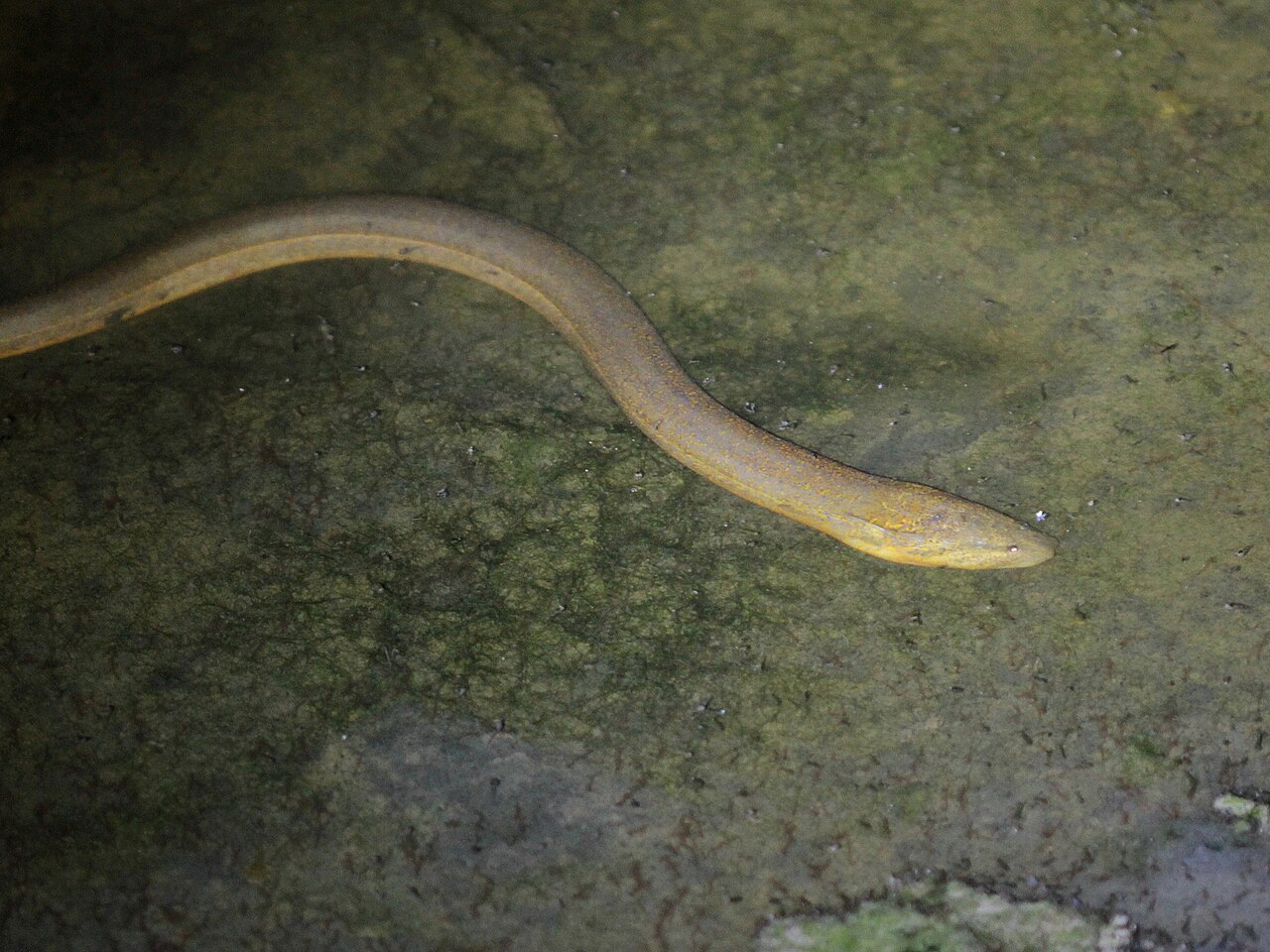
There are about 99 species of eel-like fish in this order, grouped into three families. They are specially adapted for life in warm, slow-moving waters—and some can even survive on land for short periods.
Synbranchiformes are found mainly in parts of Asia, Africa, Australia, and Central and South America. All but three species live in freshwater habitats such as swamps, caves, and slow-moving or brackish waters. Many are predators, feeding on small fish, insects, and other aquatic animals.
These fish are often called swamp eels or spiny eels, though they are not true eels. They have long, slender bodies, lack a swim bladder, and usually do not have the pelvic fins seen in many other fish. They range in size from about 8 to 48 inches (20 to 150 cm). Some species also have very small or no scales, giving them a smooth, slippery appearance.
Their gills are poorly developed, and many species can also breathe air by gulping it at the water’s surface. This ability allows them to survive in low-oxygen environments such as muddy swamps, rice paddies, and stagnant ponds.
Some members of this group can even burrow into mud or travel short distances over land, especially when their watery habitats dry up, making them highly resilient and adaptable.
In some species, individuals can change sex during their lifetime, starting as females and later becoming males.