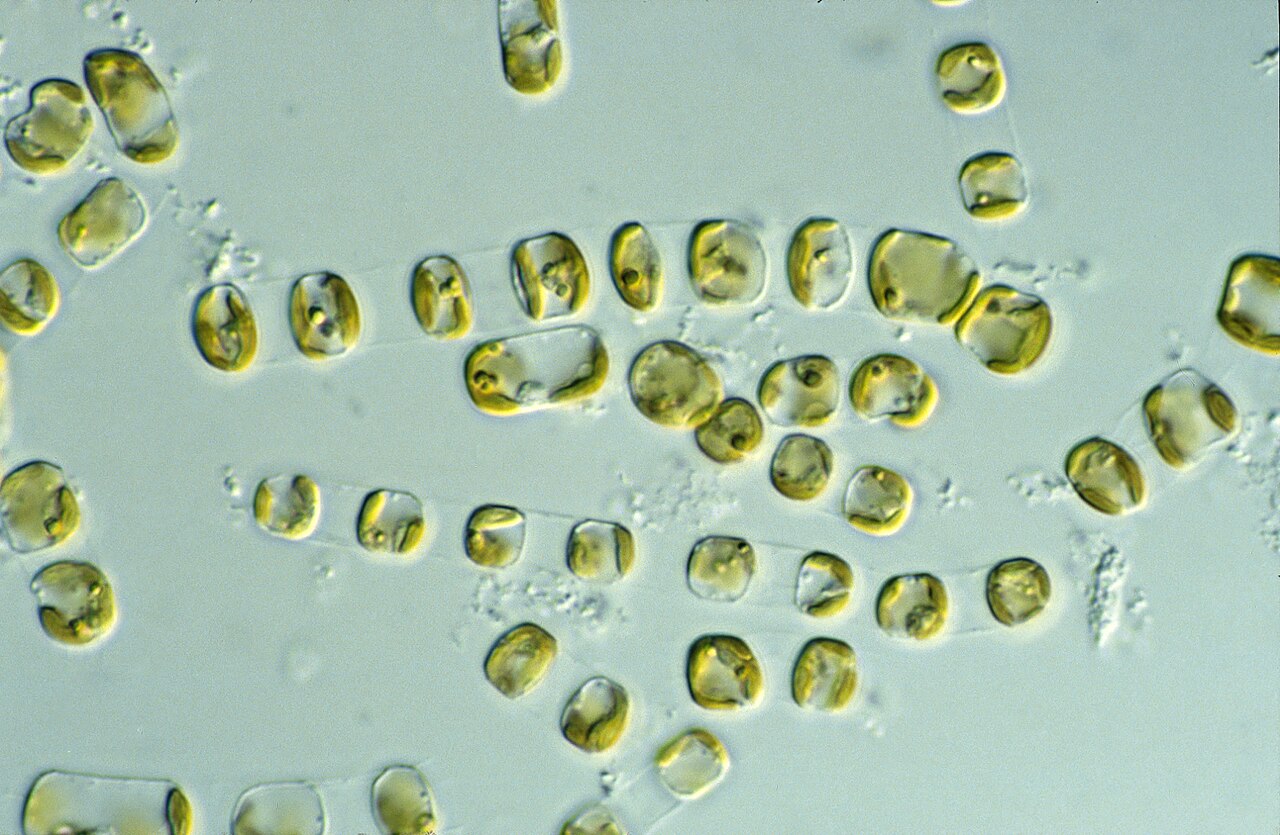
Diatoms are single-celled algae. They often join together in long chains.
One of the most important plants in the sunlit zone is also the smallest. Phytoplankton are organisms that float on or near the surface of the water. Most are rounded and single-celled. All phytoplankton use photosynthesis for their energy, but some get additional energy by consuming other organisms.
The most common phytoplankton are diatoms and dinoflagellates. Diatoms are single-celled algae. They often join together in long chains.
Dinoflagellates are small organisms with two tails or flagella. Dinoflagellates come in all kinds of shapes and sizes. Some have shells, and some don’t.
Not all dinoflagellates rely only on photosynthesis for all their energy. Some wrap themselves around food and absorb it. Some dinoflagellates can make light using bioluminescence.
Zooflagellates, like dinoflagellates, have long flagella. They either absorb their food or engulf it in food vacuoles or pockets.
They live under many different conditions. Some are parasites and can be found in the digestive tracts of animals like cockroaches and termites; others are free swimmers. The free swimmers are zooplankton.
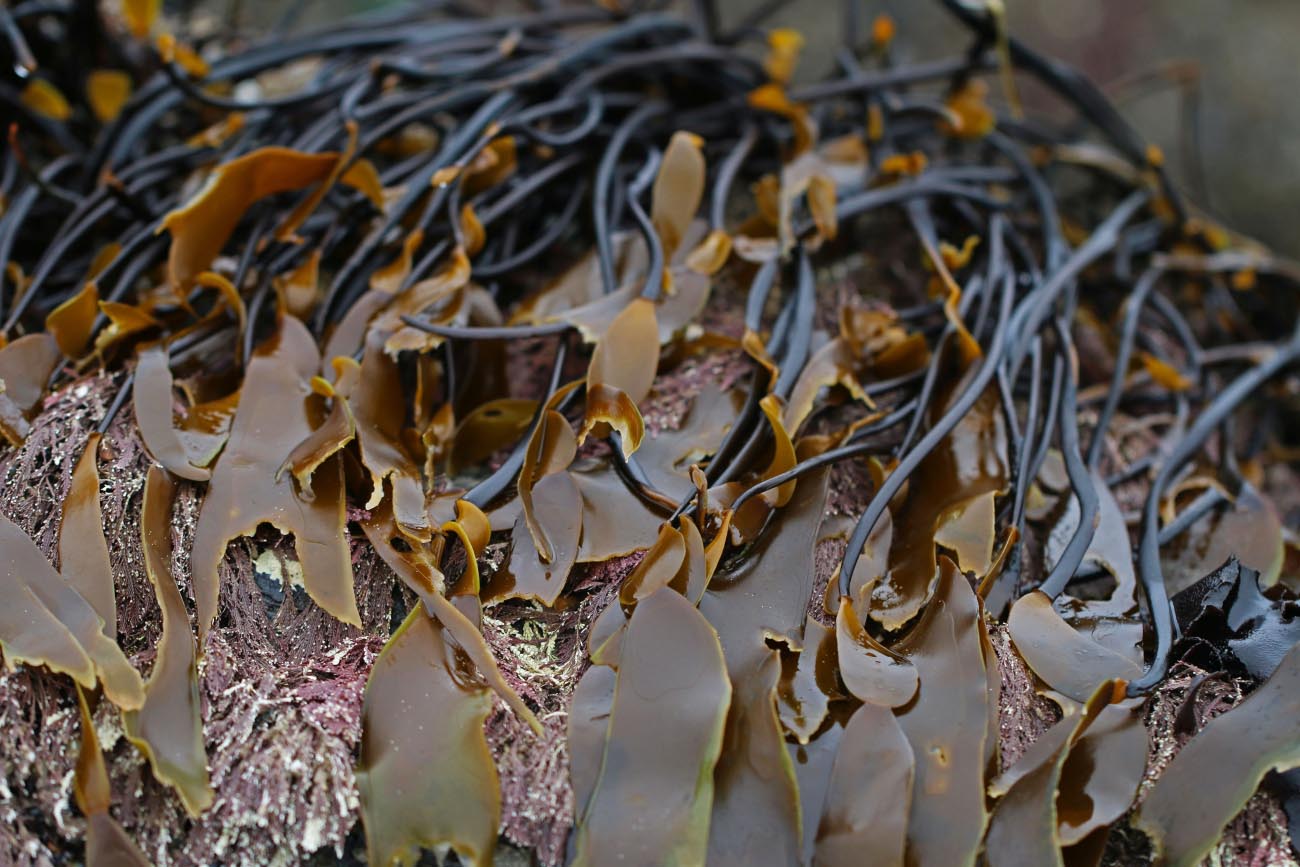
Stiff-stiped kelp is a species of brown algae.
Phaeophyta, or brown algae, are a type of phytoplankton found in oceans and other aquatic environments. Although many brown algae are large seaweeds, such as kelp, some exist in microscopic forms that drift in the water.
Kelp is one of the most well-known types of brown algae and can form underwater forests along coastlines. These kelp forests provide food, shelter, and breeding areas for many marine animals, including fish, sea urchins, and sea otters.
Kelp can grow very quickly and often anchors itself to the seafloor with strong root-like structures called holdfasts.
Another important group of phytoplankton is blue-green algae, also called cyanobacteria. These organisms are actually bacteria, not true algae, but they behave like plants in many ways.
Cyanobacteria are very common in both freshwater and marine environments. Like other phytoplankton, they carry out photosynthesis, but some are nitrogen fixers and can convert nitrogen gas from the air into nitrates, a form of nitrogen that they and other marine plants can use for growth.
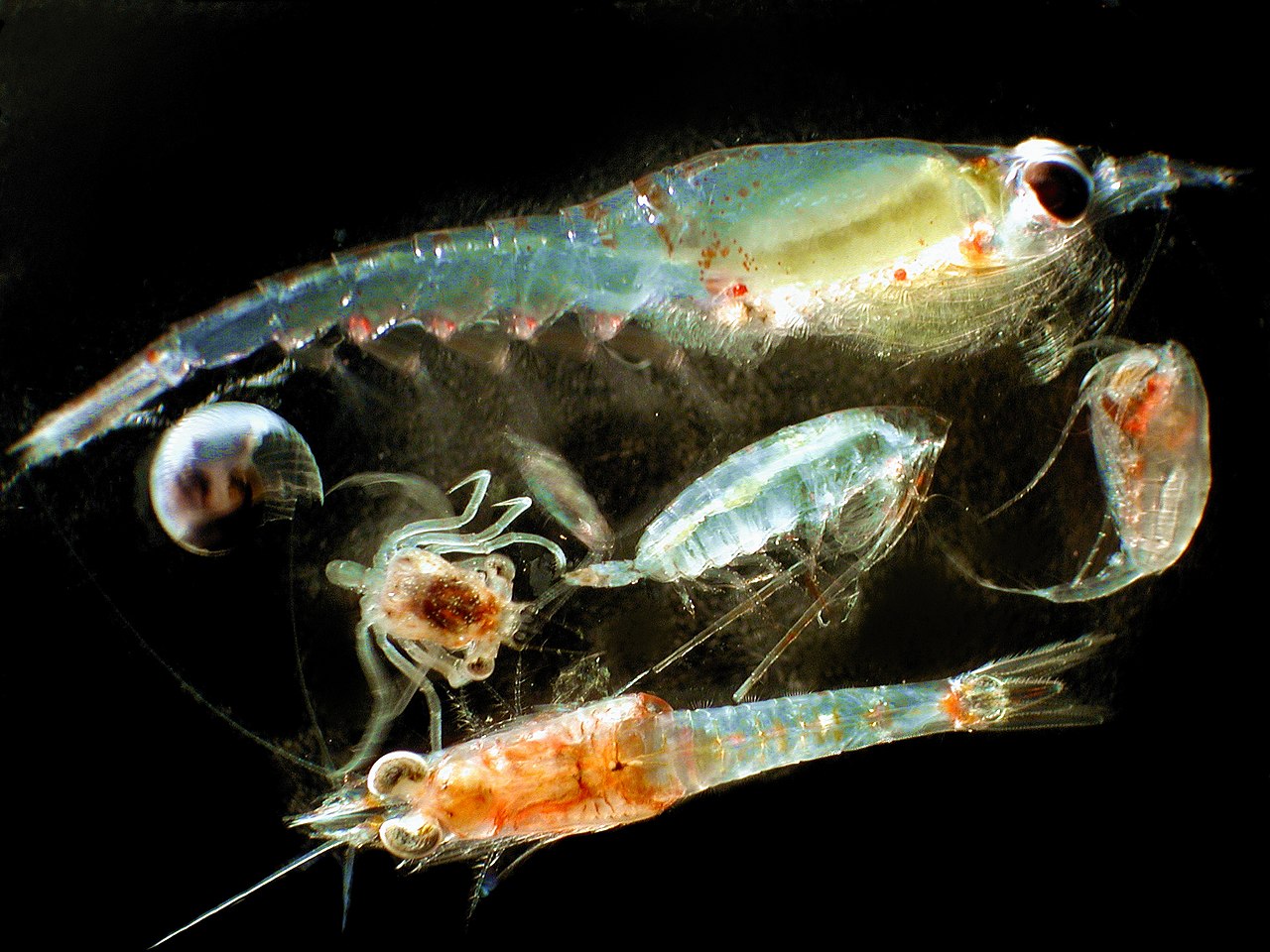
Zooplankton range in size from tiny microbes to jellyfish, although most zooplankton are tiny, single-celled organisms.
Zooplankton are ocean animals that don’t swim at all or are very weak swimmers, and they drift or move with ocean currents. They can be found in the sunlit zone and in deep ocean waters. Zooplankton range in size from tiny microbes to jellyfish, although most zooplankton are tiny, single-celled organisms.
There are two types of zooplankton. Permanent or holoplankton will always be zooplankton. Temporary or meroplankton are made up of the larvae of fish, crustaceans, and other marine animals. If they survive, they will grow into free-swimming organisms called nekton.
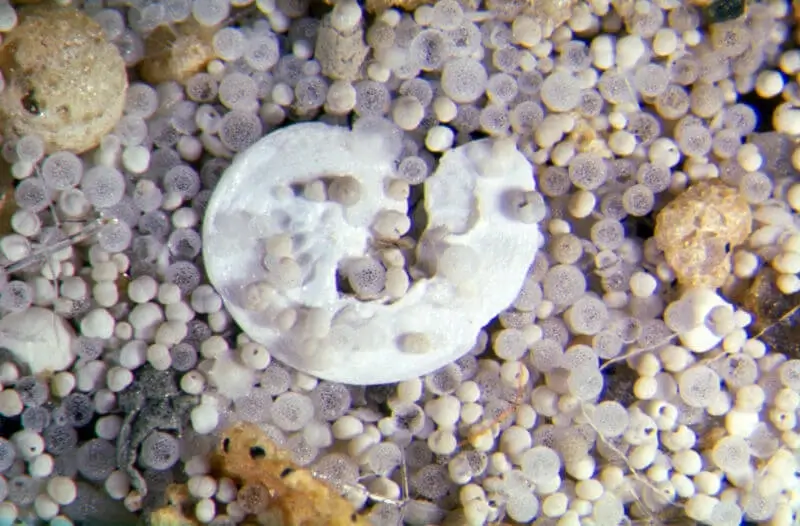
Foraminifera are tiny single-celled, shell-covered organisms.
Foraminifera are tiny, single-celled, shell-covered organisms, usually between a millimeter and a centimeter in diameter. As they grow, they add chambers to their shells. Depending on the species, the shell may be made of sand, calcite, or organic matter.
They move and catch their food with thin, hair-like extensions called pseudopodia. When foraminifera die, their shells sink to the ocean floor and form an ooze.
It is estimated that 30 percent of the ocean floor is made of the shells of foraminifera. Both limestone and chalk come from foraminifera.
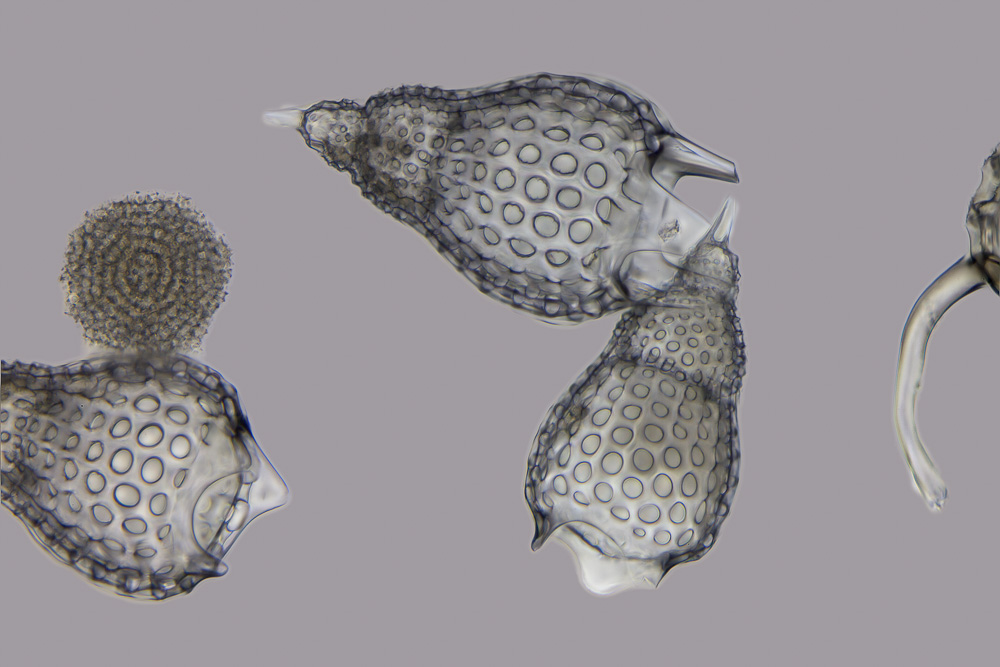
Radiolarians have long, sticky, tentacle-like arms called pseudopodia.
Radiolarians are tiny, round, single-celled organisms that live in the ocean and are known for their glass-like shells. They build their shells out of silica, a material found in minerals like quartz and used to make glass.
Radiolarians take silica directly from seawater to build and maintain their protective outer shells.
Radiolarians have long, sticky, tentacle-like extensions called pseudopodia. They extend these pseudopodia through openings in their shells to capture floating phytoplankton and other small organisms for food.
When radiolarians die, their silica shells sink slowly to the ocean floor. Over time, as many shells collect together, they can become compacted and form layers of sedimentary rock, preserving a record of ocean life from the past.
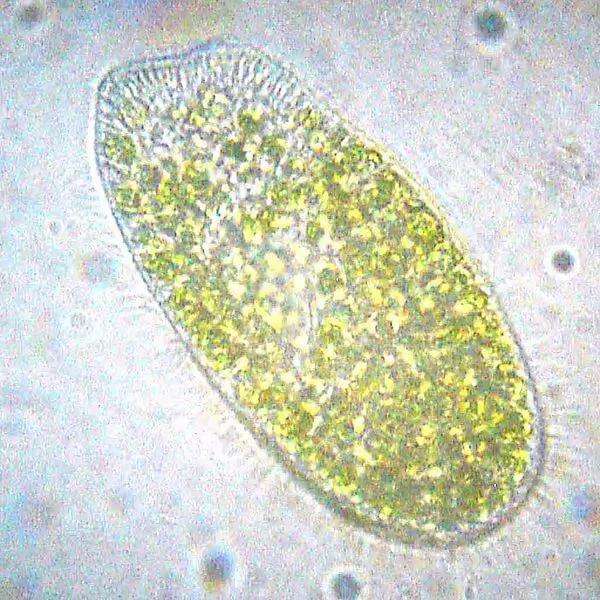
There are over 8000 species of ciliates., including paramecium.
Ciliates are single-celled organisms covered with tiny hair-like structures called cilia. They use cilia to move and to sweep food into their mouths.
There are over 8,000 species of ciliates, including Paramecium. They live in both saltwater and freshwater environments.
Some ciliates are free-swimming, while others attach to surfaces or live as parasites.
Only the free-swimming ciliates are considered zooplankton.
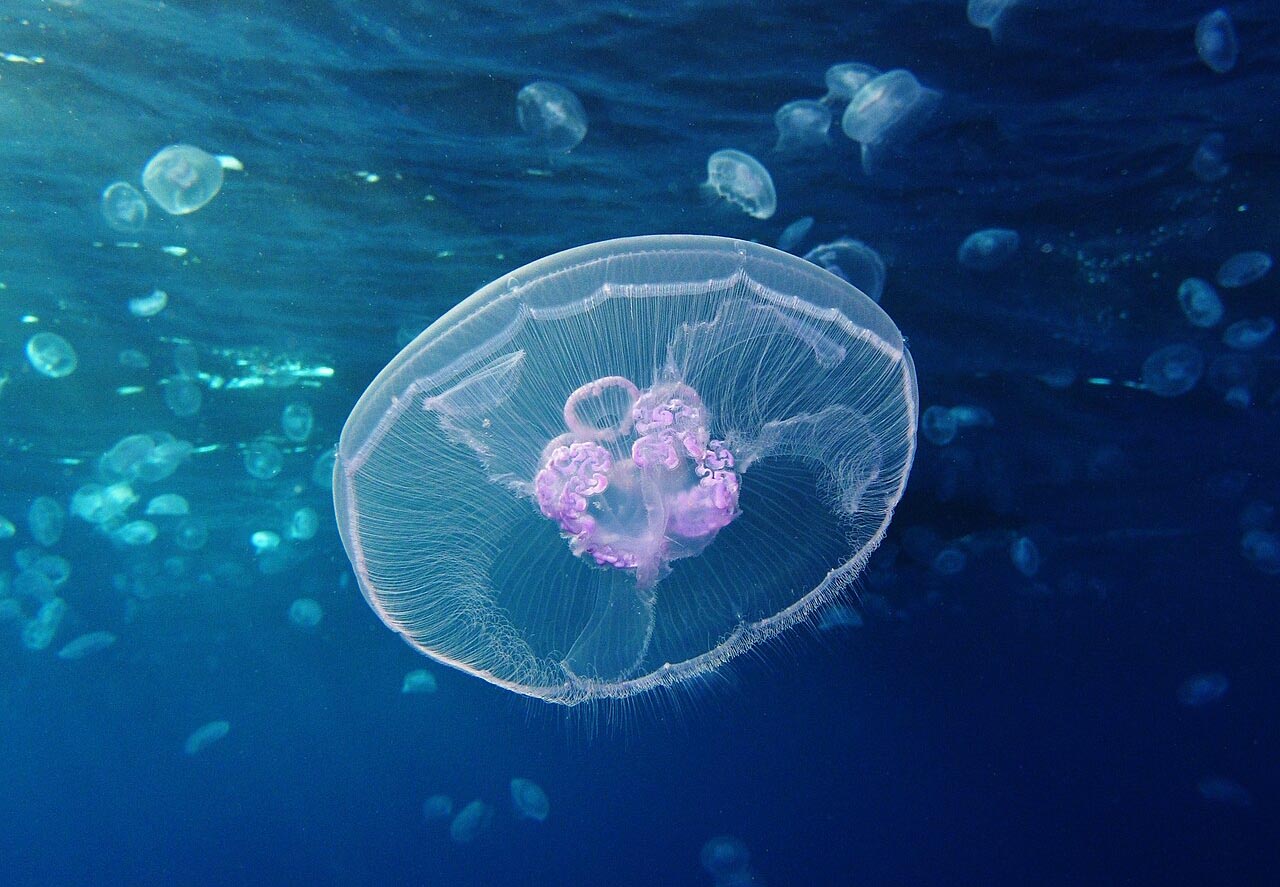
Jellyfish are also zooplankton.
Jellyfish are also zooplankton. Jellyfish are basically big stomachs and long tentacles. Their tentacles have stingers on them, and they use them to catch and paralyze food and carry it to their stomachs.
They move in the water by pumping their stomachs. They mostly move up and down in the water and let the currents carry them from side to side.
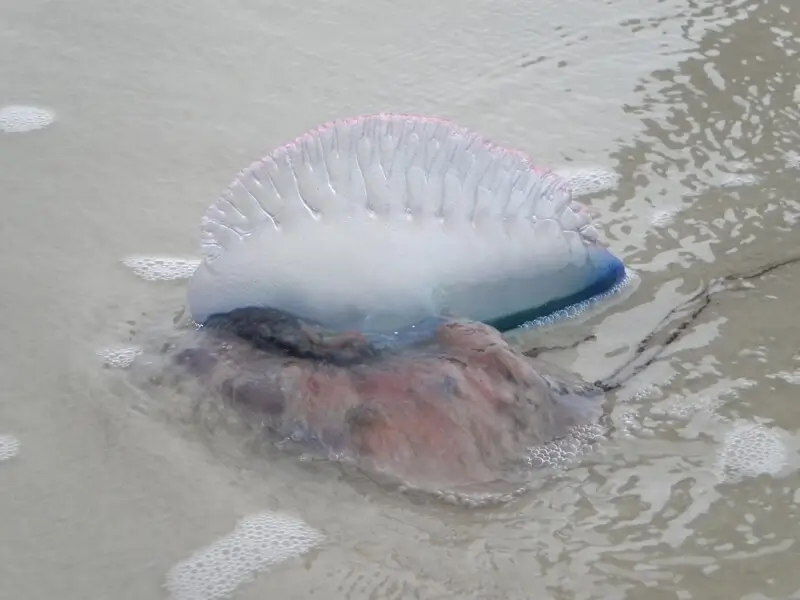
Siphonophores like the Portuguese man-of-war look like jellyfish but they are not.
Siphonophores like the Portuguese man-of-war look like jellyfish, but they are not. They are really groups or colonies of animals. Each organism in the colony has a special niche or role. Some form the tentacles, and some form the mouth and stomach.
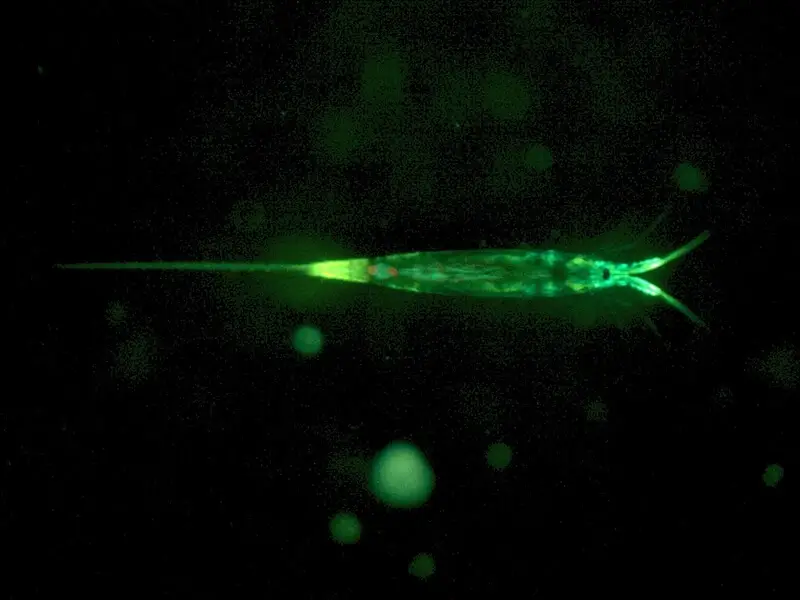
Copepods are sometimes called the insects of the sea because there are so many of them - about 10,000 species!
Copepods are sometimes called the insects of the sea because there are so many of them – about 10,000 species. They can be found in fresh and salt water. Copepods are very small, usually not more than a few millimeters long.
The largest copepod, the Pennella balaenopterae, lives on the finback whale and can grow to be over a foot long. Copepods are crustaceans. They have two antenna, a shell and segmented bodies. They graze on phytoplankton and zooplankton. Copepods are the largest source of protein in the ocean.
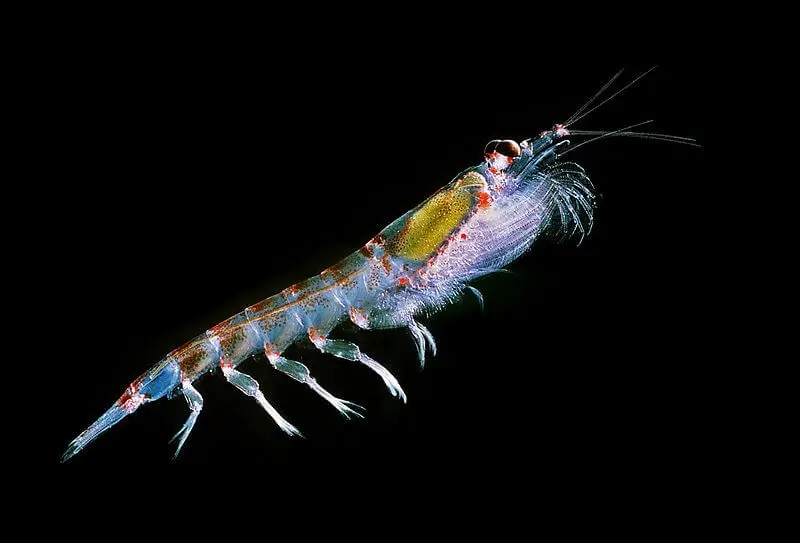
There are about 82 species of krill, ranging in size from less than a quarter of an inch long to two inches long.
Krill, one of the ocean’s smallest animals, is dinner for the Earth’s largest animal, the blue whale (Balaenoptera musculus). There are about 82 species of krill, ranging in size from less than a quarter of an inch long to two inches long.
Krill are crustaceans like copepods. They often have bioluminescent* organs. They can be found in the sunlit zone and in the twilight zone.
* Bioluminescent means that a living thing can produce and give off its own light. Some animals and other organisms do this naturally through a chemical reaction inside their bodies. This light can appear blue, green, or sometimes yellowish, depending on the species and conditions.