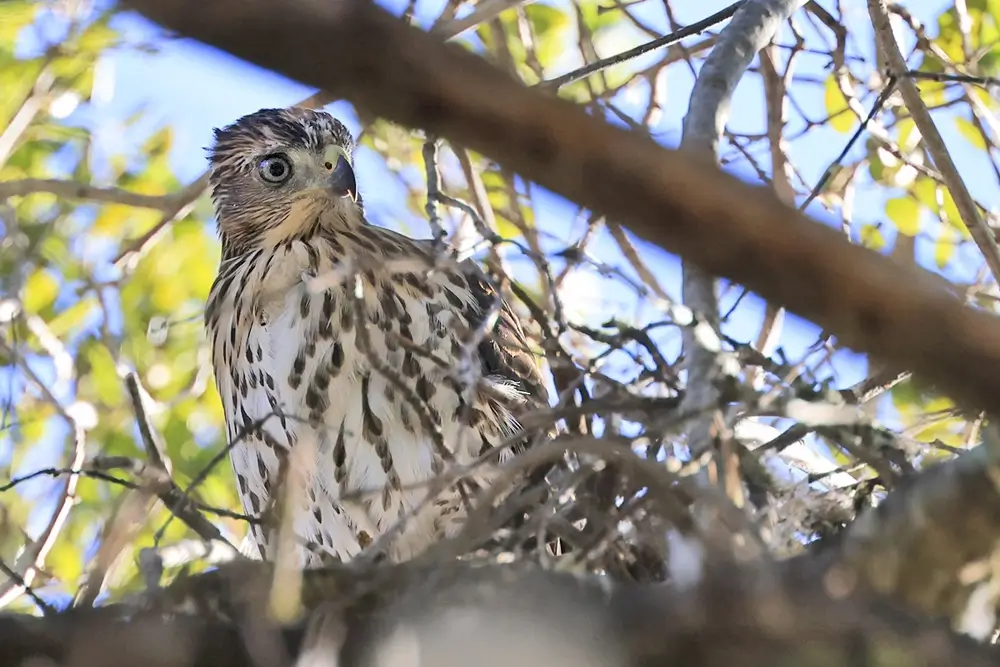
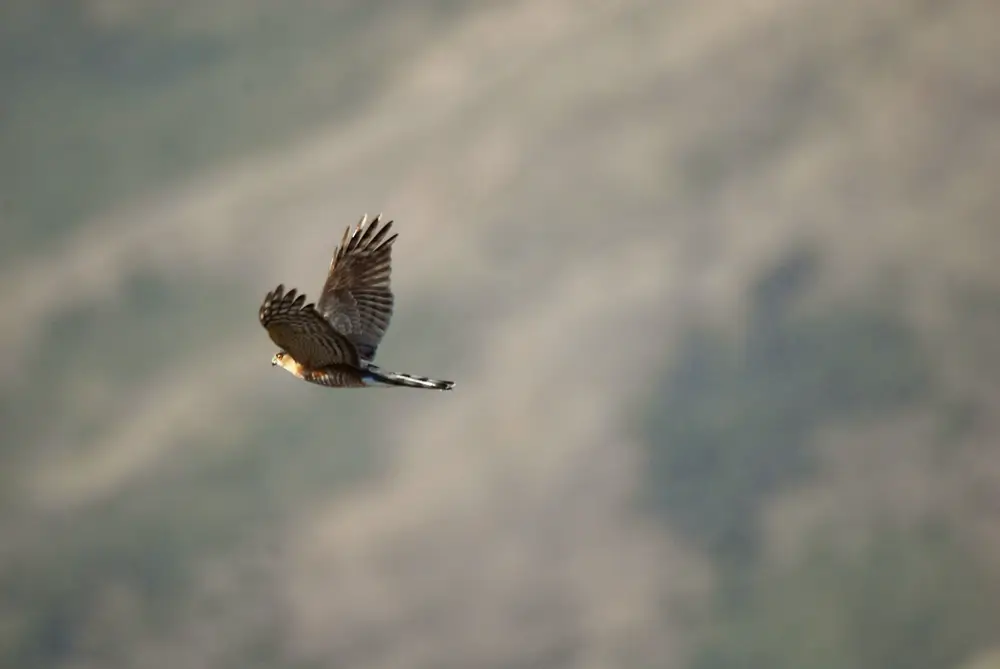
Cooper’s hawk is a medium-sized hawk, 15-20 inches (38-50.8 cm) in length with a wingspan of 24-35 inches (61-89 cm).
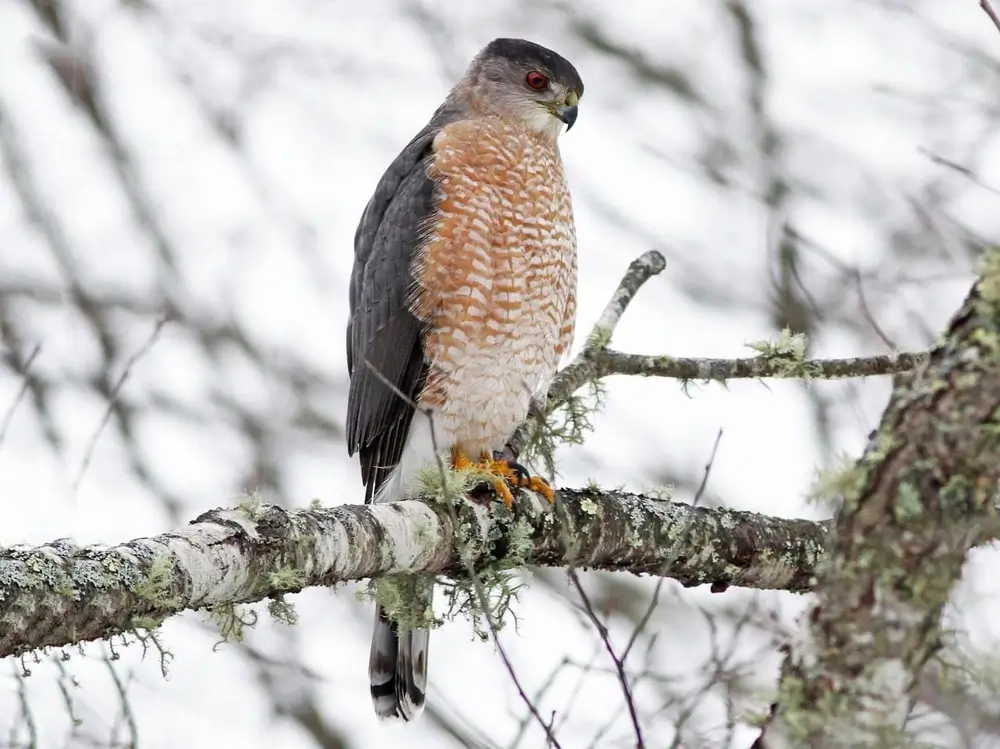
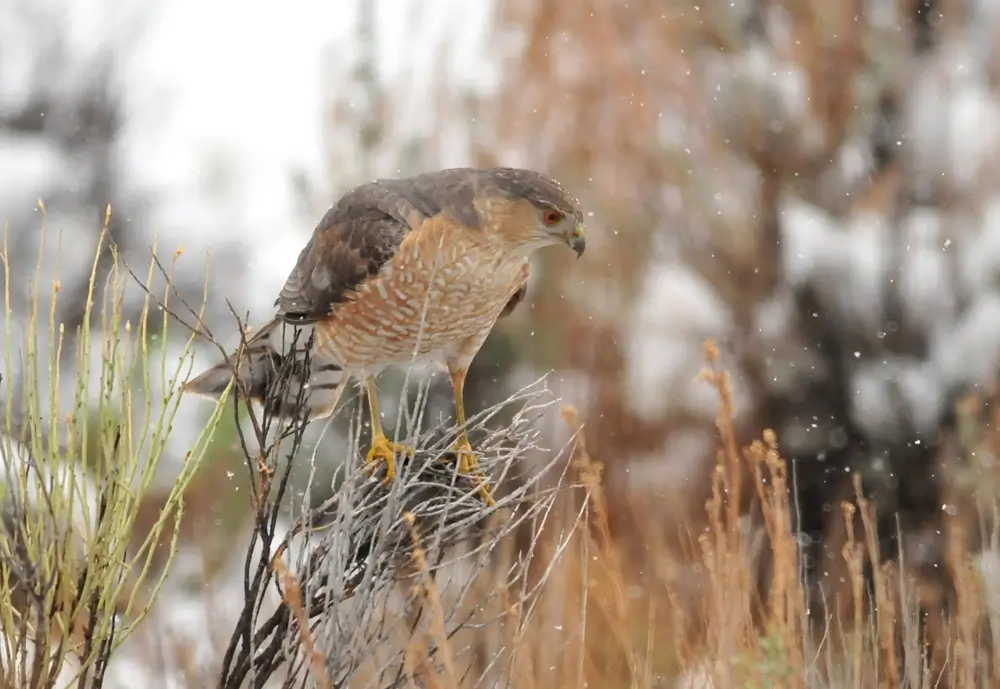
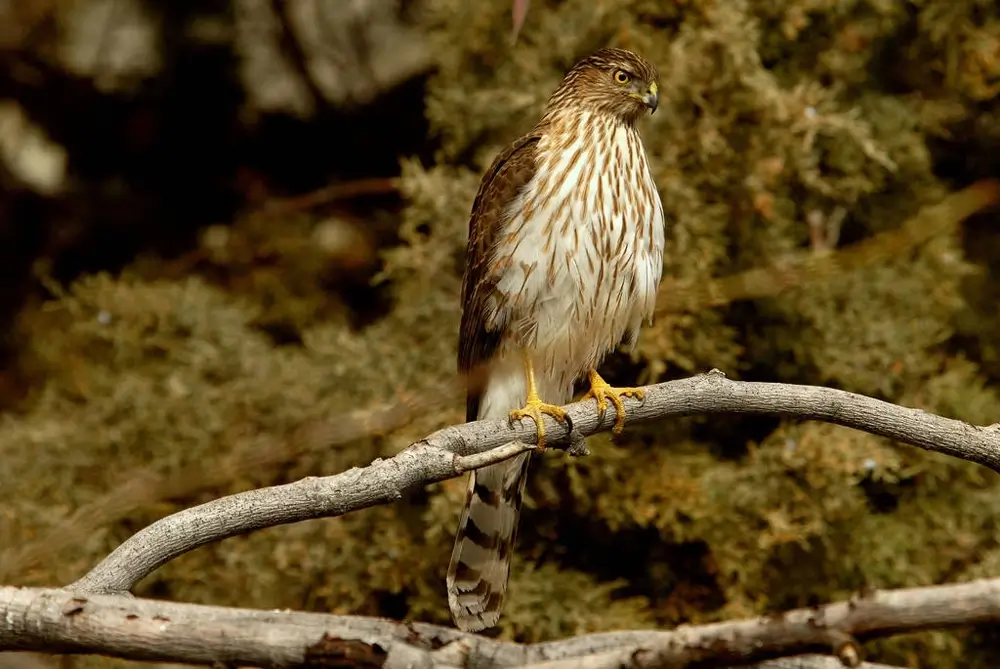
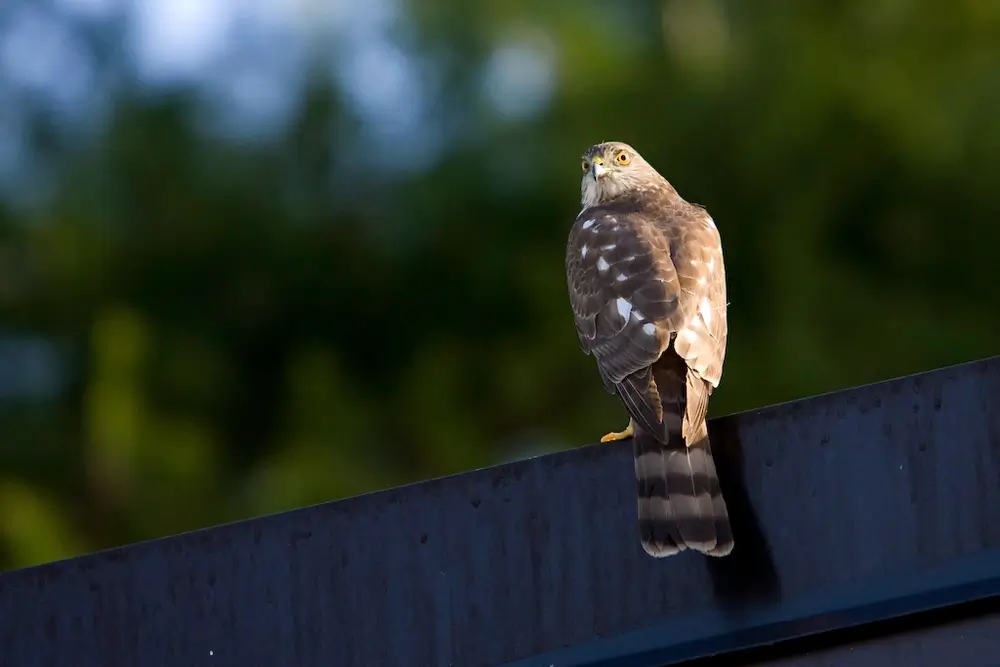
It has a long, rounded tail with gray and black bars and a white band at the tip; short, rounded wings; red eyes; and yellow legs. It is grayish-brown on its back and wings and white with reddish-brown streaks on its breast and belly.
Males and females look alike, although the female can be 1/3 larger than the male.
Habitat
Cooper’s hawk is found in forested areas. It prefers deciduous forests with open areas, but it is also found in mixed forests and coniferous forests. It is also found in urban and suburban areas with tall trees.
Diet
Cooper’s hawk eats medium-sized birds and small mammals. It stalks its prey, staying hidden by forest cover. It flies close to the ground, stalking and chasing its prey through the trees. It captures its prey with its feet and then squeezes the prey to kill it.
Cooper’s hawks also drown their prey by holding it underwater. Flying through the forest after prey is a dangerous way to get your food, and many Cooper’s hawks injure themselves.
Life Cycle
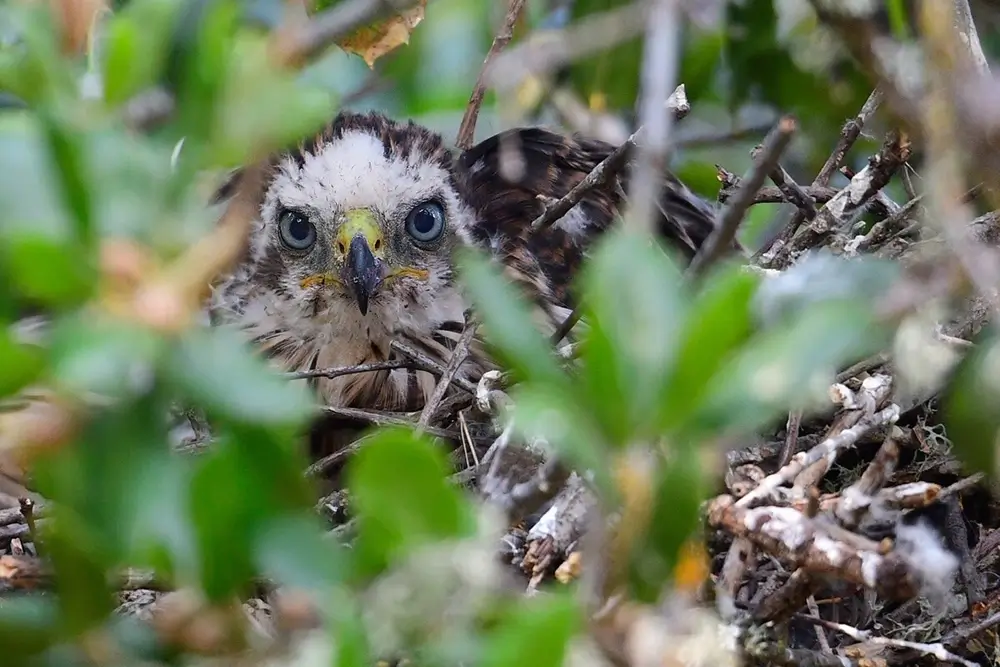
The male Cooper’s hawk may court the female for up to a month before mating. Both the male and female Cooper’s hawk build a nest in a tree 20-50 feet (6.1-15.2 m)above the ground. The nest is an open bowl of sticks and twigs and is sometimes lined with bark and vegetation.
The female lays 3-5 eggs, and the male brings food to her while she is incubating the eggs. The male incubates the eggs when the female has to leave the nest.
The eggs hatch in 30-33 days. The male continues to bring food to the nest for the female. The female then feeds the chicks. The chicks fledge when they are about five weeks old and continue to be fed by the female for another two weeks.
Cooper’s hawk can live as long as 12 years in the wild, but many die before they reach the age of 2.
Behavior
The Cooper’s hawk population, especially in the eastern United States, was greatly reduced in the mid-twentieth century due to the use of the pesticide DDT.
DDT, which was used to control insects that damaged crops, was getting into the food that the Cooper’s hawk ate. The pesticide made it more difficult for the Cooper’s hawk to absorb calcium, and the lack of calcium made the shells of the Cooper’s hawk’s eggs thinner. Many eggs broke before they could hatch, and the Cooper’s hawk population declined.
DDT use was outlawed in the U.S. in 1972, and the Cooper’s hawk population has slowly recovered.
Did You Know?
Support for NatureWorks is provided by:
The Cooper's Hawk in NH
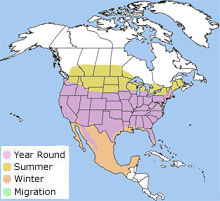
Cooper’s hawk is found throughout New Hampshire, although it is less common in northern New Hampshire.
It can be a year-long resident in the southern part of the state. Cooper’s hawk was once more common in New Hampshire in the 1800s and 1900s.
Pesticide poisoning might have caused a decline in the population, not only in New Hampshire, but across the eastern U.S. Populations are now increasing.