

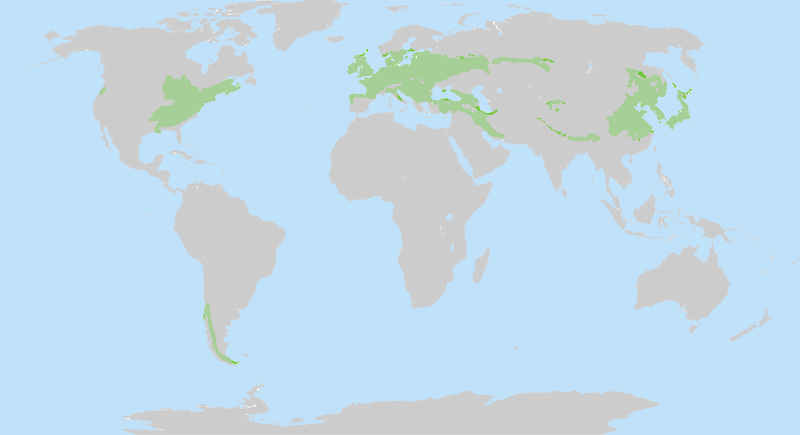
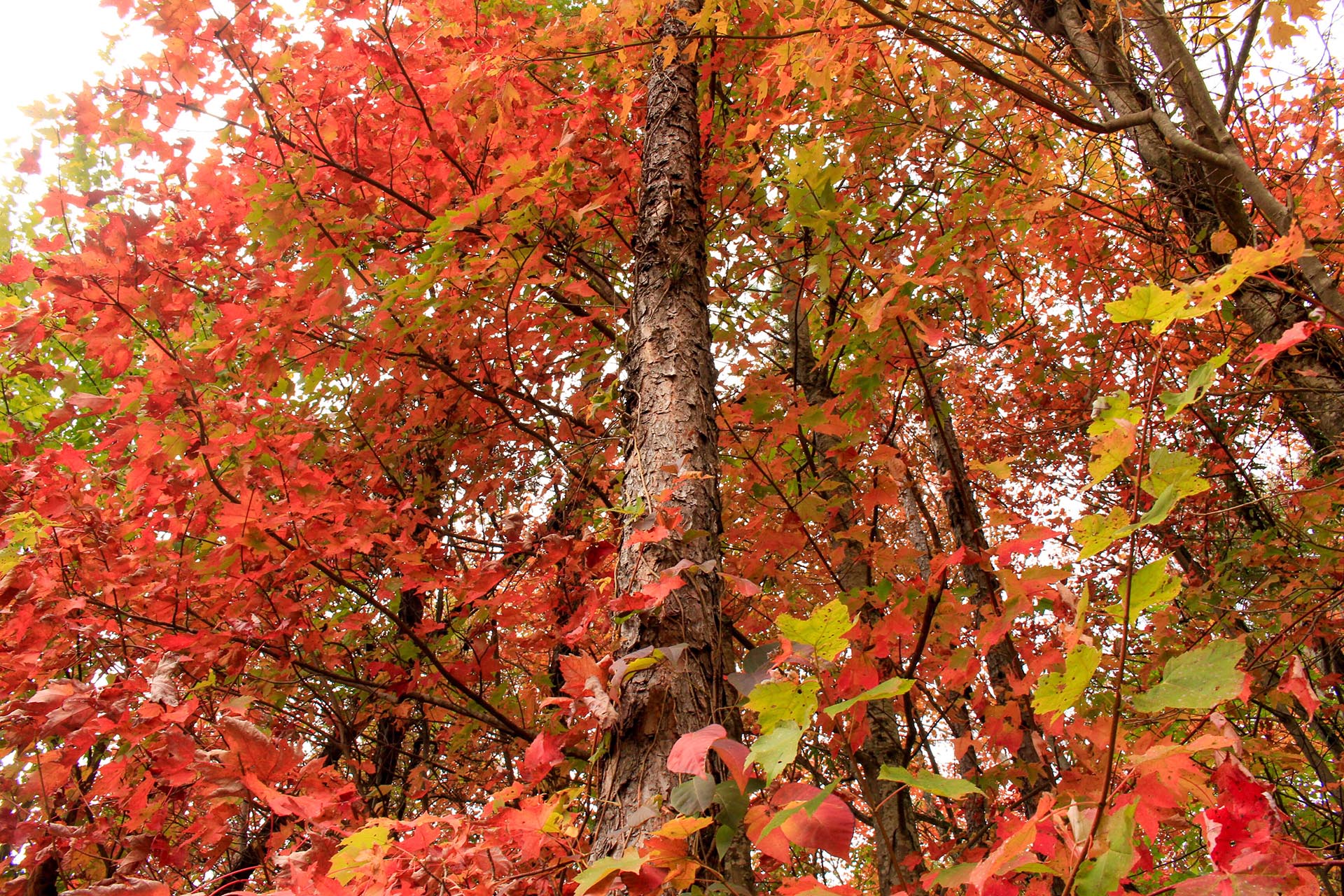
Maples in the fall.
This biome is always changing because it has four distinct seasons: winter, spring, summer, and fall. Winters are cold, while summers are warm. Temperate deciduous forests receive about 30 to 60 inches (76.2 -152.4 cm) of precipitation each year, and this precipitation falls throughout the year as rain or snow.
The soil in these forests is rich and fertile because fallen leaves decompose and return nutrients to the ground. This makes the land good for growing plants and trees, especially hardwood trees like oak and maple. Because of these natural resources and moderate climate, many large human populations live in areas where temperate deciduous forests are found.
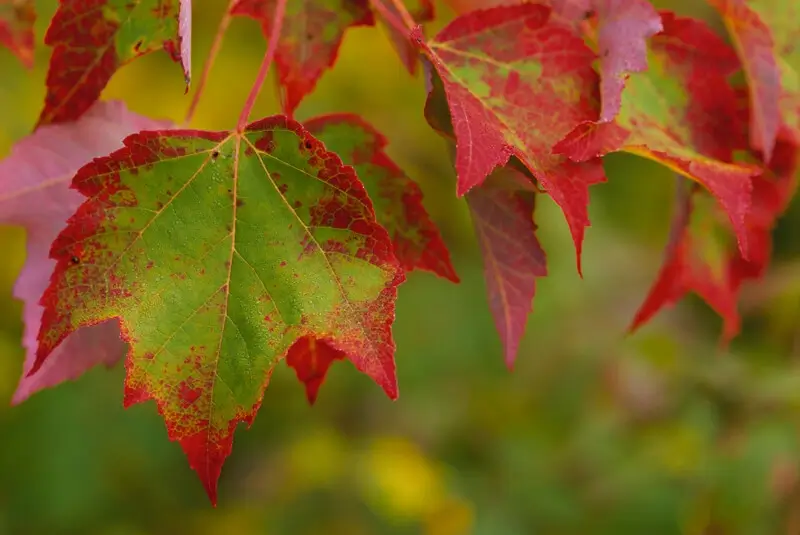
The leaves of deciduous trees change color and fall off in the autumn and grow back in the spring.
The leaves of deciduous trees change color and fall off in the autumn, then grow back in the spring. These trees have broad, flat leaves that lose water quickly. The temperate-deciduous forest is sometimes known as the broadleaf forest.
In winter, the ground often freezes, making it hard for trees to absorb water. To survive, deciduous trees drop their leaves to conserve water.
During the winter, deciduous trees become dormant and enter a resting stage. In the spring, they begin to grow again and produce new leaves and flowers.
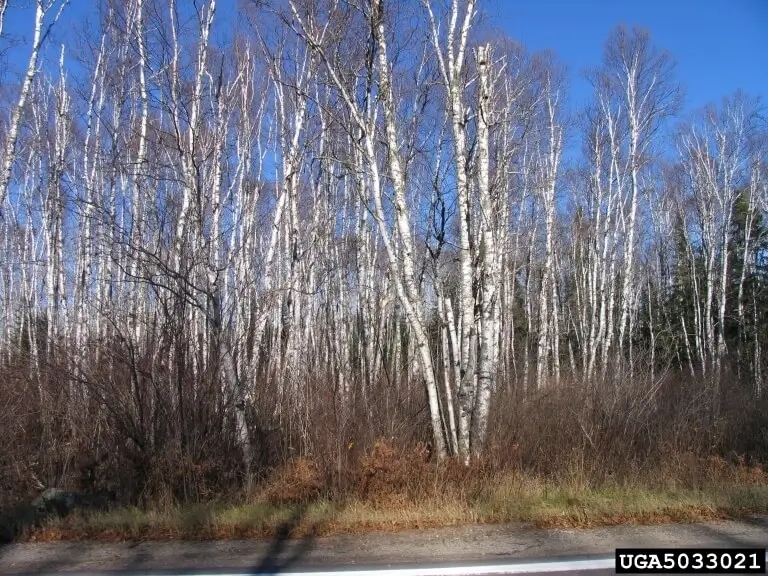
Temperate deciduous forests have a great variety of plant species.
Temperate deciduous forests have a wide variety of plant species. These forests are often organized into three main layers. The forest floor is the lowest layer, where you can find lichens, mosses, ferns, wildflowers, and other small plants. Above that is the shrub layer, which includes bushes and young trees. The top layer is the canopy, made up of tall hardwood trees such as maple, oak, birch, magnolia, sweetgum, and beech.
Although hardwood trees are the most common, some conifer trees—like spruce, fir, and pine—can also grow in these forests, especially in cooler areas. In some regions, temperate deciduous forests gradually blend into the taiga (also called the boreal forest), creating a transition zone where both types of trees can be found.
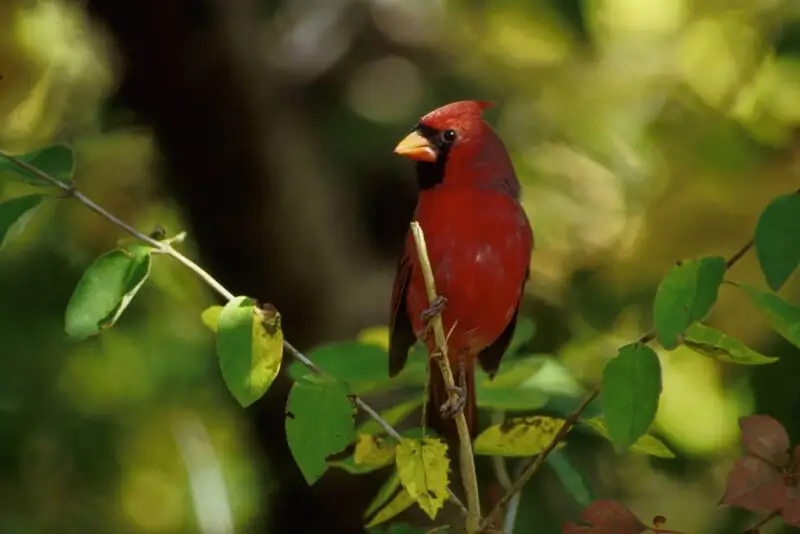
The cardinal is about eight inches in length. It has a black mask on its face; a crest on its head; and a short, cone-shaped bill.
Animals in temperate deciduous forests must survive big seasonal changes. Winters can be cold, and food can be scarce, while summers are warm and full of plant growth. To cope, some animals migrate (travel to warmer places), and others hibernate (enter a deep sleep to save energy during winter).
Temperate deciduous forests are found in many parts of the world, and different animals live in each region. For example:
In New Hampshire and other parts of the U.S., these forests are home to many kinds of insects, spiders, slugs, frogs, turtles, and salamanders. You can also find birds such as broad-winged hawks, northern cardinals, snowy owls (mostly in winter), and pileated woodpeckers. Common mammals include white-tailed deer, raccoons, Virginia opossums, porcupines, and red foxes.
In Japan, you might find the Japanese Macaque, also known as the “snow monkey.”
In Germany and other parts of Europe, animals include the European Badger and Red Deer.
In China, forests are home to species like the Giant Panda (in mountain forests with deciduous trees) and the Golden Snub-nosed Monkey.
In Chile and Argentina, you may find animals such as the Kodkod and the Pudú.
Even though the species are different around the world, they all share one important trait: they are adapted to forests with four seasons, where trees lose their leaves each fall.
