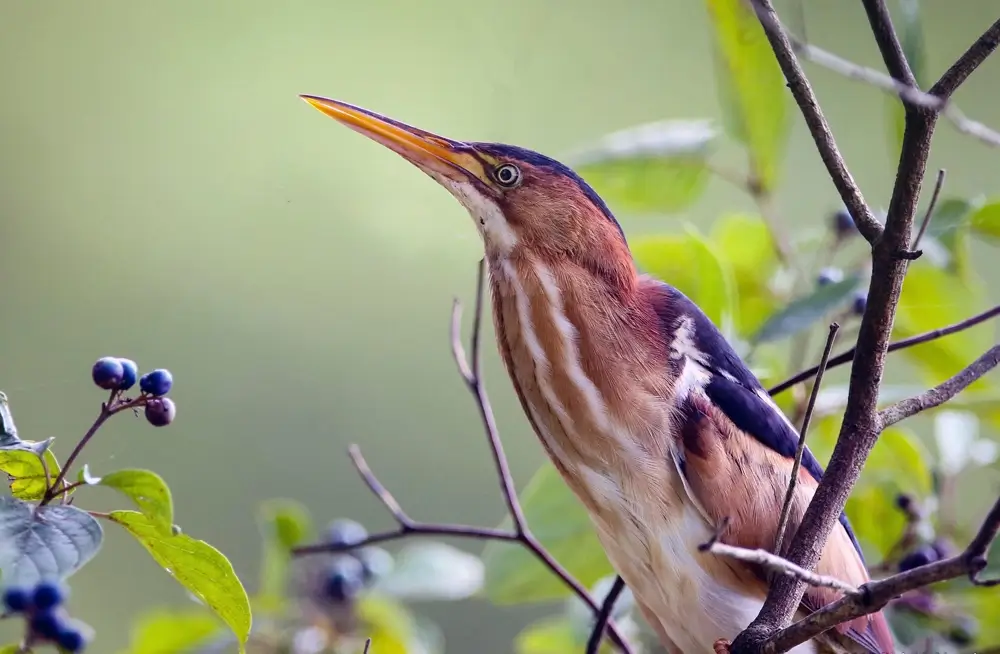
The least bittern is a very small and secretive wading bird that is 11-14 inches (28-36 cm) in length with a wingspan of 16-18 inches (41-46 cm).
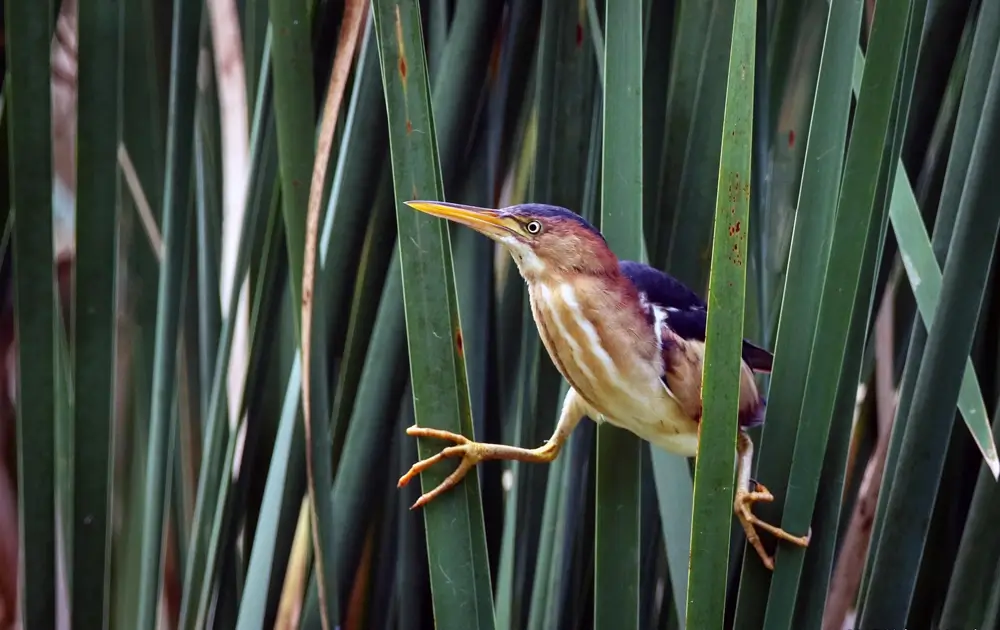
It has a dark brown or black crown and back, an orange-brown neck and sides, a white chin, and an orange and white striped throat and breast. It has white stripes on its sides and yellow-gold patches on its wings that are visible when it is in flight. It has a pointed yellow bill, yellow eyes, and long legs that are green in the front and yellow in the back.
Males and females look alike, but the female is a little duller in color.
Habitat
The least bittern is found in freshwater or brackish marshes with tall grasses, cattails, and reeds.
The male and female least bittern build a platform nest of reeds, cattails, sedges*, and other plant matter a foot or so above the water.
The female lays 2-7 eggs at a rate of one egg per day. Both parents incubate the eggs and care for the young. The eggs hatch in 24-28 days, and the chicks leave the nest 1-2 weeks after hatching.
The least bittern has a lifespan of 5-10 years in the wild.
*Sedges are plants that look like grass and usually grow in clumps in wet areas. Unlike most plants, which have round stems, sedges have stems shaped like triangles. They also have silica in their leaves. Silica is the same material used to make glass, so sedge leaves can be very sharp! A handy way to remember the difference between sedges and grasses is: “Sedges have edges.”
Behavior
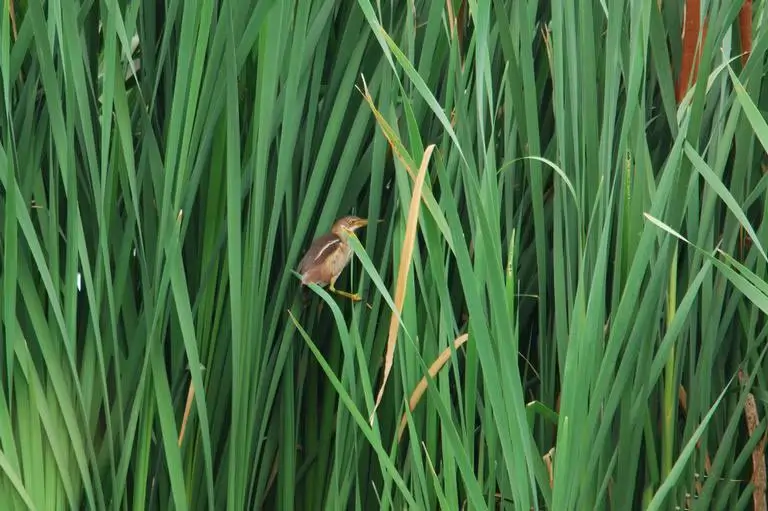
The least bittern, like the American bittern, relies on camouflage coloration to protect itself from predators. It spends most of its time hidden in the reeds. It seldom flies, preferring to stay hidden in the tall marsh grasses.
When startled, it sometimes stands motionless and points its bill straight up in the air in an attempt to blend in with the tall marsh vegetation. The least bittern often perches on tall marsh grasses, reeds, or low tree branches.
Did You Know?
Support for NatureWorks is provided by:
The Least Bittern in NH
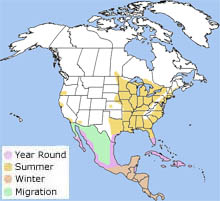
The least bittern has been spotted in southern New Hampshire during the breeding season. Since 2009, it has been recorded at locations in Durham, Newington, Epping, Stratham, Hinsdale, Salem, Sandwich, and Newmarket.
In 2014, nesting was confirmed at World End Pond in Salem, where observers recorded a nest with chicks and observed them through fledging.