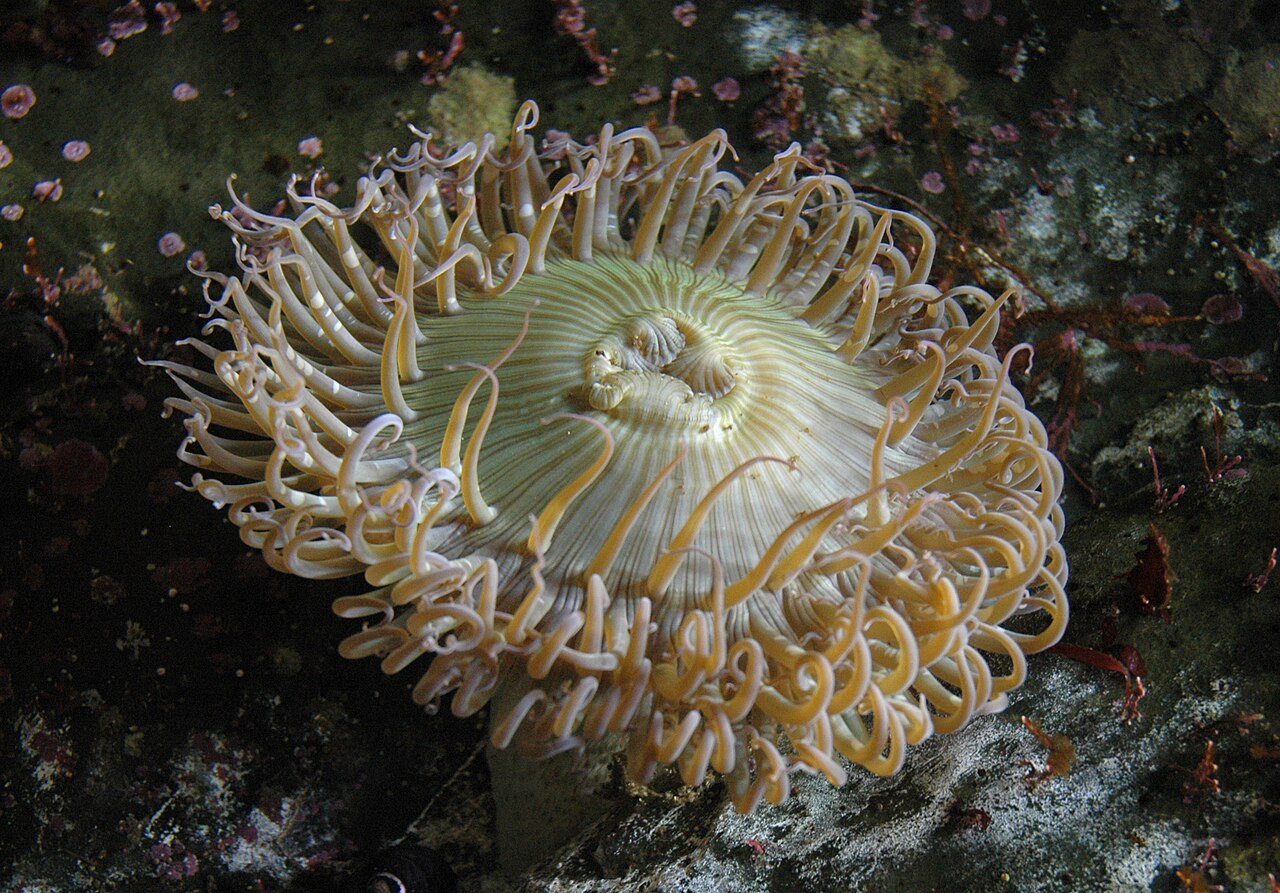
Anthozoans are a group of animals that include corals and sea anemones. There are more than 7,500 known species, making them one of the most diverse groups in the phylum Cnidaria.
Anthozoans live only in saltwater and spend their entire lives in polyp form. A polyp is a soft, tube-shaped body that is usually attached to a surface. Unlike jellyfish, anthozoans do not have a free-swimming stage in their life cycle.
Their bodies are simple but effective. They have a cylindrical shape with a single opening that works as both a mouth and an anus. Around the mouth is a ring of tentacles. These tentacles contain stinging cells called nematocysts, which are used to catch prey and for defense.
Some anthozoans, like many corals, build hard skeletons made of calcium carbonate. These skeletons form coral reefs over time. Other anthozoans, like sea anemones, do not have hard skeletons.
Some species live alone, such as many sea anemones. Others, especially reef-building corals, live in large colonies made up of many connected individuals.
Anthozoans can reproduce in two ways. They can reproduce sexually by releasing eggs and sperm into the water. They can also reproduce asexually by budding or splitting into new individuals.
Most anthozoans are carnivores. They use their tentacles and stinging cells to capture small fish, plankton, and other tiny organisms floating in the water.
Even though anthozoans have stinging defenses, they are still eaten by some animals, including certain fish like butterflyfish, as well as starfish, snails, and marine worms.
Examples of anthozoans include brain coral, which forms large, rounded shapes that look like a brain; staghorn coral, which grows in branches like antlers; and sea anemones, which look like colorful underwater flowers.