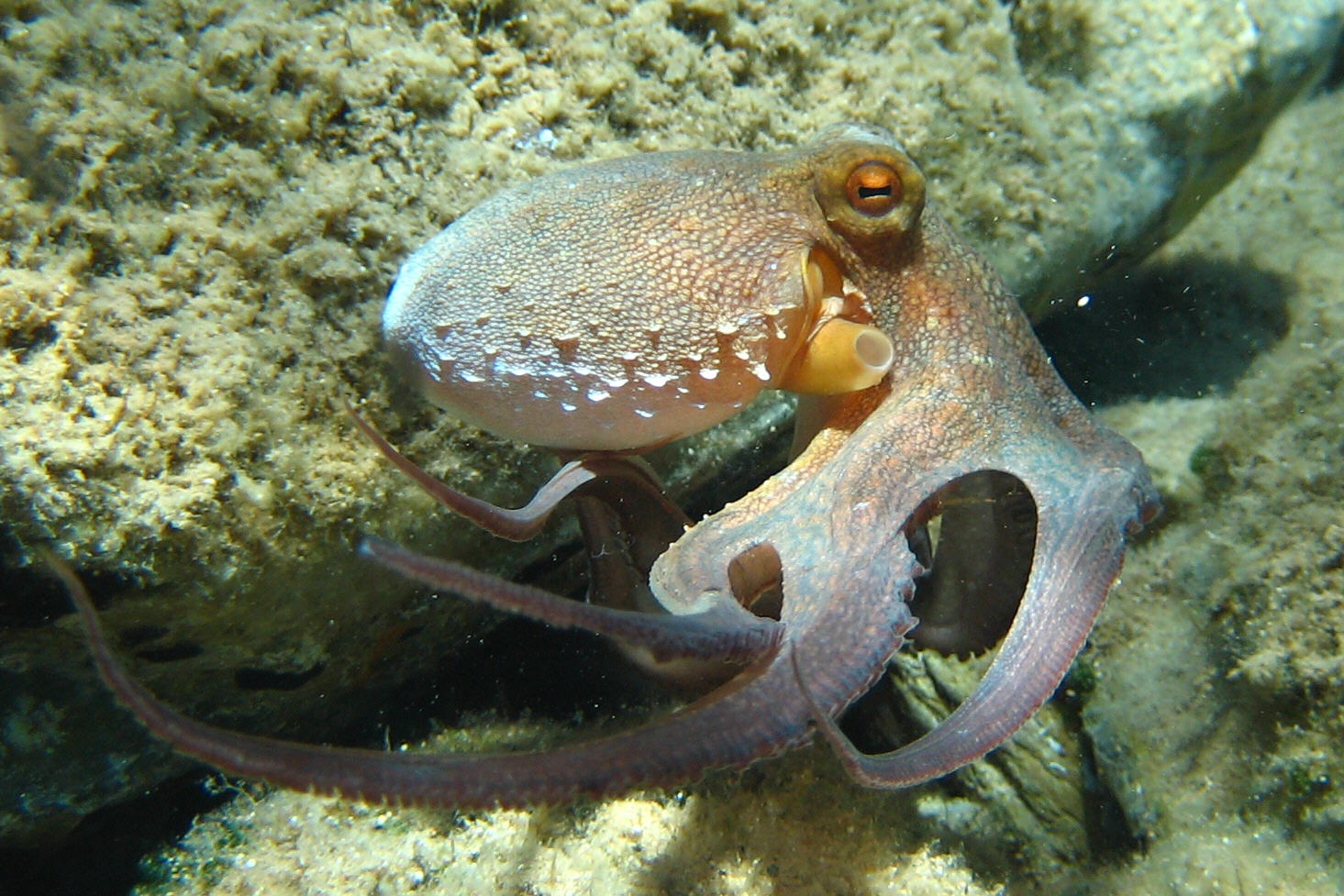
Mollusks are soft-bodied animals that often have a hard shell for protection. They are found in ocean and freshwater environments, and on land. Snails, clams, squids, and octopuses are all in this phylum.
There are 86,600 extant (living) and as many as 100,00 extinct species in this phylum, making it the second-largest phylum, after the Arthropoda phylum. This is also the largest marine phylum. Mollusks make up 23% of all named marine life.
Mollusks have three main body parts:
Head-foot – used for movement and sensing the environment.
Visceral mass – contains most of the organs, like the heart, stomach, and reproductive organs.
Mantle – a special layer of tissue that can make a shell in some species.
They also have a radula (a tongue-like structure with tiny teeth) for eating, though some, like clams, filter food from water instead. Many mollusks have gills for breathing in water, and some land species have lungs.
Mollusks are very diverse: some move slowly like snails, while others, like squids, are fast swimmers.